
Where extending the EU’s carbon border adjustment mechanism does – and does not – make sense
New CER analysis shows that proposals to extend the CBAM to finished goods risk shifting its focus from preventing carbon leakage towards protecting European industries, while adding costs and paperwork. Negotiators should focus the extension on products where it can prevent carbon leakage or close loopholes in existing rules.
On November 30th, negotiators from the Council, European Parliament and Commission will discuss again to what extent the Carbon Border Adjustment Mechanism (CBAM) should be extended to finished goods. Since January 2026, imports covered by CBAM have become subject to carbon pricing designed to mirror the costs faced by EU heavy industry. The aim is to prevent carbon leakage: companies moving production abroad to avoid paying for their emissions, thereby shifting pollution elsewhere rather than reducing it. Extending the mechanism could help prevent carbon leakage further down supply chains, but including products with negligible carbon charges may do little to achieve this.
Since January 2026, imports covered by CBAM have become subject to carbon pricing designed to mirror the costs faced by EU heavy industry.
The risk of carbon leakage arises from differences in carbon pricing across countries. Since 2005, the EU Emissions Trading System (ETS) has required power producers and heavy industries to hold a permit for every tonne of CO₂ they emit. Firms can buy or sell these permits, but the EU gradually reduces the total number available, increasing the incentive to cut emissions. But this also makes producing in the EU relatively more expensive than in countries with weaker or non-existent climate rules. To keep European industry competitive, the EU has long given industries many of these permits for free. Free allowances are being gradually phased out for sectors covered by the CBAM, which is designed to ensure that imports face carbon charges comparable to those imposed on domestic production.
Further down the supply chains, EU manufacturers of machinery, cars and other finished goods also bear carbon costs indirectly. They pay more for materials produced by industries covered by the ETS than their competitors abroad do, while imports of finished goods face no equivalent charge. The Commission has therefore proposed extending CBAM to a list of finished goods – from refrigerators to medical instruments. This would also prevent ‘circumvention’, whereby firms avoid the carbon charge by processing materials offshore – such as converting raw steel into components – before importing them.
Some products should be included in an expanded CBAM, particularly those made in the EU using carbon-intensive materials, where higher carbon input costs could push production abroad. Other products, however, are already largely imported or contain little carbon-intensive material. Extending the CBAM to these goods would do little to prevent carbon leakage. Instead, it would raise prices for EU consumers, add paperwork for importers, risk undermining the credibility of EU climate policy and make CBAM harder to defend under World Trade Organization (WTO) rules. With the EU trying to cut red tape, the final negotiations should focus on products where the benefits of preventing carbon leakage justify the additional complexity.
Why extending the carbon border makes sense in some cases
Carbon-intensive materials such as steel and aluminium are ‘upstream’ products, used to manufacture ‘downstream’ finished products that are sold to consumers. For example, steel, produced early in the supply chain, is used to make components for a refrigerator, which is eventually sold as a final product to consumers. Limiting CBAM to upstream products creates two problems.
The first is carbon leakage further down the supply chain. An EU-based manufacturer buys steel whose price reflects the cost of EU ETS carbon prices, while a foreign competitor can use steel that has not faced an equivalent carbon charge and export a finished product to the EU without paying CBAM. This gives foreign manufacturers a cost advantage, potentially pushing manufacturing production abroad. The EU risks protecting its steelmakers while losing the factories that buy their steel. This also gives steelmakers an incentive to push for extending CBAM further down the value chain.
The second problem is circumvention. Firms can avoid CBAM by processing a covered material abroad into a product that falls outside its scope. For example, turning steel wire into nails before importing them could allow firms to escape the carbon charge, even though the emissions from producing the steel remain largely unchanged. The Commission considers this a significant risk, although such practices are difficult to observe and document empirically.
Extending CBAM to selected downstream products can both prevent carbon leakage and close opportunities to avoid the existing rules. But how far should the extension go? The EU institutions disagree. The Commission proposed around 180 downstream products in December 2025. The Council proposed a broader list, with around 200 additional entries, in June 2026, while the European Parliament proposed an even more expansive list of around 450 products in September. Negotiators meet on November 30th, possibly for the last time, to agree on a single list, which is due to take effect in 2028.
Extending CBAM to selected downstream products can both prevent carbon leakage and close opportunities to avoid the existing rules. But how far should the extension go?
To compare the proposals, I converted all three lists into the same customs classification and grouped the resulting entries into 386 products. Of these, 378 products have sufficient data for the analysis.
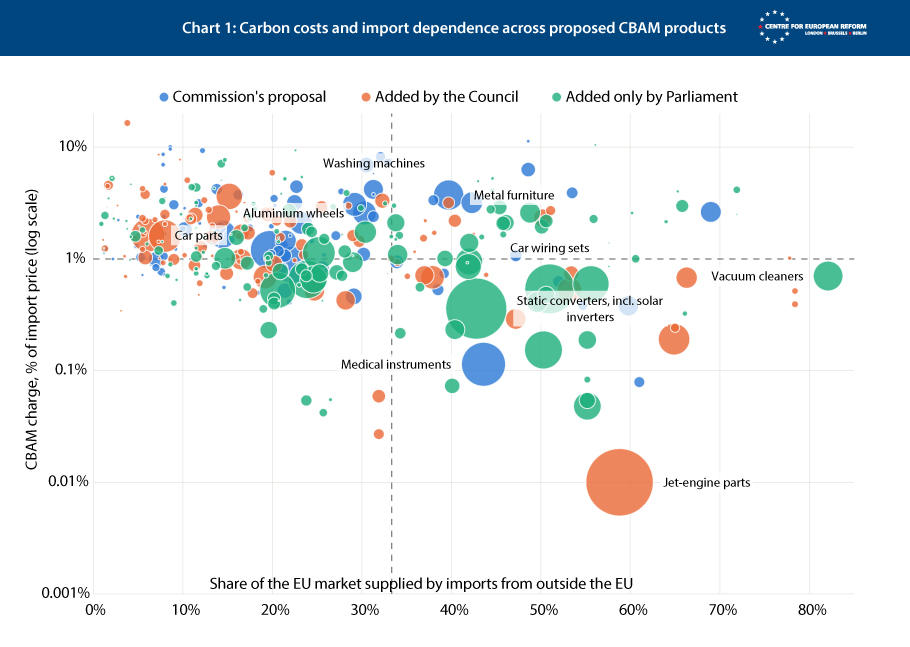
Note: Explore the interactive CBAM Downstream Chart. Each circle represents a product. The vertical axis shows the estimated carbon charge as a share of its import price, while the horizontal axis shows the share of the EU market supplied by imports. Circle size represents annual import value (2022-24 average). Filled circles indicate that a single country supplies more than half of EU imports of that product. Dashed lines mark the thresholds of 1 per cent for carbon costs and one-third for import dependence. Hover over or click on a circle to identify the product.
Source: Author’s calculations based on Eurostat Comext and Prodcom data; European Commission proposal COM(2025) 989 (December 2025) and CBAM certificate prices; Council general approach ST 10423/26 (June 2026); and European Parliament amendments P10_TA(2026)0276 (September 2026).
What the data reveal about expanding CBAM
The CER’s interactive CBAM Downstream Chart compares the three proposals using EU trade and production data. Following the approach used by the European Commission and supported by other academic research, it looks at three things.
First, on the vertical axis, products are ranked by how much the carbon charge adds to prices. The larger the increase, the stronger the incentive for firms to offshore production. Second, the horizontal axis shows the share of the EU market supplied by imports. For products like metal furniture, where imports already supply a large share of the domestic market, there is less production at risk of relocation, but more chance that charging for emissions will push other countries to price carbon. Third, filled circles identify products where the EU relies heavily on a single country outside the EU, indicating potential risk from ‘weaponised interdependence’.
The analysis uses deliberately simple indicators to identify two potential risks. First, it identifies products where carbon costs are at least 1 per cent of their import price, following the approach of the German Environment Agency, which assesses carbon-leakage risks using carbon costs relative to product prices. This threshold is below the average estimated carbon charge across all three proposals, giving the longer product lists the benefit of the doubt.
Second, it flags dependency on foreign suppliers when imports account for more than a third of the EU market and one country supplies over half of them. The one-third threshold is a relatively demanding bar for dependency, since imports from outside the EU are worth about 13 per cent of the EU’s GDP. Neither indicator should be considered as conclusive: significant carbon costs do not necessarily mean production will relocate, nor does reliance on one foreign supplier necessarily make supplies insecure. Together, however, they help identify products with a stronger case for inclusion in an extended CBAM.
The most striking finding is that 103 of the 378 products – many of which are machinery of some sort – have both low estimated carbon costs and no concentrated import dependence. Most of these products were added by the Council or Parliament. On the chart, they are the circles below the horizontal dashed line, apart from the filled circles to the right of the vertical one. Their estimated carbon costs are relatively small and therefore unlikely to cause much leakage, and their imports are not concentrated enough to indicate a major dependency risk. There is little reason to include these products unless doing so would close loopholes in CBAM. Negotiators should focus instead on products where preventing carbon leakage justifies the additional costs.
At the other end of the spectrum, 33 products meet both tests. Refrigerators and metal furniture, for example, face estimated carbon costs of about 3-4 per cent of their import price, while imports account for a substantial share of the EU market. In such cases, CBAM could both prevent carbon leakage and help reduce import dependency. But the latter should remain an additional benefit, not a justification for extending CBAM in the absence of a meaningful carbon-cost disadvantage.
As the proposed lists expand, their connection to carbon weakens. Goods added by the Council and Parliament tend to contain less carbon-intensive material relative to their value than those on the Commission’s original list. In fact, nearly 70 per cent of Parliament’s additions, by import value, would face a carbon charge below 1 per cent of their price. The downward pattern in the chart illustrates this shift: products with higher import shares tend to face smaller carbon charges relative to their price. In other words, the additional products seem to be increasingly selected for their exposure to foreign competition, rather than their risk of carbon leakage. This raises the question of whether some additions reflect pressure to protect EU producers from foreign competition, rather than concerns about carbon leakage. This distinction also matters under WTO rules, where a measure designed to address carbon leakage is easier to justify than one intended to protect domestic industry.
And if supporting the domestic industry is the goal, at least in part, raising the cost of imports through CBAM is often not the best tool. Static converters – power supplies, battery chargers and the inverters that connect solar panels to the grid – illustrate the problem. The EU imports €14.7 billion of them a year – two-thirds from China – yet the estimated charge under CBAM would be just 0.36 per cent of the price. Such a small charge is unlikely to encourage domestic production or diversify suppliers. It would mainly increase prices paid domestically and paperwork on importers, without addressing the EU’s dependency.
There is nothing wrong with the EU pursuing two objectives: preventing carbon leakage and reducing strategic dependency on foreign suppliers. But CBAM is credible if designed to address the first, while the second requires different policy tools. Expanding CBAM to products with little embedded emissions risks confusing these objectives and turning climate policy into a form of industrial protectionism. It would also be adding an ever longer list of import obligations without addressing the high energy costs and other competitive pressures facing European manufacturers.
What carbon pricing cannot fix
The expanding product lists reflect a wider political shift. The European Green Deal, announced in 2019, focused on reducing emissions. The Clean Industrial Deal, announced in 2025 added an explicit goal of retaining factories and investment in the EU. Rising energy costs, Chinese competition and the need to produce clean technologies at scale have made EU governments more anxious about industrial decline. In this environment, CBAM has become an attractive multi-purpose instrument: a climate measure that can protect European producers from foreign competitors.
The costs of protectionism aside, there are limits to what CBAM can achieve. It can offset the disadvantage created by EU carbon pricing, but it cannot compensate for high energy costs, foreign subsidies or other comparative advantages that third-country producers often have. When the EU relies heavily on imports of a product whose carbon cost is tiny, the problem is not carbon leakage. Calling it one will not make a border charge a useful industrial strategy.
The costs of protectionism aside, there are limits to what CBAM can achieve.
Moreover, CBAM may be collected at the border, but its full costs are not necessarily borne by foreign suppliers. Many of the products added by the Council and Parliament are machinery and components bought by European manufacturers. Higher input costs could weaken their competitiveness in export markets, even when the carbon charge is too small to change foreign production decisions. These higher costs would also be felt by European households.
CBAM’s own design also imposes practical limits. Its rationale is to ensure that imports face carbon costs comparable to those borne by EU producers. For steel or aluminium, that comparison is relatively straightforward. With a complex finished product, emissions arise across multiple components and production stages. The further CBAM extends down the value chain, the harder it becomes to calculate and verify a genuinely comparable charge.
The additional administrative burdens and the risk of challenges under international trade rules increase with the complexity of the products covered. The WTO has already established a dispute panel following a Russian complaint against the EU’s existing CBAM in September 2026. This does not mean every downstream extension is legally questionable, but it makes a well-evidenced extension more defensible.
Meanwhile, political pressure to blunt the EU’s own carbon price signals is growing. In July 2026, the Commission proposed restoring some of the free emissions permits due to be withdrawn from CBAM sectors, pushing the end of their phase-out from 2034 to 2038. The concern behind that proposal – that clean industrial production is not yet sufficiently competitive – is understandable. But expanding CBAM indiscriminately while delaying the removal of free permits risks weakening the very carbon price signal the border mechanism was intended to protect.
Keep CBAM focused on carbon, and tackle dependency directly
Negotiators should apply two tests when deciding whether a product should fall under the expanded CBAM.
First, does the carbon charge create a meaningful risk of production moving abroad? Second, would excluding the product allow firms to avoid existing CBAM rules – for example, by importing nails rather than steel wire? Products that meet neither test should generally be excluded. The aim should be to prevent carbon leakage without imposing unnecessary costs and red tape on EU businesses.
Reducing dependency on foreign suppliers requires different tools, tailored to the risks involved. For critical products, public procurement can reward suppliers that diversify their sources, while strategic stockpiles can provide insurance against disruptions. Where foreign competition is distorted by dumping or unfair subsidies, the EU should use trade defence instruments. Rather than trying to produce everything domestically, the EU should focus on sectors where it is most competitive, or in which concentrated foreign supply poses the greatest economic security or defence risks.
More broadly, building competitive manufacturing capacity across Europe requires affordable clean electricity, stronger grids and targeted investment in the most vulnerable supply chains. Ultimately, the question is whether CBAM remains a climate instrument or increasingly becomes a tool of industrial protection.
The question is whether CBAM remains a climate instrument or increasingly becomes a tool of industrial protection.
The EU is right to extend CBAM where carbon costs put European producers at a disadvantage and may be right to reduce dependency on foreign suppliers, but the latter requires different tools. Keeping these objectives separate would strengthen CBAM’s credibility with trading partners, make it easier to defend under WTO rules and preserve its potential to encourage carbon pricing abroad. The final agreement between the Council, the Parliament and the Commission should be judged by how much carbon leakage it is likely to prevent, not by the length of the product list it includes.
Method and sources
This CER analysis compared the Commission’s proposal, COM(2025) 989 (December 2025), the Council’s position, ST 10423/26 (June 2026), and Parliament’s position, P10_TA(2026)0276 (September 2026). The three lists mix single customs codes, broader headings and whole chapters of the tariff, so I converted every entry into eight-digit customs codes.
The codes were then grouped into 386 products, mostly six-digit tariff subheadings. Each product is credited to the first position that lists it: the Commission, then the Council, then Parliament. Each is matched to average imports from outside the EU in 2022-24 (Eurostat Comext) and to EU production (Eurostat Prodcom). Eight products lack usable production data, which leaves 378 that can be assessed for import dependency.
The estimated carbon charge is calculated by multiplying each product’s metal content by 1.9 tonnes of CO₂ per tonne of steel, roughly the global average, or an assumed 1.55 per tonne of aluminium, and by a carbon price of €82.32 a tonne.
Articles of iron, steel or aluminium, such as nails and chains, are counted as all metal. Other goods, such as refrigerators and pumps, are assumed to be 79 per cent steel or aluminium by weight, the average for the Commission’s list. These assumptions aim to be estimates of the potential carbon charge, it is not a current CBAM bill, and it does not use plant-level or country-specific emissions.
AI assistance: The author developed the research question, methodology, data sources and assumptions. AI tools assisted with calculations and the development of the interactive visualisation. The author retains full responsibility for the analysis and conclusions.
Explore the interactive product-level analysis here.
Data, code and methodological notes here.
Elise Viadere is a research fellow at the Centre for European Reform.
Add new comment