
Rearming Europe for deterrence: Short-term priorities and policy options
- A number of European intelligence agencies assess that Russia may look to attack a NATO state by 2030, as a way to test NATO’s mutual defence commitment. Russia is already intensifying cyber-attacks, information operations, sabotage and other forms of hostile activity below the threshold of war that might trigger a military response. At the same time, the US is pulling back from its commitments to European security. To be able to deter Russia in the short-to-medium term with less US help, European NATO allies will have to fill key capability gaps quickly.
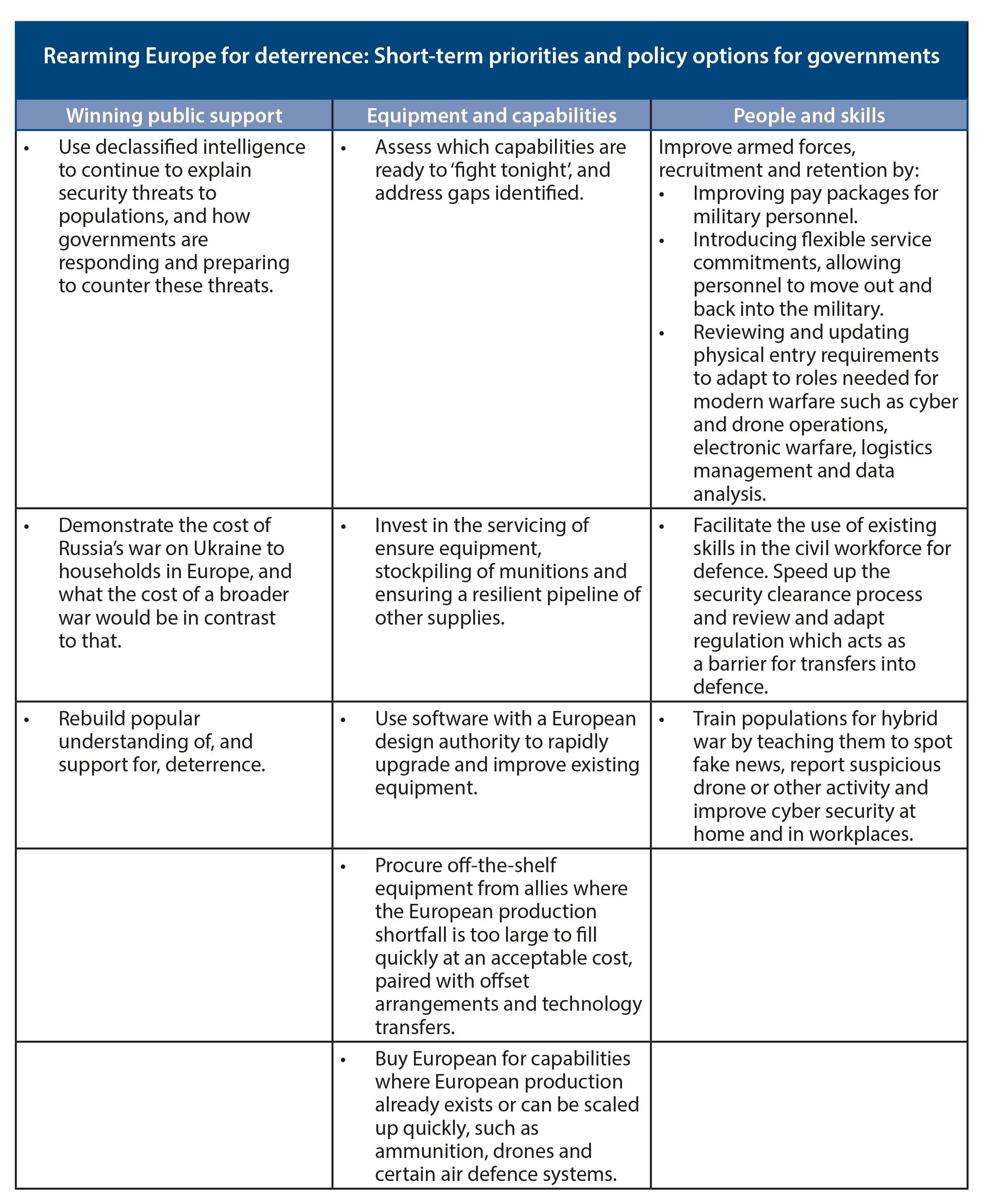
- European governments are spending significantly more on defence, but this alone will not ensure improved readiness. Alongside major investments in new capabilities and platforms, governments need a more realistic assessment of their capabilities that are ready to ‘fight tonight’. Based on that assessment and any gaps it identifies, European governments need to build up the personnel, systems, logistics and technology required. They should also focus more sharply on investing in servicing equipment, stockpiling munitions and other supplies, and ensuring a pipeline of personnel trained to use existing capabilities.
- As defence budgets grow, European governments no longer have to choose between building up the European defence industrial base and acquiring equipment quickly, regardless of its source. They can buy off the shelf, if necessary from non-European suppliers, to fill urgent capability gaps for which it would be too costly or take too long to build up the European defence industrial base, while simultaneously investing in long-term European industrial capacity.
- European governments need to take lessons from Ukraine on how to achieve a concentration of war fighting capacity and use modular defence equipment systems in any potential conflict. Unmanned cheap systems are a low-cost way for Europeans to bring mass to any eventual conflict and will go some way to making up for lack of personnel, especially in the early days of a crisis. Software can be used to improve equipment rapidly and cheaply, without new hardware purchases.
- To improve armed forces recruitment and retention, ministries of defence need to improve pay packages for personnel, introduce flexible service commitments, and review which roles need stringent physical requirements and loosen the requirements for those that do not.
- Governments should also think more creatively about the skills needed for national security. This includes facilitating the use of existing skills in the civil workforce for defence. Ministries of defence should speed up the security clearance process and review regulation which acts as a barrier for transfers into defence.
- Europe’s adversaries already seek to destabilise European societies with information operations, drones flown around critical infrastructure or used to close airports, cyber attacks and sabotage. Governments can make better use of the civilian population to contribute to the defence of Europe by training them to spot fake news, report suspicious drone or other activity and improve cyber security at home and in workplaces.
- Throughout these efforts, obtaining public buy-in for rearmament continues to be key. Governments can use declassified intelligence to explain what the security threat is, and outline what they are already doing to keep the nation safe and deter the threat. An element of this could be demonstrating the cost of Russia’s war on Ukraine to households in Europe, and what the cost of a broader war would be in contrast to that.
Various European intelligence agencies have shared their assessment that Russia may look to attack a NATO state by 2030, as a way to test NATO’s mutual defence commitment.1 Russia is already intensifying cyber-attacks, information operations, sabotage and other forms of hostile activity below the threshold that might trigger a military response.2 At the same time, the recent US National Defense Strategy and National Security Strategy have made it clear that the Trump administration regards it as Europe’s responsibility to deter and, if necessary, defend the continent from Russia at the conventional level.3 This has led to a process of burden-shifting within the NATO alliance whereby the US is reducing its conventional military contributions, while European NATO countries and Canada step up. The burden-shifting discussion has exposed capability gaps among European NATO allies. These gaps need to be filled in the short-to-medium term, given the threat posed by Russia and the US’s commitments elsewhere in the world.
This report identifies policy options and steps that European governments can take in the short term to help improve military readiness and contribute to deterrence. The first section of the report briefly addresses how to win more public support for rearmament, which is needed to make these efforts successful in the long run. The second section presents suggestions to ensure Europe has operational capabilities for deterrence. The third section looks at the people and skills needed for rearmament, and the steps to take in the short-to-medium term to build a strong defence skills ecosystem and pipeline, whether for the military, industry or broader society.
The report draws on discussions held during an expert workshop convened by the Centre for European Reform and the Hanns Seidel Foundation in London in March 2026 with experts, industry and government representatives from various European countries.
Winning public support for rearmament
Rearmament in Europe is going to be difficult to achieve without public buy-in. As a previous CER policy brief set out, rearmament requires more defence spending, and the consequent spending trade-offs will be unpopular. Cuts in public services may fuel further discontent among populations already struggling with a cost-of-living crisis, and may increase support for populist, far left or far right political parties. Building a national consensus on the trade-offs required is essential.4
The starting point for countries in Western and Southern Europe, whose populations may feel more removed from the Russian threat, is to continue to explain the security threats and the costs that these threats are already imposing on citizens. An aspect of this could be demonstrating the cost of Russia’s war on Ukraine to households in Britain, France, Germany, Spain and others, and what the cost of a broader war would be in contrast to that. Many do not make the connection between Russia’s war on Ukraine and the wider threat Moscow poses to European security, when in reality these are intrinsically tied. Using declassified intelligence is a useful tool; and often more detail is better. Such efforts need to go hand in hand with outlining what governments are already doing to keep the nation safe and deter threats.
Additionally, governments need to rebuild popular understanding of, and support for, deterrence. The purpose of rearming Europe is to be ready to defend the continent should an adversary decide to attack. But just as importantly, it is also about signalling to any adversary, such as Russia, that the cost of an attack would be too high for them to bear and thus dissuade them from doing so in the first place.
Equipment and capabilities for deterrence
Defence spending in Europe has increased significantly. European NATO allies and Canada spent $574 billion on defence in 2025.5 More than half of NATO countries are also spending over 30 per cent of their defence budgets on equipment, largely surpassing the NATO guideline of 20 per cent. Among EU NATO countries, investment in new equipment exceeded €100 billion for the first time in 2024, and is estimated to have reached nearly €130 billion in 2025.6
Yet more funding alone will not address readiness challenges. Improving Europe’s ability to deter by raising the costs for Russia of a potential attack requires operational equipment, personnel and new ways of thinking about how to bring both mass – in other words the concentration of war fighting capacity – and modular defence equipment systems to potential conflict. European NATO allies will have to develop this mass both at a lower cost and with fewer people than the US would.
The German army’s readiness was lower in 2025 than it was in 2022, despite Germany spending $97.7 billion on defence in 2024.
More broadly, there is a question of what the European way of war is. The answer to this question will determine which capabilities are required for Europe to deter and defend. In the interim, below are steps that can be taken in the short term to improve readiness, while governments continue to hash out this broader vision.
Ensuring the readiness of existing capabilities
Despite the hike in defence spending, the readiness of existing equipment and forces continues to be poor. As early as 2023, German defence minister Boris Pistorius said Germany needs to be kriegstüchtig, or combat ready.7 Yet the German army’s readiness was lower in 2025 than it was in 2022, despite Germany spending $97.7 billion on defence in 2024.8 Germany is also struggling to establish the new brigade in Lithuania which it has pledged.9 In the UK, workshop participants noted readiness issues with the UK’s Heavy Equipment Transporter fleet: of the fleet, only a small number are fully operational at any given time.
The gap between spending and readiness reflects three issues. First, defence programming decisions have tended to prioritise the procurement of new platforms over the maintenance and readiness of existing ones. Procurement of new big-ticket items tends to be more politically attractive than undertaking maintenance of what the armed forces already own. Second, as a consequence of the first issue, years of underinvestment has left many European armed forces with equipment that on paper is operational, but in practice is not. Issues like ageing stocks, unfilled spare parts pipelines and maintenance backlogs have built up over decades of underinvestment. Third, the ‘people problem’, discussed in section two, compounds the issue and leads to equipment that is nominally operational but not ready to be deployed due to the shortage of trained personnel.
As NATO begins to prepare for a smaller US role within the alliance, a more realistic assessment of European capabilities that are ready to ‘fight tonight’ is needed.10 Following that assessment and any gaps it identified, European governments will need to build up the personnel, systems, logistics and technology required, alongside major investments in new capabilities or platforms. The armed forces need to focus more sharply on investing where needed in the servicing, maintenance, building up of munition and other spare part stockpiles and ensuring a pipeline of sufficiently trained personnel for existing capabilities.
In addition, being ready to fight tonight needs to include a comprehensive assessment of military mobility, as the civil infrastructure required to move troops from A to B in Europe has also degraded for two reasons. The first is a lack of investment.11 The second is that NATO mandated equipment is a lot heavier than their Russian counterparts, yet NATO standards for infrastructure have never been extended to countries who joined the alliance after the end of the Cold War. This means roads and bridges need to be strengthened or rebuilt. Within a NATO framework, governments should conduct and share honest capability audits, such as assessments of what is operational today, properly manned and ready to deploy.
Speed and depth
Europeans have long faced two options in defence procurement policy. The first was the development of a European defence industrial base, where European firms produce the military kit their governments procure. The second option was for European governments to procure off-the-shelf equipment from non-European countries. Until recently, most European ministries of defence acquired their equipment through a combination of these options. Those countries without a significant indigenous defence industry put the emphasis more heavily on procuring outside of Europe, in particular from the US. Those with homegrown defence industries (France, Germany, Italy, Sweden and the UK) made efforts to acquire capabilities domestically or through collaboration with each other, but needed to secure significant exports to third countries (such as the Eurofighter Typhoon combat aircraft, which has been sold to Saudi Arabia and several other Gulf states) to sustain their industrial capacities.
Improving Europe’s ability to deter requires operational equipment, personnel and new ways of thinking about how to bring mass to potential conflict.
Buying off the shelf avoided facing difficult questions about how to address market fragmentation in Europe and ensured European armed forces had access to high performance equipment. The majority of off-the-shelf orders were placed with the US, which increased interoperability within NATO, and also reinforced US influence and political and military leadership in NATO.
Yet Europe’s reliance on non-European industrial capacity has created risky dependencies. European readiness today depends on US supply chains and software updates, limiting European autonomy. This is particularly problematic at a time when the US prioritises the needs of its own forces and its allies in other regions.12 After just three months of its war against Iran, the US has needed to delay European orders for equipment to replenish its own stocks.13
Decades of underinvestment in the European defence industrial base also meant it was difficult to ramp up production quickly when needed. This was demonstrated most clearly with the EU’s 2023 pledge to deliver one million 155mm artillery shells to Ukraine within one year. Although production caught up, the target was initially missed due to the lack of industrial capacity.14
Since Russia’s full-scale invasion of Ukraine in 2022 prompted increased European defence spending, the balance between purchases of US and European weapons and munitions has begun to shift. Between February 2022 and September 2024, approximately 52 per cent of European NATO countries’ defence capabilities were procured from European suppliers, and 34 per cent from the US.15
Today, as defence budgets grow, European governments no longer face an either/or choice. They can buy off the shelf to fill urgent capability gaps for which it would be too costly, or would take too long, to build up the European defence industrial base, while simultaneously investing in long-term European industrial capacity. As a report by the CSIS notes, given the backlog in orders for US weapons and the lack of US industrial capacity, it makes strategic sense for Europe to invest rapidly in increasing production and have both regions produce equipment at scale.16
Where European production capacity already exists or can be scaled up quickly, such as for ammunition, drones, and certain air defence systems, buying European should be the default option. For urgent requirements where the production shortfall is too large to fill quickly at an acceptable cost, buying from non-European allies is necessary but should be paired with technology transfer requirements and offset arrangements whereby reciprocal investments are made – though these are complex agreements to negotiate.
Lessons from Ukraine on mass, procurement and modularity
Russia’s war on Ukraine has upended assumptions about what kind of capability investment is most valuable. Mass is key, yet European procurement culture has spent much of the past thirty years focusing on high quality equipment, rather than ensuring the availability of large quantities.
Ukraine’s experience has shown that decentralisation of decision-making and production is key to enabling faster procurement when at war. In Ukraine, the Ministry of Defence is the main customer, but brigades also have procurement authority for their own preferred equipment and non-lethal equipment is bought through commercial platforms.17 The Ministry of Defence has accelerated the path for certification, and the government has reduced red tape to let market forces operate when it comes to procuring lethal weapons.18 Decentralised manufacturing networks have also cropped up, supplementing formal industrial production with more agile manufacturing.19 The innovation cycle is led by demands from the frontline, where soldiers make handmade modifications to unmanned weapons systems, subsequently use 3D printers to adapt these systems, and send these modifications back to manufacturers to be incorporated into the next iteration of the weapon system.20
For countries not at war, which neither have nor need the same fast innovation cycle, such levels of decentralisation may be counterproductive as there is less accountability for public money. In distributing funds across many manufacturers, it is also impossible to achieve economies of scale. Even so, for some categories of equipment which are more urgent, less costly and non-lethal, introducing elements of decentralisation may be useful.
Where European production capacity already exists or can be scaled up quickly, buying European should be the default option.
In the rest of Europe, much of defence procurement is currently hemmed in by formal requirements-setting processes. Workshop participants identified these as a primary driver of inflated costs of defence equipment as they tend to reflect institutional preferences, risk aversion and a procurement culture which prefers gold-standard equipment over timely delivery. This is beginning to change and according to IISS analysis, key countries like the UK, Poland, Germany and France are reforming defence procurement by reducing excess bureaucracy and the number of decision-makers involved in order to increase production pace and volume.21 Nonetheless, complex certification processes and safety rules designed for equipment in civilian contexts remain.22
Focusing on modular defence equipment systems is a key way to enable innovation. RUSI research has argued that procurement must switch to prioritising modular, adaptable systems which allow experimentation and iterative upgrades at the subsystem level, rather than continuing to prioritise single platform systems.23 Shifting to such modular systems allows components of equipment to be ‘levers for innovation’. Ukraine is a clear example: it has been able to bring mass through the extensive use of unmanned systems, which in turn are rapidly optimised through constant innovation cycles as outlined above. The very short feedback loops between frontline operators and manufacturers have played a role in enabling these innovation cycles in support of mass.24
Unmanned cheap systems are a low-cost way for Europeans to bring mass to any eventual conflict and will go some way to making up for lack of personnel, especially in the early days of a crisis. But Europe cannot rely on drones and other such weapon systems alone for it’s defence in any sustained conflict.
Beyond drones, ‘software-defined’ equipment is an essential dimension of waging modern war. Much existing equipment could be improved rapidly and cheaply through software updates, without new hardware purchases. Ukraine has used software as an integration layer to make up for lack of interoperability and using more dated equipment.25 It has developed a compatibility matrix which specifies mechanical and safety compatibility for known combinations of ammunition and propellants.26 Kropyva, a software tool developed iteratively since Russia’s invasion of Donbas in 2024, has helped Ukraine fire ammunition more precisely by accounting for variations in propellant charges.27
Yet currently, in much of the rest of Europe, procurement cultures are built around hardware as a one-time acquisition, rather than software as a continuous service. Of course, software management and updates come with their own dependency risks too and their design authorities, i.e. the legal entity who has the legal authority to decide on weapon systems, need to be carefully considered.
People and skills for deterrence
Ensuring European NATO allies have the right equipment at the required levels of readiness is just one side of the coin. The other side requires ensuring a strong pipeline of skilled personnel in the armed forces and the broader defence ecosystem that can deploy the equipment, work in R&D or defence production, or contribute to defence efforts in other ways. Europe needs more people to actively participate in national and European defence in a multitude of roles.
In practice, this means recognising that three distinct groups of people are needed: the first group are military personnel, who contribute to hard deterrence and defence efforts by their willingness to fight for their country. The second group are those who work for the defence industry. They bring expertise and skills from a range of sectors, including engineering and computing, and put these to use by building the next generation of equipment. Finally, the third group is the much broader pool encompassing all of society. The threat to much of Europe is that of an intensifying hybrid war. This requires the whole of society to contribute to defending their societies (including critical civil infrastructure) from grey zone activities, like drone incursions and cyber security operations, to spotting suspicious packages and being vigilant against mis- and disinformation operations, as something they can do alongside their day jobs.
Governments need to train populations for hybrid war by teaching them to spot fake news and report suspicious drone activities.
Closing the gap between the military and society
Europe has a structural societal problem. The end of conscription in most European countries during the late 2000s removed the main institutional mechanism through which citizens engaged with the armed forces. As a result, for younger generations of Europeans, the military is a largely abstract concept. A poll conducted in 2026 found that fewer than a third of EU citizens said they would be willing to fight for their country in a war, although more are willing to support national security efforts in non-combat roles.28
Since 2022, numerous countries in Europe have brought back some form of conscription. Croatia, Latvia, Lithuania and Sweden have reintroduced or expanded compulsory military service. Denmark has extended service duration and moved to include women. France and Germany announced new voluntary national service programmes in 2025.
While bringing back a form of compulsory civic service, which may include military service, could be a useful mechanism to train young people in specific skills and to grow the reserve forces, it is not a panacea for all European countries. Scaling up the reserve requires a significant ecosystem to support this, from physical infrastructure like registration centres, to instructors training the new recruits. Building this ecosystem at scale rapidly is a challenge Germany has come up against since reintroducing its voluntary military service. Sweden too is struggling to train new recruits at the pace required due to the lack of instructors.29
There are also risks in reverting to conscription. While contributions to, for example, the fire service, civil protection organisations and the armed forces are welcome and can be seen as a ‘school for life’, imposing this on unwilling young people risks adverse consequences. It may reinforce polarisation and opposition to a country’s rearmament efforts.30
The Swedish and Norwegian conscription models, on which the German model is based, may offer a useful alternative, notwithstanding the training challenges outlined above. In those countries, conscription is selective and places are only offered to those motivated to join and who pass the assessments and physical tests.31 In practice, this means around 20 per cent of the cohort of 18 year olds is offered a place annually. The newly revised Greek conscription model offers recruits the possibility to obtain certification in practical civil skills like heavy machinery operation and healthcare assistance, offering the development of skills that can be used long after military service has ended.32
Where conscription is politically impossible to introduce, civil society organisations may have an important role to play in closing the gap between the military and society. Based on RAND Europe research, the armed forces should build partnerships with public health and disaster response NGOs, helping to activate different networks in emergencies, and facilitate public access to education and training in disaster response and national preparedness.33 In Ukraine, civil society organisations play a key role in civil defence efforts, be it through contributing to procurement of equipment, delivering training, combatting disinformation, developing IT solutions and more.34
Policy options to improve armed forces’ recruitment and retention
Recruitment and retention are also a structural challenge for armed forces. Demonstrating the scale of the challenge, Germany’s new military strategy set itself the target of increasing active-duty personnel from 185,000 today to 260,000 and reservists from 60,000 to 200,000 by 2035.35 The German government reported in early 2025 that 28 per cent of enlisted positions and 20 per cent of officer posts were unfilled.36 In the UK, successive political decisions and an inability to recruit have reduced the regular army from 110,000 in 2010 to just under 74,000 today.37
A shift is required from exquisite systems to ‘good enough’ systems which are easier to learn to use, in much larger numbers.
Recruitment and retention difficulties have a direct impact on readiness: Denmark and the Netherlands have been unable to meet their international obligations in the past as a result of personnel shortfalls.38
A major challenge to recruiting and retaining personnel in the armed forces is the mismatch between what armed forces demand of recruits, such as long, inflexible service commitments, rigid hierarchical structures and often poor living conditions, and what younger generations expect from employment.
In countries where conscription is not a realistic policy option due to the public’s opposition, there are other ways to incentivise people to join the military. These are various levers that can be used in the short term to make the armed forces a more attractive employer.
The first is pay. Pay matters, yet for decades military personnel have been underpaid. Tax-free bonuses for deployments or for being stationed overseas are also useful financial incentives which have been used in the past.
Second is flexible service commitments. Not just younger generations, but also those with some years of experience want more flexible models of employment. In the UK, the 2023 Haythornthwaite Review for the Ministry of Defence recommended a more flexible spectrum of employment categories with different options and models for how personnel might serve and switch between military and civilian careers at different life stages.39 Central to this is the creation of skills-driven career pathways, as opposed to the existing linear career models within the armed forces. Allowing personnel to move out and back into the armed forces brings greater experience and skillsets to the military, especially if they spend time working with industry.
The third is physical entry requirements, which need to be reviewed and updated. Many roles in the military still require a level of physical fitness that justifies stringent standards. But others, such as those in cyber and drone operations, electronic warfare, logistics management, data analysis etc., do not. The current one-size-fits-all approach screens out people who will be essential in a future conflict scenario.
Fourth is physical infrastructure and housing. Poor living conditions on military bases deter people from joining the armed forces. Ministries of defence have begun to partner – rather than outsource housing – with industry to build modernised and well-equipped barracks on bases, but this should become more widespread. Industry should be incentivised to invest in base infrastructure as part of their relationship with defence.
Building an ecosystem of skills for national security
Compounding the personnel challenge is a broader skills challenge. The global shortages in AI, robotics, data analytics, materials science and cyber security that are key for modern militaries reflect the shortages affecting the wider economy. The global cyber security workforce gap stands at 4.76 million unfilled roles.40 Within the EU, the European Commission wants to reskill 600,000 people by 2030 to close gaps in the defence industry.41 The question is how to make defence a more attractive destination for mid-career professionals with the required skills, and lower the unemployment rate as to not create labour shortages in other sectors.
Here too, Ukraine has lessons for the rest of Europe. The shift to drone warfare required a larger workforce than prior to the technological development of the war, and increased the number of roles further removed from direct fighting by supporting the maintenance, repair and data analysis of drones, thereby reducing casualties.42 It has become easier to use defence-relevant skills found in the civil sector, but facilitating this requires a permissive environment.43
One lever governments can pull is to facilitate the use of existing skills in the civil workforce for defence. Currently, bottlenecks include issues like getting security clearance and a complex regulatory environment which acts as a barrier for transfers into defence. Many of the processes involved reflect decisions taken decades ago, but they are now leading to shortages, for example, in nuclear engineers. While continuing to be rigorous, the clearance process needs to be sped up by allocating more resources to it. Facilitating better workforce planning and staffing for specific skillsets that defence requires would be a relatively straightforward step for governments to take.
To ensure a sustained pipeline of skilled personnel, governments need to address structural issues too. There is currently a significant focus on 16-19 year olds. In the UK, examples include making defence easier to find on the university portal UCAS and opening five defence and four advanced manufacturing Technical Excellence Colleges that specialise in STEM skills with curricula co-designed by industry, as well as an overall increase in skills funding.44 But in the longer term, Europe’s demographic trends will likely mean that there will be a shortage of people to staff the entire ecosystem. This makes dual-use and tech solutions that help address productivity challenges more important.
These developments also put more emphasis on whole of society efforts. Most governments in Europe are concentrating their efforts on growing the number of people working for or with the armed forces, either as recruits or as reserves. Yet this is too narrowly focused on conventional war fighting, while Europe already faces intensifying hybrid attacks. It is likely that the next full-scale war will be asymmetric, meaning numerical strength alone will not be the sole deciding factor. European forces will have to adopt tactics and technologies that negate this.
While this still requires skills that are specific to defence, countries will also need to make use of society at large, and train people for hybrid or asymmetric war. In practice, this would mean training the public to spot fake news, report suspicious drone or other activity and improve cyber security at home and in workplaces. This approach also taps into large segments of European populations who would support war efforts, but only in non-combat roles.45
European governments also need to dramatically rethink the capabilities Europe will use to deter and fight adversaries. In the event of a sustained, long-term conflict, countries will not have time to train newly recruited soldiers to use highly specialised equipment. Instead, a shift is required from exquisite systems to ‘good enough’ systems which are easier to learn how to use, in much larger numbers.
Conclusion
In the context of an ongoing fundamental shift from a US-led NATO to a Europe-led NATO, discussions about capabilities and personnel are essential. Central to this is the question of what the European way of war is. Europe may not be able to generate the mass the US has, and therefore has to think more strategically and smartly about hard power projection and using all political, military and most importantly, societal levers to defend itself. Some of the challenges it faces are structural and will take years to address comprehensively, but there are also steps that can be taken now.
This report has put forward options and ideas for ‘quick wins’ which can be completed in short time scales to meet the challenges of both an increasing Russian threat and an overstretched or disengaging US military presence in Europe. Most importantly, Europe needs capabilities that are ready to ‘fight tonight’, and the people to enable this. The options put forward in this report alone will not sufficiently deter adversaries, but they are intended to contribute to improving readiness in the short term – a much-needed priority.
2: LSE IDEAS, ‘The Russian threat to European security: How should NATO respond as the global order changes?’, 2026.
3: White House, US, National Security Strategy, November 2025; Department of Defense, US, National Defense Strategy, January 2026.
4: Armida van Rij, ‘How to build public support for defence spending in Europe’, Centre for European Reform policy brief, March 2026.
5: NATO, ‘The Secretary General’s annual report’, 2025.
6: European Defence Agency, ‘Defence data 2024-2025’, 2025.
7: Ministry of Defence, Germany, ‘Verteidigungsminister: „Wir müssen kriegstüchtig werden!“‘, November 10th 2023.
8: Sabine Siebold, ‘‘50 per cent battle-ready’: Germany misses military targets despite Scholz’s overhaul’, Reuters, February 13th 2025.
9: Max Bergman and Otto Svendsen, ‘How Europe can defend itself with less America’, Center for Strategic and International Studies, October 2025.
10: Christian Mölling and Tobias Schütz, ‘Defence: Europe needs a plan B for NATO’, European Policy Centre, April 4th 2026.
11: Hans Horan, Pieter-Jan Vandoren, Daniel Fiott and Jan Feldhusen, ‘Assessing Europe’s resilience and preparedness in an era of strategic risks’, The Hague Centre for Strategic Studies, January 2026.
12: Armida van Rij and Kajsa Ollongren, ‘The EU must enable its defence industry to boost capabilities and reduce dependence on US systems’, Chatham House, March 19th 2025.
13: Demetri Sevastopulo, Henry Foy, Steff Chávez and Christopher Miller, ‘US warns Europe of delays to arms shipments as Iran war drains stockpiles’, Financial Times, May 1st 2026.
14: Sascha Ostanina and Thierry Tardy, ‘Turbo-charging the EU’s defence industry and security posture’, Jacques Delors Centre, April 17th 2024.
15: Ben Schreer, ‘Europe’s defence procurement Since 2022: A reassessment’, Military Balance Blog, IISS, October 2024.
16: Max Bergmann, Otto Svendsen and Jonathan Burchell, ‘Europe needs an ASAP program for air defense’, CSIS, March 23rd 2026.
17: Tamar Jacoby, ‘Partnering with Ukraine: Rearming Europe through defence industrial co-operation’, LSE IDEAS, April 2026.
18: Tamar Jacoby, ‘Partnering with Ukraine: Rearming Europe through defence industrial co-operation’, LSE IDEAS, April 2026.
19: Sahaidachnyi Security Center, ‘Quality vs quantity in EU drone acquisition policy’, March 2025.
20: Svitlana Shcherbak, ‘Not just “game of Lego”: How Ukraine turned 3D-printing into decentralized military conveyor belt’, Defense Express, April 7th 2026; Tamar Jacoby, ‘Partnering with Ukraine: Rearming Europe through defence industrial co-operation’, LSE IDEAS, April 2026.
21: International Institute for Strategic Studies, ‘Progress and shortfalls in Europe’s defence: An assessment’, IISS Strategic Dossier, September 2025.
22: International Institute for Strategic Studies, ‘Progress and shortfalls in Europe’s defence: An assessment’, IISS Strategic Dossier, September 2025.
23: Mirko Niederkofler, ‘Drones win battles, components win wars’, RUSI, December 17th 2025.
24: Élie Tenenbaum, Bohdan Kostiuk, Daryna-Maryna Patiuk and Anastasya Shapochkina, ‘Mapping the MilTech war: Eight lessons from Ukraine’s battlefield’, Institut français des relations internationales, February 2026; Joyce Hakmeh, ‘What Ukraine can teach Europe and the world about innovation in modern warfare’, Chatham House, March 5th 2025.
25: Élie Tenenbaum, Bohdan Kostiuk, Daryna-Maryna Patiuk and Anastasya Shapochkina, ‘Mapping the MilTech war: Eight lessons from Ukraine’s battlefield’, Institut français des relations internationales, February 2026.
26: Eric Johnson, ‘Guns and ammo: The Ukraine war and NATO’s ammunition interoperability problem’, Modern War Institute at West Point, July 7th 2025.
27: Élie Tenenbaum, Bohdan Kostiuk, Daryna-Maryna Patiuk and Anastasya Shapochkina, ‘Mapping the MilTech war: Eight lessons from Ukraine’s battlefield’, Institut français des relations internationales, February 2026.
28: Gallup International Association, ‘Fewer people are willing to fight for their country compared to ten years ago’, March 2024; Politico, ‘More Europeans see US as threat than China’, February 2026.
29: Sverige Radio, ‘Sweden still ambitious after two years in Nato – but challenges remain’, no date.
30: Kamuran Samar, ‘With war on its doorstep, could Europe embrace compulsory military service once again?’, Euronews, July 16th 2024.
31: Elisabeth Braw, ‘In Norway, young people compete to serve in the military’, Defense One, January 25th 2024.
32: Ministry of Defence, Greece, ‘Minister of National Defence N. Dendias presents phase B of “Agenda 2030” Armed Forces Reform’, July 24th 2025.
33: Ben Caves, Rebecca Lucas and Livia Dewaele, ‘Enhancing defence’s contribution to docietal resilience in the UK’, RAND Europe, 2022; Linda Slapakova, Rebecca Lucas and Theodora Ogden, ‘Should the UK bring back national nervice? Considerations and lessons from international research’, RAND Europe, June 2024.
34: Kateryna Barysheva, Yurii Buhai and Polina Istomina, ‘The new citizen-soldier: Civil society actors driving change in national defence’, Sahaidachnyi Security Center, January 2026.
35: Ministry of Defence, Germany, ‘The overall concept of military defence military strategy and plan for the armed forces responsibility for Europe’, April 2026; Linus Höller, ‘Germany unveils strategy for becoming Europe’s strongest military by 2039’, Defense News, April 22nd 2026.
36: Bundestag, Germany, ‘Annual report from the parliamentary commissioner for the armed forces 2025’, 67th report, 21/4200, March 3rd 2026.
37: Ben Chu, Anthony Reuben and Thomas Spencer, ‘As former NATO chief warns about defence spending, how much has the military shrunk?’, BBC Verify, April 14th 2026.
38: EUROMIL, ‘Survey results: The problems of recruitment and retention in European armed forces’, 2024.
39: Ministry of Defence, UK, ‘Agency and agility: Incentivising people in a new era – A review of UK armed forces incentivisation’, June 19th 2023.
40: ISC2, ‘Global cyber security workforce study: Preparing for an AI-driven world’, 2024.
41: European Commission, ‘EU defence industry transformation roadmap’, 2025.
42: Sahaidachnyi Security Center, ‘Recruitment strategies in the age of high-tech warfare’, March 2025.
43: Kateryna Barysheva, Yurii Buhai and Polina Istomina, ‘The new citizen-soldier: Civil society actors driving change in national defence’, Sahaidachnyi Security Center, January 2026.
44: See HMG, ‘Next generation empowered through Technical Excellence Colleges’, April 14th 2026.
45: Chris Lunday, ‘More Europeans see US as threat than China’, Politico, April 8th 2026.
The author is grateful to those who participated in the workshop held at the CER in March 2026 for their insightful contributions. My appreciation also extends to Peter Watkins and the CER colleagues who reviewed this paper. Finally, the CER is grateful to the Hanns Seidel Foundation London office, which gave financial support to this project.
Any errors and views expressed in this report remain the author’s own.
By Armida van Rij, a senior research fellow at the Centre for European Reform.
With Michael Martin Richter, UK Country Director at the Hanns Seidel Foundation.
June 2026
Download full publication
View press release
Related content

Unpacking Europe: Rearming Europe for deterrence
