
The EU must make the Hormuz crisis a turning point
The EU is facing its second major gas-price shock in four years. Governments need to protect vulnerable households and firms without repeating the costly blanket support of the 2022 energy crisis. But national governments and the European Commission should also use the crisis as a cautionary lesson to make the EU more resilient to future gas shocks.
The EU is entering this winter with less gas in storage than usual. On October 27th, EU storage was 75 per cent full, compared with 83 per cent at the same time last year and 91 per cent in October 2022. Disruption of traffic through the Strait of Hormuz and Iranian attacks on Qatar’s energy infrastructure have pushed up natural gas prices just as member-states are refilling their natural gas reserves for the winter. The war has also pushed up petrol and diesel prices, but gas poses a particular challenge in the EU because its price affects electricity bills and industrial costs. Although the EU’s gas supply system is more diversified than in 2022 and the Commission sees no immediate risk to security of supply, the diversification has not sheltered the EU from exposure to global gas prices.
Such exposure creates an immediate fiscal problem. Since the 2022 crisis, EU rules have required member-states to fill gas storage to 90 per cent ahead of winter, with some flexibility when market conditions are unfavourable. Governments can oblige suppliers to store gas, compensate them for doing so or purchase strategic reserves themselves. The EU Agency for the Cooperation of Energy Regulators (ACER), estimates that filling storage to 80 per cent ahead of winter 2026-27 could add €10-15 billion to refilling costs. These costs can feed through to consumers’ gas bills, while government compensation and strategic purchases put pressure on public budgets. Governments also face pressure to shield households and firms from rising gas prices. With less fiscal room than in 2022, support should be targeted at the most vulnerable, while preserving incentives to reduce gas consumption.
Beyond the short-term challenges lies a structural problem. The EU needs to reduce both the amount of consumption and overall influence of gas. Gas prices affect multiple sectors of the economy, particularly the electricity sector. The European Commission has opened the door to additional fiscal flexibility to support a transition away from gas. Member-states can request permission to exceed their agreed public spending limits by up to 0.3 per cent of GDP annually, capped at 0.6 per cent over 2026-28. This fiscal flexibility is explicitly intended for measures that reduce dependence on fossil fuels, not short-term relief from high energy prices. Additional spending should accelerate electrification and investment in clean electricity generation, grids, batteries, and demand-response measures. Yet, investment must go hand in hand with market rules that make alternatives to gas financially attractive.
Beyond the short-term challenges lies a structural problem. The EU needs to reduce both the amount of consumption and overall influence of gas.
Liquefied Natural Gas (LNG) has changed the economics of gas storage
For decades, Russian pipeline gas flowed to member-states relatively evenly through the year, while consumption rose sharply in winter. That pattern created a predictable seasonal spread: gas was usually cheaper in summer and more expensive in winter. Energy market traders could earn a return by storing gas, and the EU got winter reserves without having to pay separately for the energy security they provided.
Russia’s full-scale invasion of Ukraine in 2022 changed this system. The EU has since replaced much of the Russian pipeline gas it lost with LNG. LNG’s share of EU gas imports rose from about 20 per cent in early 2021 to almost half by the second quarter of 2026.
LNG has changed the economics of the EU’s gas supply: unlike pipeline gas, LNG cargoes can be easily redirected towards whichever market pays most. That helps when supply is tight by widening access to suppliers but also leaves member-states more susceptible to price shocks in the global gas market. The EU’s summer-winter gas demand pattern matters less when sellers can choose to supply Asia in the summer.
The Iran war makes this structural change more painful. For much of the injection period, roughly April to October, gas bought for immediate delivery cost more than gas for the following winter (see Chart 1). This reversed the usual incentive to store gas: traders faced buying gas at high prices in summer only to sell it at lower prices in winter, making storage commercially unattractive. The same pattern was already visible in 2025, indicating that this is beyond a Hormuz crisis consequence. The risk is that today’s costly gas storage issue becomes tomorrow’s security-of-supply problem. The Iran conflict is dragging on, shipping through Hormuz remains vulnerable, and a cold winter or further attacks on European energy infrastructure could quickly tighten the system once more.
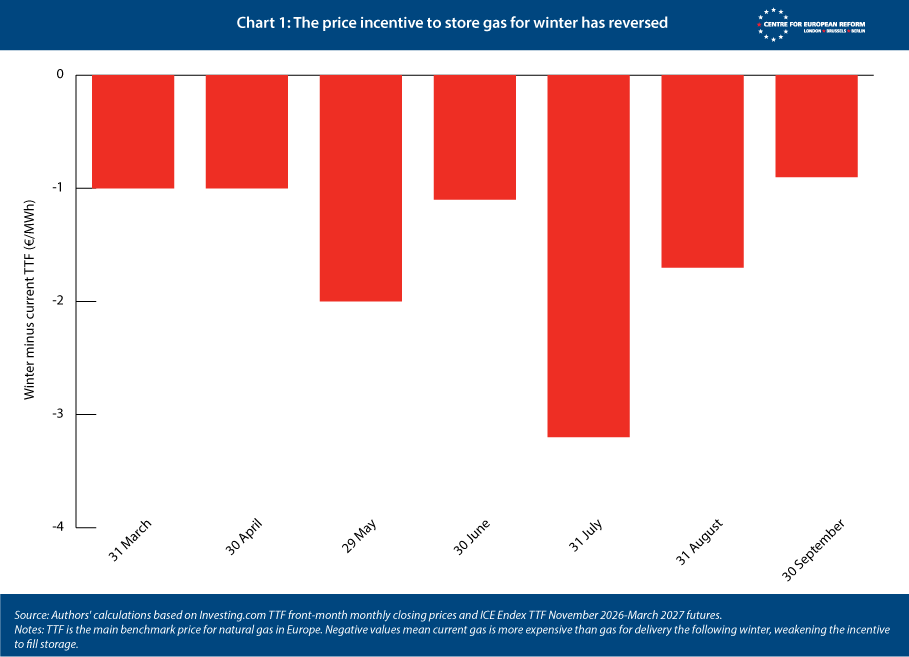
The inverted seasonal spread means that the energy market is not covering the wider value of energy security. As energy security is a public good, during a cold winter, stored gas helps keep homes warm and factories running. If the market cannot provide that security, governments must intervene. The cost of gas-based energy security then falls increasingly on taxpayers and consumers.
Storage is only part of the bill. The EU economy remains uniquely exposed to gas prices, which feed into electricity prices, industrial costs and inflation. Research on French manufacturing during the 2021-22 shock finds that firms fully passed energy cost increases on their selling prices when they reset them, with especially large effects on chemicals and metals.
If climate change and geopolitics were not enough to convince the most hard-nosed rationalist to phase out gas, the economic impact is becoming harder to ignore. Member-states pay to secure gas storage and then bear the wider economic damage when its price jumps. The Commission once described gas as a transitional fuel and LNG as an insurance policy against supply disruptions. But that insurance is proving increasingly expensive, with costs driven by global markets largely beyond the EU’s control. The faster alternatives replace the services gas provides, the smaller the bill becomes.
More of the gas shock is being socialised
Storage is one channel through which the EU’s dependence on gas affects member-states’ public finances. A second appears after prices rise, when national governments use tax cuts, price caps or transfers to shield households and firms. These measures do not erase the shock. They shift part of its cost from energy bills to taxes and public debt and thereby socialise it.
The Commission estimated that the energy support measures member-states had announced by early May would cost €14.5 billion in 2026. Extending them until the end of the year would raise the bill to €38.6 billion. Yet, three-quarters of this support is untargeted, benefiting households and firms regardless of their vulnerability to higher prices (see Chart 2). More than two-thirds of the spending also lowers energy prices directly, mainly through cuts in fuel taxes and excise duties. Such measures weaken incentives to reduce fossil-fuel consumption, while increasing the burden on public finances (see Chart 2).
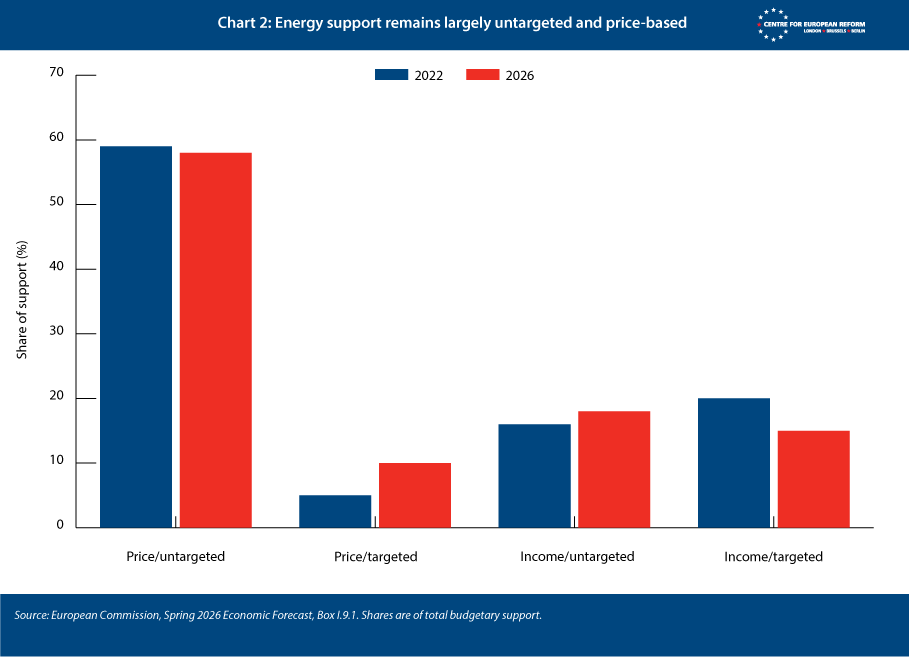
The pressure to intervene is understandable. Low-income households cannot easily absorb a sudden jump in heating costs, and firms cannot replace equipment overnight. With several national elections due next year, notably in Poland, Spain, Italy and France, broad price relief also has obvious short-term political appeal. However, governments are facing much higher borrowing costs than in 2022, which makes the design of support more important. A cash transfer helps a household pay the bill, whereas a price cap or tax cut also makes the next unit of energy cheaper, weakening the incentive to save or switch fuels, while taxpayers pick up part of the cost.
Targeted income support can protect vulnerable households at a lower cost to taxpayers. This is also the direction set out in Commission guidance: emergency support should be targeted, timely and temporary, while preserving incentives to reduce demand. So far, national measures range from energy vouchers and income support to tax cuts and price caps. Governments should therefore favour targeted transfers over cuts to fossil-fuel taxes.
Phasing out gas means breaking its grip on prices
Support measures decide who pays for a gas shock. What makes the next shock cheaper is using less gas and limiting how far its price raises electricity prices, industrial costs and inflation.
Higher gas prices should in principle make electrification more attractive. When gas becomes expensive relative to electricity, a heat pump becomes more appealing than a gas boiler and an electric industrial process more attractive than a gas-fired one. Yet the EU captures too little of this advantage, as expensive gas often pushes up electricity prices, and gas-fired power plants often determine those prices. ACER also warns that high electricity-to-gas retail price ratios can discourage electrification, with network charges, taxes and other bill components often widening the gap.
European electricity markets generally set the price according to the most expensive plant needed to meet demand - and in many hours, that is a gas-fired plant. In 2022, gas-fired power plants produced only 19 per cent of EU electricity but set the electricity wholesale price 55 per cent of the time. Joint Research Centre (JRC) modelling suggests that, in a scenario where storage capacity and system flexibility remain limited, gas could still set the price around half of the time in 2030 even if it supplies only 11 per cent of electricity. The result is perverse: when gas prices rise, so do electricity prices, making the switch away from gas less attractive.
More renewables are essential, but they alone will not break gas’s grip on electricity prices. Gas plants can still set electricity prices during periods of low wind and solar generation, a phenomenon known in German as Dunkelflaute, literally meaning “dark doldrums”. Reducing their role requires a larger and more flexible electricity system: more clean generation to meet rising electricity demand, more batteries and other storage, stronger grids and interconnectors, and consumers able to shift some demand away from peak hours.
More renewables are essential, but they alone will not break gas’s grip on electricity prices.
Australia shows such a mechanism in practice. In the second quarter of 2026, battery discharge became the dominant price-setter during the evening peak, setting wholesale prices 46 per cent of the time, up from 22 per cent a year earlier. Greater renewable output, battery discharge and lower evening demand all contributed to lower wholesale prices. Spain points in the same direction. In early 2026, gas accounted for around 21 per cent of Spanish electricity generation but set prices only 15 per cent of the time.
Efficient market design can lower the cost of phasing out gas
Phasing out gas will not remove dependencies. For instance, China accounted for more than 80 per cent of global battery-cell production in 2025. That concentration is a risk. The risk is different from dependence on a fuel that must be continuously imported, but it is not trivial. A supply-chain disruption would not shut off batteries or solar panels already installed in the EU, but it could make the next wave of investment slower and more expensive. The best response is to diversify suppliers and build manufacturing capacity for critical clean-energy technologies and components. The EU should focus on the most concentrated supply chains rather than trying to produce everything at home. The EU’s Net-Zero Industry Act and proposed Industrial Accelerator Act are already moving in that direction.
The challenge is to reduce gas dependency without making the transition unnecessarily expensive. Three recommendations can help keep the transition affordable.
First, ensure the investment incentives are correct. The relative prices should make switching away from gas attractive: carbon pricing should make gas less competitive, while taxes and levies on electricity should not undo that incentive. Where direct electrification is not cost-effective, hydrogen and biomethane may offer alternatives, but support should reflect their economic value rather than favouring particular technologies. The EU also needs major grid investment, but if all those costs are loaded onto electricity bills, electrification will become less attractive. Some of the costs must be spread more broadly, including to gas users, while electricity network tariffs should encourage consumers and generators to use the grid where and when capacity is available.
Where direct electrification is not cost-effective, hydrogen and biomethane may offer alternatives, but support should reflect their economic value rather than favouring particular technologies.
Second, make sure markets reward flexibility wherever it creates value. Batteries should not depend only on revenues from balancing supply and demand in real time. They can also shift electricity from cheap to expensive hours on the wholesale market, ease congestion on the grid and receive payments for being available when supply is scarce. Demand response – consumers shifting electricity use to times when electricity is cheaper or more abundant – can provide many of the same services. Market rules must allow batteries and demand response to compete across these different markets, with aggregators pooling smaller consumers where necessary.
Third, only use public support where private returns fall short of public value. Cross-border grids, security of supply and strategic resilience can generate benefits that no private investor can fully capture. Where well-designed markets can already reward investment and flexibility, subsidies should not replace those revenues. This is increasingly the logic of EU policy. The Clean Industrial Deal State Aid Framework is designed to crowd in private capital, while EU funding is planned to support cross-border grids whose benefits extend beyond any single investor or member-state.
Conclusion
Two major gas shocks in four years must change how the EU thinks about its dependency on gas. Diversifying suppliers has improved security of supply, but it has not insulated member-states from global price spikes that feed into electricity and industrial prices. Governments must protect vulnerable households and firms when shocks hit, while using prices, infrastructure investment and electricity markets to reduce the EU’s vulnerability to future gas-price shocks. If the EU needed another reminder to phase out gas more rapidly, the Hormuz crisis is providing one.
Elise Viadere is a research fellow at the Centre for European Reform.
Add new comment