
Resist, constrain and change: A European strategy for relations with Russia
- The threat from Russia is long-term. Putin has revived Russian imperialist ideology and militarised the economy and the education system. European governments and institutions need a collective strategy for dealing with Russia, and a narrative to explain it to their publics.
- The current US administration does not share the sense of threat that most Europeans feel and has sought to exclude Europeans from its negotiations with the Kremlin. Europeans need to develop their own strategy, co-ordinated by the EU but with buy-in from others, including non-EU states, to win the systemic competition with Russia.
- A good strategy needs to be rooted in the reality of the problem and the tools and resources available. That is part of the reason why George Kennan’s 1946-47 analysis of the Soviet Union and proposed strategy of containment worked, and why the EU’s 1999 Common Strategy on Russia did not: the latter ignored the reality of an increasingly hostile Russia.
- A new European strategy should have three objectives:
- to resist current Russian aggression by increasing the cost to Russia – at a minimum, preventing it from benefitting from expansionist policies;
- to constrain Russia’s power and influence in Europe and beyond, leaving no power vacuums for it to exploit and no fissures in European societies for it to widen;
- to increase the probability of change in Russia while guarding against the danger of Putin’s successor being equally aggressive. Putin has spent two decades destabilising neighbouring countries and threatening the West. It is quite likely that his successors would seek better relations with the West, at least while consolidating their hold on power; but there should be no immediate return to pre-2014 business-as-usual between Europe and Russia.
- When the confrontation between Russia and Europe ends depends on when the rulers of Russia decide that their interests are not served by continuing it. It may last a long time, so Europe needs to make itself more resilient, through more investment in the right kinds of defence and infrastructure, and learning the right lessons from Ukraine. There should be more co-ordination between the EU and the UK over mitigating and responding to Russia’s ‘everywhere war’ of propaganda, cyber attacks and sabotage. Germany and the UK are rightly following up the 2025 Kensington Treaty, in which they agreed (among other things) to work together in combatting hybrid threats.
- EU and UK sanctions need to inflict more pain on Russia. While Russia is short of petrol and diesel, sanctions should be used to put pressure on supplies from other countries. The UK and EU member-states also need to step up sanctions enforcement.
- Russia is also a competitor and a threat to European interests elsewhere, exploiting power vacuums and divisions in society. Putin thinks that in international relations Russia is fated to be among the winners and other European states among the losers. Europe has to prove him wrong. Part of the answer is in solving Europe’s domestic problems.
- Ideally, the EU would create an ‘Office for the Protection of European Values’, modelled on Germany’s Office for the Protection of the Constitution (BfV), to investigate and disrupt anti-democratic movements and foreign support for them. If that is impossible, then national security services and governments should be more aggressive in investigating and exposing Russian influence operations.
- Russia can exploit the impatience of EU candidate countries with the slow process of joining the Union. The EU should do more to strengthen the sense that the candidates are already part of the family.
- Europe needs to use its soft power tools to compete with Russia (and China) in the global south: development aid, international public service broadcasting and people-to-people contacts, including academic exchanges. But cuts to aid and broadcasting and visa barriers to travel are not helping.
- Russia’s war against Ukraine is putting the Russian economy under stress. Europe should do everything possible to increase that stress through sanctions and other measures. It should also consider how it can encourage more working-age Russians to emigrate, to exacerbate labour shortages in the armed forces and the military industrial sector.
- The rise to power in Russia of more pro-European forces after Putin is unlikely. Europe should support the democratic opposition in exile and in Russia, but the successor regime will probably not be democratic. The first steps towards normal relations should depend on what it does externally, in particular withdrawal from occupied territory in Ukraine. Only the Russians themselves can overturn Russia’s current political culture, if they decide that they would be better off as a peaceful, democratic state. But dismantling the effects of decades of Putinist indoctrination is likely to take many years, if not several generations.
- Europe needs to understand Russian reality better. European governments and EU institutions need to invest in expertise and in open-source and secret intelligence. Without good information, European leaders are more likely to take bad decisions.
- The spending needed to implement a Russia strategy is likely to be unpopular with publics. But Europeans need to understand that other countries, such as the US or Ukraine, will not solve the problem of Russia for them; and Europe has the resources to out-compete Russia across many domains. Continuing with the current approach also has costs. Failure to deter Putin from attacking Ukraine has cost European governments about €230 billion in military and economic support for Ukraine so far. If Russia attacked a NATO country, the costs would be much higher. The UK and the EU have a shared interest in resisting, constraining and changing Russia. They should agree the outlines of a strategy at the EU-UK summit in November 2026, if possible.
Since the start of Russia’s full-scale invasion of Ukraine in February 2022, European governments and EU institutions have focussed on the short-term demands of deterrence and defence. Following Donald Trump’s inauguration as US president in January 2025, they have done so with diminishing support from the US. But the threat from Moscow is long-term. Vladimir Putin has been in power in Russia since 2000. During that time, he has gradually but relentlessly revived Russian imperialist ideology and territorial ambitions, and militarised the economy and the education system. Some countries, including the UK, already have Russia strategies, though they may not be public. But a collection of individual strategies cannot be as effective as a joint strategy. The current Russian regime treats even the most powerful European countries with contempt, as German foreign minister Johann Wadephul discovered when he held a meeting with his Russian counterpart, Sergei Lavrov, in New York in September 2026: Lavrov told him bluntly that their meeting had been unnecessary, and that he had heard nothing different in the German position.1
To avoid recurrent Russian aggression against its European neighbours, European governments and institutions need to come up with a collective long-term strategy for dealing with Russia, and a narrative to explain the threat and their response to their publics. The advantage of a large group of countries all exerting their influence to a single end is that some have access to more military, diplomatic, financial and information resources than others; a better co-ordinated effort to use these resources can increase their impact.
At one time, the work on such a strategy would have been led by the United States, and centred on NATO. The current US administration does not share the sense of threat that most Europeans feel, however.2 Donald Trump wants to reduce the pressure on Putin, inviting him to the G20 summit in Miami and reportedly contemplating business deals with Moscow before Putin ends the war.3 The US has excluded Europe from its negotiations with Russia and Ukraine, even though the outcome will have a major impact on European security. For as long as Trump is in power, it makes little sense to think of a ‘Western’ policy towards Russia: Europe and the US are on diverging paths. The next administration may revert to a more traditional US foreign policy, but Europeans cannot rely on that; they need to develop their own strategy. The EU will probably have to co-ordinate the process, though ideally the strategy should be one that most or all European countries, including the UK, can buy into, whether they are members of the EU or not.
The White House may think that Putin can be placated with Ukrainian territory and American business deals. But senior European military and intelligence personnel are warning with increasing urgency of the risk of a Russian attack on NATO. The Danish defence intelligence service even suggested in September 2026 that a long-range attack on facilities supporting Ukraine’s war effort, or an incursion into NATO territory, could come within months.4 In the last year, Russian officials and propagandists in the state media have said repeatedly that Russia is already at war with NATO.5 European governments should treat such statements seriously. Like the Soviet Union before, the Russian defence and security establishment sees conflict as a spectrum, ranging from low-key information operations to nuclear war; it does not make the sharp distinction between war and peace that Western governments do. The Sahaidachnyi Security Center, a Ukrainian defence and security think-tank, tracks what it calls ‘the everywhere war’ – acts of sabotage, terrorism, cyberattacks and other hostile acts against European countries, with a proven or suspected Russian hand behind them, that fall outside the normal definition of conventional war. Since January 2022 it has recorded 527 events – 410 of them attributed to Russia by government officials or intelligence agencies. The frequency of these attacks is increasing: in 2022, there were 56 proven or suspected attacks; in the first eight months of 2026, there were 121.6
European governments have (to varying degrees) increased their defence spending in order to deter attacks or defend against them. But they have also relied on the hope that others would solve the problem of Russia for them: either Ukraine, with its unbreakable “spirit of resistance”, according to European Commission President Ursula von der Leyen; or US President Donald Trump, the “only person in the whole world who is able to break deadlock when it comes to the war in Ukraine”, according to NATO Secretary General Mark Rutte.7
Europe, including the UK, must accept that the threat from Russia is persistent and comprehensive, and that the European response needs to match it. Europe cannot rely on Ukraine to defeat Russia or the US to broker a lasting peace with Moscow on acceptable terms. The UK’s 2025 National Security Strategy says “Authoritarian states are putting in place multi-year plans to out-compete liberal democracies in every domain, from military modernisation to science and technology development, from their economic models to the information space”. European governments and institutions need a similar comprehensive and long-term strategy to win the systemic competition with Russia and to create conditions that could eventually produce positive changes in Russia’s system of governance.
This policy brief looks at past examples of successful and unsuccessful strategies for dealing with the Soviet Union or Russia. It sets out goals for a European strategy, describes the ways in which they could be pursued and looks at the cost of implementing such a strategy – and of not implementing it.
What do good and bad strategies look like?
A good strategy needs to be rooted in the reality of the problem and the tools and resources available to address it. Having a good strategy is not a guarantee of success; having a bad one is almost a guarantee of failure.
European governments and institutions need a comprehensive strategy to win the systemic competition with Russia.
In 1946 and 1947, the famous American Sovietologist George Kennan wrote two seminal texts that played a central role in guiding Western – and especially NATO –policy towards the Soviet Union until the end of the Cold War. The first of these, written in February 1946 when Kennan was the acting head of mission in the US embassy in Moscow, was ‘the long telegram’ – more than 5,000 words, mostly analysing for the US government what the Soviet Union was doing and why, a subject on which he was expert. The second, written after his return to Washington, was published by Foreign Affairs in July 1947 as ‘The sources of Soviet conduct’, and initially attributed to ‘X’ – since Kennan, as a serving civil servant, was not allowed to publish it under his own name. This covered some of the same ground as the long telegram, but with a clearer prescription for US policy: “the main element of any United States policy towards the Soviet Union must be that of a long-term, patient but firm and vigilant containment of Russian expansive tendencies”.
In both texts, Kennan stressed the need for the US not simply to stand up to the Soviet Union on the international stage, but to show the world that America was taking care of its own problems. Though Kennan later took issue with some of the ways in which containment was implemented, the basic prescription was effective: it reflected Kennan’s knowledge of Soviet and American strengths and weaknesses and his understanding of the extent and limits of US influence. It provided the intellectual basis for NATO’s deterrent posture – coupled with a willingness to pursue dialogue and détente, once deterrence and stability were firmly established.8
The EU’s most comprehensive attempt to set out a strategy for relations with Russia, by contrast, had noble aspirations but ultimately led nowhere because it was predicated on a Russia that did not exist, and had an unrealistic view of the EU’s ability to influence the development of this new Russia. ‘The Common Strategy of the European Union on Russia’ – which the current author had a hand in drafting – was adopted by the European Council in June 1999 and set out two main goals:
- “a stable, open and pluralistic democracy in Russia, governed by the rule of law and underpinning a prosperous market economy benefiting alike all the people of Russia and of the European Union”;
- “maintaining European stability, promoting global security and responding to the common challenges of the continent through intensified co-operation with Russia”.9
Russia was changing course, however, even as the strategy was adopted – becoming less committed to democracy and openness; more suspicious of Western motives; and more inclined to look for zero-sum solutions to European security problems than win-win outcomes. The Common Strategy’s successors – the ‘Four Common Spaces’ of 2003 and the ‘Partnership for Modernisation’ of 2010 – repeated the mistake of ignoring this increasingly worrying Russian reality.10 It is only fair to note that the May 2002 declaration ‘NATO-Russia Relations: A New Quality’, issued by NATO leaders and Putin, reflected an equally utopian view of Russia’s direction of travel.
After Russia’s 2014 annexation of Crimea and intervention in eastern Ukraine, the EU seems to have given up trying to devise a comprehensive strategy to deal with its former ‘strategic partner’. The best it managed was five ‘guiding principles’ for EU policy towards Russia, endorsed in 2016:
- full implementation of the Minsk agreements (the texts negotiated by France and Germany with Russia and Ukraine in 2014 and 2015, which brought about a temporary and unstable ceasefire in eastern Ukraine) as a key element for any substantial change in relations;
- strengthening relations with the EU’s eastern partners and other countries, including in Central Asia;
- strengthening the EU’s internal resilience, including in the areas of energy security, hybrid threats and strategic communication;
- selective engagement with Russia on foreign policy issues and in other areas where there was a clear EU interest;
- willingness to support Russian civil society and invest in people-to-people contacts, particularly between young people.11
Europe’s approach to Russia has certainly evolved over the last three decades. Since the start of the full-scale Russian invasion of Ukraine, the five principles have been overtaken by policies of support for Ukraine and sanctions on Russia. But Europe – EU institutions, EU member-states, the UK and other European countries – now need to play the long game. To end up in a better situation than it is in now, Europe collectively needs to be clear about its desired long-term goals, and have plans to achieve them.
What does Europe want to achieve in relation to Russia?
A European strategy should have three objectives, operating simultaneously but implemented over different timescales. The first goal should be to resist current Russian aggression by increasing the cost to Russia, and at a minimum to prevent Russia benefitting from expansionist policies. The immediate aim would be to ensure that Russia could not encroach any further on the territory of its neighbours. Beyond that, Europe should make it harder and more costly for Russia to hold onto the territories it occupies or controls in Ukraine, Georgia and Moldova.
Europe needs to compete with Russia in Europe and globally, as the West competed with the Soviet Union.
The second goal should be to constrain Russia’s power and influence in the rest of Europe and beyond, and to leave no power vacuums for it to exploit. Russia has used old Soviet tactics and networks of influence to spread disinformation and undermine Europe’s standing in the global south. It has used mercenary forces to support military juntas in parts of Africa and get control of mineral resources in return. Above all, it has worked to exploit shortcomings in European societies and political systems and to widen fissures within and between European countries, including in countries that are candidates for EU membership. It has resorted to sabotage and terrorism in an effort to destabilise European countries. In the long telegram, Kennan wrote: “Every courageous and incisive measure to solve internal problems of our own society, to improve self-confidence, discipline, morale and community spirit of our own people, is a diplomatic victory over Moscow worth a thousand diplomatic notes and joint communiqués.” Europe needs to compete with Russia in Europe and globally, as the West competed with the Soviet Union.
The third goal of a European strategy is the most important and challenging: to increase the probability of change in Russia itself. The Putin regime has successfully persuaded many European politicians and officials that they should “always keep a-hold of Nurse for fear of finding something worse”.12 The West’s fear of instability in Russia is not in itself irrational. The break-up of Yugoslavia, the civil war in Libya after the fall of Qadhafi, and the state failure of Syria from 2011 onwards are all warnings of what might happen – and none of those states had nuclear weapons. But Russia has also been able to play on this fear to encourage the West to support continuity in Russia. Soon after the war began, the former head of the UK’s Secret Intelligence Service warned that Putin could be replaced by someone worse.13 A 2026 editorial in Newsweek was headlined ‘Beware the sudden death of Vladimir Putin’.14 Putin has spent almost two decades destabilising and invading neighbouring countries, at the cost of massive casualties on all sides; has periodically threatened, or allowed those around him to threaten, nuclear attacks on the West; and has authorised assassination attempts and terrorist attacks on targets in Europe that have cost the lives of European citizens. Continuity in Russia is in itself against Western interests.
European leaders need to lose their fear of what comes after Putin, and focus on speeding up the process of transition. Western influence on the precise outcome will be limited. It is possible that someone more aggressively expansionist could take power after Putin; but Russian and Soviet history suggests that it is equally likely that Putin’s successor or successors would seek better relations with the West. At the very least they are likely to want a pause in the confrontation while they consolidate their hold on power and settle scores with domestic rivals. It is highly unlikely that the next administration in the Kremlin will be democratically elected or respect human rights, but future leaders might well not share Putin’s obsession with absorbing Ukraine into Russia and eradicating Ukrainian identity, even if they would like to hold onto occupied territory. A Russian journalist in exile wrote in 2023: “the Putin regime is the main source and translator of radical thought in modern Russia, and its continuation will inevitably lead to greater radicalisation in Russian society”.15 The termination of the Putin regime would offer at least a chance for Russia to alter that trajectory.
European leaders must be realistic: they might hope for a durable peace with Russia, but European action alone will not guarantee it. Even granting the Kremlin everything it demands might simply lead the way to yet further demands. European governments must also avoid the trap of seeing friendly relations with Moscow as an end in themselves, for which Europe should be willing to compromise its principles, make significant concessions or return to pre-2014 ‘business as usual’ in the economic sphere. When the confrontation ends ultimately depends on when the rulers of Russia decide that it is not in their national interest to devote an ever-increasing share of the national budget to defence, starve the civilian economy of investment and make Russia’s demographic problems even worse. Meanwhile, even in the event of a ceasefire in Ukraine, Europe should be more than cautious about giving Russia financial resources or access to technologies that would increase the long-term threat it posed to its neighbours.
Resisting Russian aggression: “A journey of a thousand miles begins with a single step” 16
Change might come to Russia quickly (as it did in the last years of the Soviet Union). Hoping for that is not a plan, however. Europeans need to assume that confrontation with Russia will last many years. The first steps towards changing Russia can only be taken in parallel with measures to make Europe itself more resilient.
European leaders must be realistic: they might hope for a durable peace with Russia, but European action alone will not guarantee it.
1. Military strength
The first step European countries and EU institutions must take if they are to win the contest with Russia is to stop its advances in Ukraine and deter it from testing NATO and European solidarity. European governments need to move beyond seeing their defence efforts simply in terms of increasing budgets – though that is necessary – and focus on developing as quickly as possible the specific capabilities that will do most to put Russia on the back foot. To achieve this, they need to learn from Ukraine’s successes and failures.
There are at least two separate battles going on in Ukraine at present. The first, in which Ukraine is doing reasonably well, is on the front line. Since Ukraine’s 2023 summer offensive stalled, stalled, those defending the territory they hold – whether Ukrainian or Russian forces – have generally had the upper hand over attackers. But in recent months Ukraine has regained some territory from Russia, while Russia is suffering heavy casualties in its continuous efforts to advance. Europe could step up its help to the Ukrainians in areas such as intelligence, and by providing continued supplies of ammunition and ensuring that Ukrainian and European firms can manufacture drones and other equipment for Ukraine safely in other parts of Europe, as well as in western Ukraine. Technologically and tactically, however, the battle at the front is one for which the Ukrainians are better prepared than any European army. Europeans need to draw on Ukraine’s experience.
One of the lessons of the war is that while many people in Ukraine are willing to support the war effort financially or by working in defence industry or other military support functions, many fewer are willing to volunteer for duty at the front, and plenty will go to considerable lengths to avoid it. Many countries in Europe would probably find themselves in the same situation in the event of a conflict. A Gallup poll in 2024 suggested that Western Europeans were considerably less willing to fight for their countries than Ukrainians: only a third of Britons said they would do so, and fewer than a quarter of Germans, compared with over 60 per cent in Ukraine. The figure for Ukrainians before Russia’s 2014 annexation of Crimea was 40 per cent, and willingness to fight might well increase in other countries if they come under direct attack.17 European governments should probably accept, however, that armed forces need to be reshaped to rely more on remotely piloted or autonomous systems, with humans kept out of harm’s way wherever possible. Armed forces that rely more on air, sea and ground drones than masses of troops would also reflect Europe’s demographic situation, with fewer people of ‘fighting age’ available. European countries are already starting to move in the direction of using more uncrewed systems, with the Royal Navy, for example, testing the launch of torpedoes from uncrewed vehicles, as well as armed aerial drones launched from ships.
Russia can produce drones and missiles faster than Ukraine can build or buy counter-measures.
The second battle between Russia and Ukraine, which is more evenly balanced, is the battle targeting cities, industrial capacity and infrastructure. In this battle, the offence has the advantage over the defence. Ukraine has focussed on hitting economic and defence industrial targets inside Russia, with significant success. Its strikes on Russian oil refineries and oil and gas export terminals have led to petrol, diesel and aviation fuel shortages and have cut Russian government revenues. According to the International Energy Agency (IEA), throughput in Russian refineries in June 2026 was 30 per cent lower than in June 2025; petrol production was down around 20 per cent and diesel production by almost 30 per cent. Despite the high global oil prices resulting from the US-Israeli war with Iran, the IEA reported that Russia’s budget revenues for January-August 2026 were down almost 17 per cent on the same period in the previous year, as the government imposed restrictions or bans on the export of refined products in an effort to protect domestic consumers.18 The Russian government has now moved to classify most data about oil and gas production, processing and export – a clear sign that the figures are bad.19 Ukraine has also hit a number of important defence production facilities, some of them repeatedly – though these tend to be harder to keep out of action for a long period. While Russia regularly claims to have shot down huge numbers of Ukrainian drones and cruise missiles, enough are clearly getting through to cause significant damage. European states should accelerate the manufacturing and stockpiling of ballistic and cruise missiles that would give them similar or better deep strike capabilities, allowing them to hold at risk key parts of Russia’s oil and gas industry and its defence industrial sector as a deterrent against conflict.
There are also lessons to be learned from Russia’s strikes on Ukraine’s rear. In particular, Europe should assume that if its confrontation with Russia continues to escalate, a wide range of non-military as well as military targets are likely to be under threat as a means of undermining civilian morale and economic activity. With help from China, Iran and North Korea, Russia is able to produce drones (including jet-powered drones), cruise missiles and ballistic missiles faster than Ukraine can build counter-measures or procure them from its allies – despite Ukraine having made rapid progress in counter-drone technology and ballistic missile defence. Russia has attacked some defence industrial facilities, but much of its air campaign has targeted civilian infrastructure, as well as cultural sites, including museums, printing presses and book depositories: by the end of August 2026, Russia had destroyed 12 million books this year.20 In recent weeks, it has dramatically increased the number of attacks on targets such as schools and petrol stations in central Kyiv, as well as key bridges across the Dnipro river that link the eastern and western parts of the city. From a pattern of concentrated nightly attacks, it has moved to attacks throughout the day, seeking to exhaust and demoralise the population. Meanwhile, Russian strikes on Ukrainian Black Sea ports are preventing Ukrainian grain exports, damaging the economy and threatening a food crisis in parts of the Middle East and Africa. Russia has also struck all Ukraine’s steel mills, closing down several of the most important plants and doing serious damage to a sector crucial both to tax revenues and defence production.21 Ukraine has not been able to repair all the damage that Russian attacks did to electricity generating stations and the electricity grid last winter, before a new bombing campaign begins this winter. Russia is also striking railway infrastructure, essential for keeping goods and people moving within Ukraine and across the borders to the rest of Europe.
Europe needs more effective air defence. But like Ukraine, the rest of Europe has been too dependent on US-built Patriot air-defence and anti-ballistic missile (ABM) systems. With the US prioritising resupplying its own forces and those of its allies in the Middle East, fulfilling existing European orders is likely to take several years. In addition, each interceptor missile costs around $4-5 million – much more than the missiles it is designed to shoot down.22 But Europe is far from being able to produce missiles for its indigenous ABM system, SAMP-T, in the quantities needed to stop Russian ballistic missiles. One estimate in 2025 was that even with likely deliveries of Patriot PAC-2 and (more advanced) PAC-3 interceptors plus likely production of Aster 30 ABM interceptors for the SAMP-T system, Europe could probably only destroy 245-299 Russian ballistic missiles per year, while Russia produced 840-1,020 per year.23 Ten European countries, led by Ukraine, are trying to develop the ‘Freyja’ interceptor, a low-cost alternative to Patriot PAC-3 interceptors; but testing is likely to start only next year and keeping up with Russian manufacturing capacity will be a struggle.
The question is whether European governments can stop responding to the symptoms of Russia’s hostility piecemeal.
Europe should continue to invest in increasing production of anti-ballistic missile systems and interceptors, as well as shorter-range air-defence systems to protect against drones. But it should also improve its ability to target Russian ballistic and cruise missiles and strike drones before they are launched, all the way back to the factories where they and the components for them are manufactured. In the short term, it should provide all the support it can to help Ukraine inflict as much damage as possible on defence plants, weapons storage sites and missile launchers. It should also step up its efforts to tighten export control and sanctions enforcement to make it harder for Russia to acquire components and machine tools for its missile programmes.
European leaders will have to accept, however, that in the event of conflict, Europe is too big an area to protect completely: some missiles will get through. Then the question will be how to minimise the effects, particularly on the energy and communications systems that populations and businesses rely on. The International Energy Agency’s 2026 study ‘Energy system resilience: Lessons learned from Ukraine’ identifies ten points that other countries could act on.24 The first of these is “Put resilience at the centre of energy system planning.” The report also notes that decentralised electricity generation makes it harder to put the energy system out of action and easier to repair or restore it; and underlines the importance of cross-border co-operation, including agreements on mutual assistance made in advance of need, rather than negotiated in the midst of a crisis. The EU and UK should take note. UK Prime Minister Andy Burnham has announced the establishment of a new state-owned company, ‘Great British Grid’, to invest in upgrading the UK’s electricity grid to make it easier to connect renewable energy sources to it; the firm should also be tasked with improving the grid’s resilience in the event of attacks on it.
2. Responding to the ‘everywhere war’
The EU, its member-states, other European states (and in the case of Germany, the federal Länder) and the UK have a bewildering number of frameworks and action plans for dealing with ‘hybrid threats’, or ‘the everywhere war’. In some ways it makes sense to have different approaches to different possible events: the response to a physical attack on critical infrastructure, such as an electricity sub-station or a railway, is bound to be different from the response to an online disinformation campaign aimed at manipulating the outcome of an election.
There are existing forums for exchanges of information and expertise among European institutions and countries, including the UK. All EU and NATO member-states except for the US (which withdrew in February 2026) are members of the European Centre of Excellence for Countering Hybrid Threats, based in Helsinki, with which Ukraine, the European External Action Service and the NATO International Staff also work. There is scope for more operational co-operation between Europeans, however, whether in NATO frameworks (with or without US blessing), bilaterally or through minilateral arrangements like the Joint Expeditionary Force (JEF).25 When Burnham met German Chancellor Friedrich Merz in Berlin on October 8th 2026, they agreed to follow up the commitment in the UK-Germany Kensington Treaty of 2025 to “work to strengthen resilience as well as build capacity and capability to detect, deter, disrupt, and respond to [hybrid] threats” – a reflection of the growing threat that both countries face, and the need for more effective responses.26 JEF defence ministers discussed Russia’s hybrid attacks at their meeting in Iceland on October 2nd 2026, and agreed to continue to develop common approaches to them. The UK and EU should turn their commitments to dialogue on hybrid threats, which were part of their May 2025 Security and Defence Partnership, into action. For example, they could make detailed arrangements for mutual assistance in the event of attacks on energy or other critical infrastructure.
The question is whether European governments can stop responding to the symptoms of Russia’s hostility piecemeal, and start addressing the causes comprehensively. The EU’s defence commissioner, Andrius Kubilius, rightly told the Financial Times on the eve of an EU defence ministers’ discussion of hybrid warfare on September 28th 2026: “Hybrid war demands hybrid defence, systematically. Not just reactions to one or another event, one or two provocations.”27
The British government has announced that Home Office and Ministry of Defence ministers will brief the CEOs of defence and critical national infrastructure firms on the threat from Russia, including cyber attacks, sabotage and disinformation.28 But the UK’s National Risk Register, which identifies and categorises various sorts of risk, does not identify Russian activity as in itself a risk. Instead, various risks that could be a result of Russian attacks are scattered under headings including ‘Terrorism’, ‘Cyber’, ‘State threats’, ‘Geopolitical and Diplomatic risks’, ‘Accidents and systems failures’, ‘Societal’ and ‘Conflict and instability’. The register does not explicitly refer to Russia, even though many of the risks identified, such as major disruption to subsea telecommunications cables, reflect the experience of Russian attacks elsewhere in Europe.29
Though China has become Russia’s most important supplier, Western components still turn up in Russian weapons systems.
Not every infrastructure failure or cyber attack in Europe will be a result of Russian action. But in current circumstances, many will be, and will form part of a concerted Russian strategy for undermining European institutions and individual European governments. If senior Russian figures say that Russia is at war with the West, and if Russian intelligence officers or their proxies are carrying out warlike acts against European interests, European governments have to react on the basis that they are at war with Russia. That does not mean that they have to respond militarily, or even symmetrically, to Russian attacks. But as Kubilius told the Financial Times, “If we are facing painful hybrid threats or actions, our answer should be painful in a similar way…. Not similar means [necessarily], but pain should be at the same level”.30
Both the UK and the EU need to find ways to increase the pain level for Russia. While adding Russian military personnel and officials responsible for torture, massacres, child abduction or other war crimes to sanctions lists is necessary, it is clearly not enough to raise the price of the war to the point where Putin or (more likely) those around him decide that Russia needs a fundamental rethink of its objectives or its approach to its neighbours.
There has been good co-ordination between Brussels and London, particularly on sanctions implementation and enforcement, since the war began. In the light of this experience, the EU and the UK should work with like-minded states to tighten the screws on Russian revenue sources, particularly in the energy sector, and to interrupt supply chains serving the Russian defence industrial sector. In concrete terms, the UK and the EU need to work together (despite the opposition of London insurers and Greek shipowners) to make it harder for Russia to find any ships to carry its oil and gas exports, and to impose costs on European shipowners who continue to help Russia to fund its war of aggression.31 As Ukraine repeatedly damages Russian oil refineries and other facilities, the EU and UK should do everything possible to restrict the supply of the equipment and technology needed to make repairs.
They also need to incentivise exporters of dual-use technology and components not to supply countries with a record of allowing goods to be diverted to Russia. Though China has become Russia’s most important supplier, Western components still turn up in Russian weapons systems on the battlefield, showing that Russia can rely on clandestine supply chains for some items.
There are signs that at least some countries, including Germany, have stepped up enforcement of sanctions recently, with at least three businesspeople in Germany sentenced to prison terms this year for sanctions breaches, and other cases under investigation. The UK’s record in this area is less impressive: though there have been some significant civil penalties for breaches deemed inadvertent, there has not been a criminal prosecution since the start of the full-scale war, and the government has only recently started publishing the names of companies penalised.32 Both the EU and the UK should look at extending the strict liability rules for supply chains that oblige firms to investigate whether their suppliers and some ‘downstream’ firms that they deal with are meeting human rights and labour standards; European firms might be more cautious about the bona fides of their customers if they faced similar strict liability rules for goods that might end up in Russian weapons or enable their manufacture.
Constraining Russia and eliminating power vacuums
Restricting Russia’s expansion into its neighbourhood and preventing direct attacks on Europe is only a first step. Russia has become a competitor and a threat to European interests in other regions, often by exploiting power vacuums or divisions in society. When Putin came to power, post-Soviet Russia had largely withdrawn from traditional client states in Africa and the Middle East, and was working constructively with the West on some (though not all) of the problems of the Western Balkans after the Yugoslav wars. It was possible to envisage win-win solutions to European security problems.
Putin, however, does not think in win-win terms. He believes that there are always winners and losers in international relations, and that Russia, by virtue of its size, natural resources and armed forces, is fated to be among the winners, while other European states can only be losers. Even if Europeans want to believe that win-win solutions can still be found, Putin’s stance forces them to prove him wrong by competing successfully with Russia, both in terms of their domestic policies and in the rest of the world, including the global south.
The EU needs to strengthen the sense that candidate countries are already part of the family.
Like Kennan in 1946, Burnham makes the connection between domestic problems in the UK and opportunities for Russian mischief-making. In his speech to the United Nations General Assembly, he highlighted Russian disinformation campaigns and cyber attacks aimed at the UK and announced the creation of a new National Centre for Information Defence.33 But he also said “faced with this information warfare, security starts in every home. If you’re struggling with the cost of living and your life is not improving – or if you’re a young person not in employment, education or training – then you are going to be much more vulnerable to this kind of influence. So part of the challenge is to lift our people up and create the opportunities they need. When inequalities grow too wide, our societies are at greater risk.” With far left and far right parties ascendant across Europe – at least in part because voters’ dissatisfaction with lack of economic opportunity – other European governments should take a similar approach.
Russia is not the cause of most social and economic problems in European societies, but it is skilled in exploiting them. The links between Russia and anti-democratic, eurosceptic political movements in Europe are no coincidence. Mainstream parties can counter some of the narratives of alienation and despair that extremists use to attract support; but they could also do more to minimise the impact of Russian influence on domestic political competition.
Against the background of elections in France, Germany and the UK in the coming years in which parties that are more sympathetic to the Kremlin (and sometimes have close ties to it) could win at least a share of power, it is already very late for mainstream parties to try to make European democratic systems harder for Russia to penetrate. Ideally, the EU would create an ‘Office for the Protection of European Values’ (OPEV), modelled on Germany’s Bundesamt für Verfassungsschutz (BfV) (‘Office for the Protection of the Constitution’), to investigate and disrupt anti-democratic movements and foreign support for them, where they are trying to abrogate the values set out in the Treaty on European Union.34 The member-states could agree to expand the remit of the European Public Prosecutor’s Office (EPPO) beyond its current role of tackling crimes against the EU’s financial interests, so that it could investigate and prosecute actions – especially those influenced by foreign powers – designed to undermine European values. Such steps, however, seem very unlikely, certainly on a useful timescale. It took almost a decade to create the EPPO, from the first formal proposal to create it until the appointment of the first Chief Prosecutor, and even then some member-states initially refused to be subject to it.
If action at the EU level is unlikely, national security services and governments should be more aggressive in investigating and exposing Russian influence operations – even in cases where there is not enough admissible evidence to go to court. In 2022 in the UK, the Security Service exposed a suspected Chinese agent of influence who had cultivated MPs; even though the agent in question was not prosecuted, her activities were disrupted.35 Similar tactics could be used throughout Europe to complicate Russian efforts to recruit politicians, promote extremist political parties and exacerbate divisions in society.
Russia sees the countries that are candidates or potential candidates for EU membership as a particularly important battleground. For the EU, despite von der Leyen’s wish to run a “geopolitical Commission”, the enlargement process is primarily a technical, merit-based one, rather than driven by the Union’s geopolitical priorities. For Russia, the EU enlargement process is part of a three-decade process of the West encroaching on Moscow’s sphere of influence in Central and Eastern Europe and the Balkans.
The longer the EU leaves the candidate countries waiting to accede while refusing them most of the benefits of EU membership, the more opportunities Russia will have to exploit their impatience, play on historical grievances against their European neighbours or historical ties to Russia, and ultimately turn the candidates and the EU against enlargement, depriving both of its security and economic benefits. Even if full membership of the Union is not yet on offer to Ukraine and others, the EU needs to find a way to strengthen the sense that candidates are already part of the family, by giving them more access to the single market and to foreign and security policy discussions.36 In her state of the union speech, von der Leyen spoke of proposing ‘road maps’ for the most advanced candidates; ideally the road maps would do more than offering clarity on the steps the EU and the candidates still need to take before accession, and would make available as many of the advantages of membership as possible as candidates make progress. In an encouraging sign, Politico reported in late September 2026 that the Commission had drafted a proposal for candidate countries to receive conditional, gradual integration to the single market, though the details are not public.37
Beyond Europe, European governments need to relearn some of the lessons of the Cold War competition for influence between the West and the Soviet Union. Some are practical: development aid can be a political instrument that benefits not only the recipient whose life is improved by it, but the donor who gains political credit. When Europe cuts aid, other powers, including Russia, step in – even if what they offer is security for juntas, rather than economic assistance. Aid from the 22 EU member-states that are members of the Organisation for Economic Co-operation and Development’s Development Assistance Committee was 17 per cent lower in 2025 than in 2023; aid from the UK was down by 21 per cent, and from the US by 57 per cent.
European public-service broadcasters and media organisations need to be funded to compete with what Russia can offer.
The way that Europe portrays its assistance also matters. Development financing framed as a partnership between recipient and the giving country may produce more diplomatic benefits than aid portrayed as a generous gift from donor to recipient. That undervalues the agency of recipients and may stoke political resentment.38
Despite the cuts made, the UK and Germany remain the two largest bilateral donors in Europe. In 2025, following the signature of the Kensington Treaty, the two governments agreed to a list of 17 projects, including a development partnership. As part of this, the UK and Germany are supposed to hold an annual development dialogue to set the strategic direction of their collaboration on development. They should use this to consider how aid can improve the resilience of countries where Russia is seeking to increase its influence, and how it can support shared diplomatic aims.
Russia is using the hard power of the Africa Corps (the state-controlled successor organisation to the mercenaries of the Wagner Group) to get authoritarian regimes in Africa on its side, in the process getting the right to exploit mineral resources across the Sahel and elsewhere. But it is also using soft power in the global south. Indeed, one of its few successes since the full-scale war began in 2022 has been in promoting its narrative there. It has made mistakes, such as using deceit to recruit citizens of India and of countries in Africa to serve in the Russian army or work in its defence industry. But it has revived Soviet ‘anti-imperialist’ rhetoric of the Cold War era, and used it to damage the image of European ex-colonial powers while distracting attention from its own imperialist war against Ukraine. Its efforts are often complemented by China’s: China’s international broadcasting output is enormous, and generally repeats the Russian version of events in Ukraine uncritically.
In this context, the dismantling of the Voice of America by the Trump administration and budget-driven cuts to the BBC World Service help Russia: when the BBC gave up Arabic broadcasts in Lebanon in 2023, its FM frequency in Beirut was immediately taken by Russia’s Sputnik Arabic service; BBC Monitoring later reported on Russia’s deployment of anti-Western narratives through Sputnik’s Arabic language broadcasts.39
Russia also offers training to journalists from the global south, designed to cast doubt on (for example) Russian war crimes committed in Ukraine, or to ensure favourable media coverage of Russian military support for juntas in countries in the Sahel.40 The BBC’s charitable arm, BBC Media Action, provides some competition, including through its ‘Pursuit of Truth’ programme to support young journalists. But it has been hit by loss of funding, including as a result of the closure of USAID, which used to be a major donor.41 USAID was also an important funder of independent media across the global south; the end of its programmes meant a loss of about $150 million per year in support for journalism and the media more broadly.42 The UK and EU cannot fully replace US funding, but they should not leave the field open for Russia (and China) to train the next generation of journalists and provide them with Russia-friendly content. The BBC World Service, Deutsche Welle and other European broadcasters and media organisations need to be funded to compete with what Russia can offer.
Europe also needs to consider the importance of people-to-people contacts and educational exchanges in shaping perceptions of Western democracies and their authoritarian rivals. In the Cold War, the Soviet Union used scholarships to the Patrice Lumumba University in Moscow to cultivate promising young people from the global south, including Mahmoud Abbas, who went on to become the Palestinian president, and Daniel Ortega, later the leader of Nicaragua. At a time when Europe is putting increasing barriers in the way of African students and business travellers, Russia has negotiated agreements on visa-free travel with Botswana, Namibia and South Africa, and on a simplified e-visa programme with Eswatini, Kenya and Zimbabwe. Putin announced in 2023 that the number of African students in Russia had almost trebled since 2020, reaching 35,000.43 That is still far short of the almost 230,000 students from African countries studying in France in 2024-25, but Moscow will no doubt hope that some of the current generation will also rise to senior positions from which they can be helpful to Russian interests. Europe needs to see offering opportunities to students from Africa and other parts of the global south as a strategic investment in future influence and an instrument of competition with Russia (and China), not as a migration problem.
How can Europe promote change in Russia (and should it)?
Change in Russia tends to come either suddenly or not at all. Major changes in Russia have often come in the wake of military defeat. After the Crimean War in the 19th century, Tsar Alexander II emancipated the serfs, at least in part in effort to modernise Russia’s economy and its armed forces.44 Defeat in the Russo-Japanese war triggered the 1905 revolution, and setbacks in World War One led to the February and October 1917 revolutions. The Soviet Union’s failure in Afghanistan and its inability to keep pace with the development of US defence technology without destroying the Soviet economy contributed to the collapse of the communist system and the end of the Cold War. Some of these changes improved the lives of Russians and of their neighbours; some did not. But they all forced Russia’s leaders to focus, at least for a while, on problems close to home, rather than on acquiring more territory abroad.
Most Russians will probably continue to see their country as a ‘besieged fortress’ surrounded by enemies.
Russia’s war against Ukraine and its shadow war in Europe are putting the Russian economy and society under great stress. Europe should do everything possible to increase that stress, while being realistic about how much change it can bring about, at least in the short-to-medium term. Even the end of the Cold War and the collapse of the Soviet Union only produced a temporary surge in Russians’ desire to live in a normal country rather than an imperial power. Regardless of whether they face a military threat or not, most Russians will probably continue to see their country as a “besieged fortress” (a phrase used by Lenin) surrounded by enemies, and as a ”country civilisation” entitled to impose its will on its inferior neighbours.45 Putin did not invent these concepts, though he has used relentless propaganda in the Russian media and the education system to ensure that many Russians share his world view.
Europe, like Ukraine, should therefore focus on attrition – not only in a military sense, but in economic and societal terms. This kind of comprehensive attrition is both a means of promoting change and a way of adding to the constraints on the current and any future aggressive regime in the Kremlin.
Europe needs to be agile in identifying the ways in which Russia is trying to circumvent existing sanctions and mitigate their effects, and look for new pressure points, such as fuel shortages in Russia. Thanks to Ukraine’s attacks on its oil refineries, Russia is now having to import refined products like petrol and diesel from other countries. Europe’s focus in the war so far has been on limiting Russian fossil fuel exports; it should now look at limiting Russian refined product imports as well. In August 2026 Russia imported 172,000 tonnes of oil products – three times its total imports of oil products in 2025. The overwhelming majority of these imports came from India (and were probably made from Russian crude oil), but significant quantities also came from South Korea and Egypt.46 With the whole world facing shortages of oil products, primarily because of the continued closure of the Strait of Hormuz, there are economic as well as strategic reasons for Europe to try to divert cargoes away from Russia, for example by imposing sanctions on tankers involved in this trade or denying them maritime services, in the same way that it has targeted the ‘shadow fleet’ shipping Russian crude oil to refiners elsewhere.
Europe also needs to treat the Russian information and media space as part of the battleground. The Russian authorities have made it much harder for people inside Russia to access reliable information from the international media, but it is not impossible, and European governments should provide financial support to enable European media companies to overcome the obstacles – including by restoring the infrastructure needed to increase short-wave broadcasts when access to the internet is blocked. Without resorting to propaganda, Western public broadcasters can ensure that Russians are aware of the truths that the authorities want to conceal – such as the number of confirmed and suspected Russian casualties.47
Europe has been very reluctant to make use of Russia’s tactics of spreading disinformation and fomenting division in society. It should certainly avoid contaminating the Russian services of public service broadcasters with inaccurate or misleading information. There is no reason, however, why it should not mount more covert information operations against Russia – cautiously, and with an eye to ethical considerations (while Russia has in the past sought to encourage different groups of Americans to confront each other, Europe should avoid encouraging violence between different ethnic groups in Russia, for example).48 The Russian state believes that Western governments are already carrying out such operations, so it could hardly regard it as an escalation. With many of Russia’s banks concealing serious bad debts as a result of being forced to lend to state enterprises, for example, it might be possible to use well-placed rumours to start a run on one or more banks and disrupt the financial system; or cause panic buying of fuel based on reports about the current gap between supply and demand in various regions. In this respect, the Russian decision to make such information secret is helpful, since it leaves an information vacuum for others to fill.
European leaders should be prepared for eventual change after Putin leaves the political scene to be limited.
Europe also needs to consider how to exacerbate Russia’s problems with the competing demands of the army for more troops and industry for more workers, in a more humane way than simply increasing the casualty rate at the front. Since the full-scale war began, the EU has on the whole tried to reduce Russian citizens’ access to the Schengen area.49 Some of the measures it has taken to step up security scrutiny are very well justified. Some governments may also think that keeping Russians who are reluctant to fight penned in Russia will increase the likelihood of their actively opposing the Putin regime. On the other hand, even the enormous casualties Russia has suffered so far have not led to any large-scale protests; and the more working-age (and fighting-age) Russians leave Russia and do not return, the harder it will be for Russia to replace losses at the front and retain the workforce it needs for the defence industrial sector.
European countries should consider whether, perhaps working with third countries willing to take in Russian citizens temporarily or permanently, they can come up with a scheme that limits the risks of allowing Russian intelligence officers, saboteurs or criminals into Western countries, but incentivises Russians, especially those with valuable skills in areas such as engineering, to leave Russia.
Ideally, change in Russia would bring more pro-European forces to power, including from the currently exiled Russian democratic opposition – even though their social and foreign policy views may not always be everything that a European liberal might wish for. A democratic, pro-European regime in Russia is a very long shot, however. Europe should provide exiled opposition figures with support and protection, as they do currently, and international public services broadcasters should cover their messages in media output directed at Russia. European governments should show support for embattled human rights defenders inside Russia, and maintain contact with any remaining democratic forces. They should not shy away from cultivating potential alternative leaders among the current elite, if they can identify them. But they should be prepared for eventual change after Putin leaves the political scene to be limited and to involve figures from the current regime – as in Venezuela after the removal of Nicolás Maduro.
The first steps towards more normal relations between Russia and other European countries should not depend on any new regime’s democratic credentials, but on what it does externally: at a minimum, withdrawing from illegally occupied territory in Ukraine and elsewhere in the former Soviet Union, and dismantling its influence operations and sabotage networks in the West. A Russia that posed less of a threat to its neighbours and to Europe more widely, even if it remained ill-governed, corrupt and dysfunctional, would be an improvement on the current situation.
It is hard to see Europeans being able to transform Russia more radically than that. Only Russians themselves can overturn the political culture of Russia, if they finally decide that they would be better off as a peaceful, democratic state rather than an aggressive personalist autocracy. Even then, as in the case of the last Soviet president, Mikhail Gorbachev, and the first president of Russia, Boris Yeltsin, change is more likely to come from insiders aware of the system’s shortcomings than from an uprising by ordinary Russians.
In the absence of a catastrophic collapse of the Russian state, eliminating the effects of more than two decades of Putinist indoctrination is likely to take many years, if not several generations. After all, Germany’s process of Vergangenheitsbewältigung, ‘coming to terms with the past’, continues more than 80 years after the end of the Nazi regime.50
If, however, positive systemic change does occur, Europe should be ready to respond to it in a way that maximises the chances of it being sustainable. That will require policy agility and an acute understanding of what is going on under the surface in Russia, and especially among the elite. Many Russians in the early 1990s wanted accountability for Soviet crimes and real change in Russia. If the West had adopted different policies, more supportive of the establishment of the rule of law, and less supportive of the new establishment of kleptocrats, it might have been harder for Putin to persuade the Russian people subsequently that the West in the 1990s was their enemy. This time, Europe needs to ask more searching questions about who and what it is supporting in Russia.
What does Europe need to know about Putin’s Russia, and how should it find out?
The great American baseball player Yogi Berra reputedly said “If you don’t know where you’re going, you might wind up someplace else”. Without a detailed understanding of Russia, Europe is at risk of ending up where Vladimir Putin wants it – not where it wants to be.
Without a detailed understanding of Russia, Europe is at risk of ending up where Vladimir Putin wants it.
European governments and EU institutions should have been investing in building up Russia expertise, inside and outside government, since the 2008 invasion of Georgia, if not before – drawing on the knowledge that countries on Russia’s borders already have, talking to the Russian diaspora, and sharing intelligence and analysis. Even after 26 years of Putin’s reign, understanding of Russia in many parts of Europe is poor, however. Take the attention paid to the September 18th-20th ‘elections’ to the Duma (the lower house of Russia’s Federal Assembly). A preview on the Euronews website, for example, treated them as a relatively normal democratic process, suggesting that the vote “could offer a slight hint at public sentiment towards the conflict”.51 With Yabloko, the only party planning to stand on an anti-war platform, banned from running in the election, and clear evidence of ballot-rigging, published election figures will be meaningless as a guide to what Russians think about the war in Ukraine or anything else.
That is not to say that public opinion in Russia is unimportant, or that studying it is useless. But trying to find out what people really think is far from easy in an increasingly repressive state where even mild criticism of the war against Ukraine can result in a lengthy prison term. Perhaps the most that European decision-makers can hope to understand is whether Putin’s popularity is rising or falling, based on the most reliable opinion polling available. It currently appears to be falling, according to the Levada Centre, an independent polling organisation, perhaps because Ukraine’s long-range strikes on Russia and the resultant fuel shortages are bringing the effects of the war home to Russians.
It is also important for Europe to have as much economic data as possible. This too has become more difficult to obtain since the war began, with some datasets disappearing from Russian government websites, and evidence of some statistics being falsified.52 Based on direct and indirect evidence, however, it is still possible to evaluate the rival claims that the Russian economy is in better health than those of European countries, or (as seems more likely) that it is reaching the limits of what can be done without triggering a financial crisis or resorting to a wartime command economy.53
Few things are as hard for outsiders to see as the dynamics of the Russian elite, except on the rare occasions when something dramatic occurs. The mutiny launched by Yevgeniy Prigozhin in June 2023, for example, showed tensions between different groups around Putin; but it was quickly suppressed. There are frequent rumours of disagreements between the ‘economic bloc’ in the regime – including the governor of the Central Bank of Russia, Elvira Nabiullina – and the ‘siloviki’ or securocrats over the cost of the war and the impact it has on the rest of the economy. How important these arguments are, and whether they go beyond the normal tensions in any government between those who want to spend the money and those who have to raise it, is hard to tell in absence of resignations or sackings (both of which Putin seems keen to avoid). Putin has so far insisted on prioritising the war, arguing that Russia will soon win. The more Europe can understand about the actors around Putin, the fewer surprises there are likely to be; but this is an area in which open-source information is likely to be scarce and secret intelligence vital.
European governments will also need intelligence to get any insight into how Putin sees Europe and how his tolerance for risk is evolving. In the early stages of the war, he and his team regularly claimed that the next step in Western support to Ukraine would be a red line, leading to terrible consequences for the West; but in practice he seemed reluctant to escalate the conflict. As time has gone on and the West has crossed more of his red lines, he has been more willing to sabotage critical infrastructure or launch terrorist attacks on targets in the West. On the other hand, Putin has generally shown an instinct for self-preservation (the precautions he took during the COVID pandemic, including meeting his generals while sitting 10 metres or more away from them at the opposite end of a very long table, became an internet meme), though he has shown little concern for the safety of others.
Without good information, European leaders are more likely to take bad decisions. Training experts and developing sources of intelligence take time and cost money; the work needs to start now.
Can Europe afford to implement a Russia strategy?
Most European governments are burdened by debt, with economies under stress from Chinese and US competition and rising prices. Aging populations demand more spending on pensions and health, with ever fewer working-age people to pay for it; expanding immigration, which would help remedy these pressures, is politically unpopular. Populations greet the idea of spending more on defence and security unenthusiastically, even in the countries on the eastern flank where the threat from Russia seems most imminent. Europeans need to understand two things, however:
- Continuing to hope that other countries will solve the problem of Russia is no longer a viable strategy.
- Europe remains economically strong in comparison with Russia. It has the resources needed to out-compete Russia across many domains, if it prioritises doing so.
From Kennan’s time onwards, the US bore the lion’s share of the burden of dealing with the Soviet Union and then Russia – both in terms of deterrence and diplomatic engagement. That is no longer the case. At least as long as Trump is in office, the US is likely to be at best an ally of last resort, and at worst, more helpful to Putin than to Ukraine or the rest of Europe. At the time of writing, Trump is reportedly considering relaxing sanctions on Russia and opening the way to business deals that would relieve some of the economic pressure on Russia.54 Europe may be able to work with other like-minded countries, such as Canada, Australia or Japan, but it will have to face Russia without the help of the US.
It will have Ukraine on its side, with Europe’s largest and most battle-hardened army; but Ukraine is also under extreme pressure. It can be a partner for Europe; but the rest of Europe cannot leave Ukraine to do the heavy lifting in the confrontation with Russia.
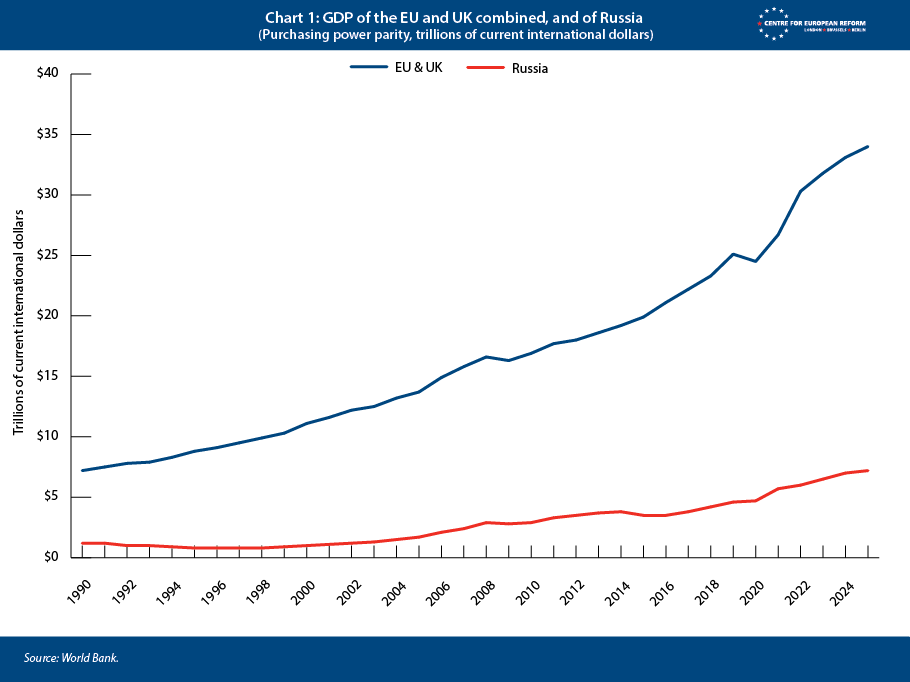
Europe is not powerless, however. In purchasing power parity terms, the combined economies of the EU and UK alone are almost five times as large as that of Russia (Chart 1). Both the EU and the UK have GDP per capita of around $65,000, while Russia’s is less than $50,000. The combined population of the EU-27 and the UK, at more than 520 million, is almost four times that of Russia. European governments may have to make painful choices about how to allocate their human and financial resources, but Russia’s choices will be harder.
Many of the resources needed to implement a comprehensive Russia strategy are already foreseen in current plans (such as defence spending increasing to 3.5 per cent of GDP by 2035, to meet NATO targets – even if Europeans may need to rethink how the money is spent, in the light of Ukraine’s experience). Other spending, such as making infrastructure more resilient, will also be needed in the context of achieving net zero greenhouse gas emissions or adapting to climate change. Some other costs are relatively insignificant: doubling the annual budget of the BBC World Service – £358 million in 2025-26 – would cost the equivalent of less than half of one Patriot missile launcher with a full load of missiles. Imposing sanctions on tankers carrying petrol and diesel could even save Europe money if it resulted in cargoes being diverted to the European market. And the EU and the UK can both revisit the question of seizing immobilised Russian assets and using them for the benefit of Ukraine, thereby reducing the cost to European taxpayers of aiding Ukraine.
Conclusion: Can Europe afford not to implement a Russia strategy?
European leaders reluctant to commit resources to a multi-year strategy for dealing with Russia with no certainty of success should also reckon with the costs of continuing the current approach. There is no indication at all that Putin is becoming less of a threat; on the contrary, the increasing frequency of sabotage and other attacks in Europe is costing European governments and businesses money due to the heightened need for security and repairs, and disrupted operations. The failure to deter Russia from attacking Ukraine has so far forced European governments to spend around €230 billion on military and economic support to Ukraine.55 The cost of years of additional spending to deter Russia from both conventional and shadow warfare against Europe will be high; the cost if deterrence fails and Russia attacks a NATO or EU member-state will be even higher.
The UK and the EU, or even individual member-states, could continue to pursue parallel but separate approaches towards Russia. In the end, it may prove impossible to get 28 or more countries to agree on a unified policy towards Russia. But Europeans have a shared interest in resisting Russia’s expansion, constraining its growing influence in Europe and beyond, and working for change in the Russian system. Agreeing to the outlines of a shared Russia strategy at the next EU-UK summit, whenever that takes place, would be a good place to start.
2: 76 per cent of Europeans believe that Russia’s invasion of Ukraine is a threat to the security of the EU (EU opinion poll ‘Standard Eurobarometer 105 - Spring 2026’, May 2026).
3: Gregory Svirnovskiy, ‘Trump invites Putin to G20 in Miami, Rubio says’, Politico, September 23rd 2026; Anton Troianovski, ‘Trump wants Putin to end the war. He may offer Russia business deals first’, The New York Times, September 18th 2026.
4: Pjotr Sauer, ‘Russia could attack a Nato country within months, Danish intelligence says’, The Guardian, September 24th 2026.
5: See, for example, Brendan Cole and Shane Croucher, ‘NATO at war with Russia, Kremlin says’, Newsweek, September 15th 2025; Gregory Svirnovskiy, ‘Russian foreign minister says Moscow is in a ‘real war’ with NATO, Europe’, Politico, September 25th 2025; Ethan Blackshaw, ‘Putin propagandist vows Russia will ‘wipe UK off face of Earth’ in deranged rant’, Mirror, August 20th 2026.
6: Sahaidachnyi Security Center, ‘The everywhere war: Sub-threshold warfare tracker’, consulted on September 27th 2026.
7: ‘2026 State of the Union address by President von der Leyen’, European Commission, September 16th 2026; ‘Trump only person who can break deadlock – Rutte’, BBC website, December 3rd 2025.
8: ‘The future tasks of the Alliance: Report of the Council (the Harmel Report)’, NATO, December 13th 1967.
9: ‘Common strategy of the European Union of 4 June 1999 on Russia’, Official Journal of the European Communities, June 24th 1999.
10: ‘EU-Russia summit (St-Petersburg, 31 May 2003): Joint statement’, May 31st 2003; ‘Joint Statement on the Partnership for Modernisation: EU-Russia Summit, 31 May-1 June 2010’, June 1st 2010.
11: ‘Outcome of the Council meeting: 3457th Council meeting, Foreign Affairs’, Council of the European Union, March 14th 2016.
12: Hilaire Belloc, ‘Jim, who ran away from his nurse, and was eaten by a lion’, from ‘Cautionary tales for children designed for the admonition of children between the ages of eight and fourteen years’, 1907.
13: Andy Wells, ‘Putin could be overthrown and replaced by someone even more extreme, former UK spy chief warns’, Yahoo News, October 12th 2022.
14: Newsweek editors, ‘Beware the sudden death of Vladimir Putin’, Newsweek, May 6th 2026.
15: Ksenia Kirillova, ’Will Putin’s successor be more flawed, brutal and inept?’, Eurasia Daily Monitor, The Jamestown Foundation, August 17th 2023.
16: Laozi, ‘Dao de jing’ (The book of the way), 4th century BC (?).
17: Fewer people are willing to fight for their country compared to ten years ago’, Gallup International, March 25th 2024; Tor Bukkvoll and Frank Brundtland Steder, ‘War and the willingness to resist and fight in Ukraine’, Problems of Post-Communism, December 5th 2023.
18: David Martin and Talya Vatman, ‘Russian refining sector struggles amid intensifying Ukrainian attacks’, The International Energy Agency, September 17th 2026.
19: Anna Suslova, ‘Putin podpisal ukaz ob ogranichenii dostupa k informatsii v sfere TEKa’ (Putin signed a decree on restricting access to information relating to the fuel and energy sector), Vedomosti, September 29th 2026.
20: Dan Johnson, ‘Russian strikes destroy 12 million books ahead of Ukraine’s first week back at school’, BBC website, August 31st 2026.
21: Vitaly Shevchenko, ‘Ukraine’s prized steel industry left in ruins by Russian missile campaign’, BBC website, September 30th 2026.
22: Andrea Shalal and Jesus Calero, ‘What is the Patriot missile system and why are supplies depleted worldwide?’, Reuters, August 10th 2026.
23: Fabian Hoffmann, ‘Europe’s missile gap: How Russia outcompetes Europe in the conventional missile domain’, Missile Matters, July 26th 2025.
24: ‘Energy system resilience: Lessons learned from Ukraine’, International Energy Agency Secretariat, February 2026.
25: ‘Joint statement from defence ministers of the Joint Expeditionary Force: 02 October 2026’, gov.uk website, October 3rd 2026. The members of the JEF are the UK (framework nation), Denmark, Estonia, Finland, Iceland, Latvia, Lithuania, the Netherlands, Norway and Sweden.
26: ‘Treaty between the United Kingdom of Great Britain and Northern Ireland and the Federal Republic of Germany on friendship and bilateral co-operation’, gov.uk website, July 17th 2025.
27: Henry Foy, ‘Can the EU help to build a ‘hybrid defence’ against Russia?’, Financial Times, September 28th 2026.
28: ‘CEOs from sensitive sectors to receive briefings on Russia threats’, gov.uk website, September 25th 2026.
29: ‘National risk register 2026 edition’, gov.uk website, August 12th 2026.
30: Henry Foy, ‘EU countries consider Nato-style joint responses to Russian hybrid attacks’, Financial Times, September 28th 2026.
31: Matthew Sellers, ‘Lloyd’s lobbies for delay as UK’s ban on insuring Russian LNG tankers approaches’, Insurance Business, September 11th 2026.
32: Mark Hunting and Anisha Sandhu, ‘Trends in Russian sanctions enforcement in Europe and the UK’, Bracewell LLP on JDSupra, September 3rd 2026.
33: ‘PM speech at UNGA: 22 September 2026’, gov.uk website, September 22nd 2026.
34: Article 2 of the Treaty on European Union: “The Union is founded on the values of respect for human dignity, freedom, democracy, equality, the rule of law and respect for human rights, including the rights of persons belonging to minorities. These values are common to the Member States in a society in which pluralism, non-discrimination, tolerance, justice, solidarity and equality between women and men prevail.”
35: Gordon Corera and Jennifer Scott, ‘MI5 warning over ‘Chinese agent’ in Parliament’, BBC website, January 13th 2022.
36: Ian Bond, ‘Ukraine’s EU accession process: Will Kyiv ever be “one of us”?’, CER insight, July 13th 2026.
37: Gabriel Gavin, ‘EU to offer single-market access to candidate countries’, Politico, September 30th 2026.
38: ‘The politics of partnership: How donors manage risk while letting recipients lead their own development’, Oxfam America, 2011.
39: ‘BBC boss warns of Russian and Chinese propaganda’, BBC website, October 14th 2024.
40: Juliana Gragnani and Maria Korenyuk, ‘How Russia is quietly trying to win over the world beyond the West’, BBC website, August 25th 2025.
41: ‘Our statement on USAID funding’, BBC Media Action, February 4th 2025.
42: Rafiq Copeland and others, ‘Crisis in journalism: The impact of the US government funding cuts on global media’, Internews Europe, BBC Media Action and Free Press Unlimited, June 26th 2025.
43: Katherine Pye, ‘Access denied: The EU’s discriminatory visa regime is undermining its reputation in Africa’, CER insight, April 2nd 2025.
44: Maureen Perrie, ‘Alexander II: Emancipation and reform in Russia, 1855-1881’, London, 1989.
45: “Russia’s special position as a unique country-civilization and a vast Eurasian and Euro-Pacific power that brings together the Russian people and other peoples belonging to the cultural and civilizational community of the Russian world”: ‘The concept of the foreign policy of the Russian Federation’, the Ministry of Foreign Affairs of the Russian Federation, March 31st 2023.
46: Luke Wickenden, ‘August 2026 – Monthly analysis of Russian fossil fuel exports and sanctions’, Centre for Research on Energy and Clean Air, September 10th 2026.
47: See, for example, ‘Tsena vtorzheniya: Skol’ko lyudey teryayet Rossiya v voyne s Ukrainoy’ (The price of invasion: How many people Russia is losing in the war with Ukraine), BBC Russian service web page, updated at least monthly.
48: Martin Riedl and others, ‘Reverse-engineering political protest: the Russian Internet Research Agency in the heart of Texas’, Information, Communication and Society, May 27th 2021.
49: ‘Commission Implementing Decision of 6.11.2025 establishing adapted rules on the issuing of multiple-entry visas to Russian nationals residing in the Russian Federation and applying in the Russian Federation for short-stay visas’, European Commission, November 6th 2025.
50: See, for example, the speech by German President Frank Walter Steinmeier at the presentation of the results of a research project on handling of the National Socialist past, Der Bundespräsident website, October 11th 2023.
51: Nathan Rennolds, ‘Russians vote in final day of parliamentary elections’, Euronews, September 20th 2026.
52: ‘State of open data in Russia during the war’, Center for Data and Research on Russia (CEDAR), August 2024; Irakli Barbakadze and others, ‘When statistics lie: Using satellite data to track Russia’s wartime economy’, VoxEU, August 19th 2026.
53: Wolfgang Munchau, ‘Europe’s leaders have failed to grasp their own weakness. That tragically makes Russia stronger’, The Telegraph, February 8th 2026; Nigel Gould-Davies, ‘The coming crisis in Russia’s political economy’, International Institute for Strategic Studies, May 2026.
54: Simon Shuster, ‘Trump’s latest appeal to Russia could outrage even his allies’, The Atlantic, September 29th 2026.
55: Kiel Institut Ukraine Support Tracker, updated August 13th 2026.
Ian Bond is deputy director of the Centre for European Reform.
October 2026
This policy brief is the first of two in the CER/KAS project, ‘Standing up for Europe, standing up to Europe’s adversaries’. The second paper will be ‘A European strategy for economic security’, by Anton Spisak.
Download full publication
View press release