
Fixing the EU's broken Israel-Palestine policy
The EU’s efforts to forge a common approach that promotes peace and human rights in the Israel-Palestine conflict have failed. As the EU rethinks its broader Middle East policy, a new approach cannot wait.
The European Commission will unveil its new EU Middle East Strategy in the second quarter of 2026. The EU should be able to act as a player, not merely a payer, in the region. It is Israel’s largest trading partner and the largest donor to the Palestinian Authority (PA), in theory giving the Union some leverage over both. EU member-states have historical ties to the region, and there are 15 EU delegations and two EU special representatives working there. Given the urgent need for reconstruction funds in Gaza and Syria, EU resources would be welcome in the Middle East.
In practice, however, deep internal divisions and shredded credibility hamper the EU’s engagement. As Israel’s war in Gaza escalated and allegations of Israeli Defence Forces’ (IDF) war crimes proliferated, the EU failed to respond, beyond some criticisms. Current EU policy fails to advance the Union’s interests or its foundational values of peacebuilding and human rights. The new Middle East Strategy should seek to do both.
Background on the EU’s engagement
The EU consensus over the Israeli-Palestinian conflict was established in the Venice Declaration of 1980, adopted by the European Community’s then-nine member-states. Even if the issue remained politically contentious, member-states backed the following principles: the right of Palestinians to self-determination; Israel’s right to security and existence; and an end to Israel’s post-1967 occupation of Palestinian territory and the establishment of illegal settlements. This represented a baseline European consensus for decades.
These principles influence both the EU’s public diplomacy and its trade arrangements with Israel. The EU-Israel Association Agreement facilitated the flow of Israeli goods to the EU (and vice versa). This opened the door to products from Israel’s illegal settlements in the West Bank (which the EU does not recognise) benefitting from preferential trade terms; in effect the EU risked providing financial incentives for settlements. Differentiation clauses, which limit the application of trade preferences to Israel’s pre-1967 borders, have been included in other EU-Israel bilateral agreements to help mitigate this risk.
But member-states differed on how to achieve the Venice Declaration’s vision. In a 2012 UN General Assembly vote on whether to give Palestine observer status, 14 EU member-states voted in favour, one against, and 13 abstained (including Croatia and the UK). Even so, the core principles of the Venice Declaration remained broadly accepted.
The EU’s response since 2023
Since the Hamas terrorist attacks of October 7th 2023, when over 1,400 people were killed and 251 hostages seized, and Israel’s ensuing destruction of Gaza, EU consensus has largely disintegrated. Disarray was soon evident: on October 9th, the European Commission announced it was immediately suspending all aid to Palestinians, only to reverse course hours later.
Divisions between member-states have since grown, with some advocating a tougher line towards Israel. Others, despite being critical of Israel’s disproportionate response, oppose concrete EU action. Some individual EU member-states have increased their pressure on Israel and support for the Palestinians. France teamed up with Saudi Arabia to organise a conference on the two-state solution in New York and led an effort to corral partner countries to recognise Palestine jointly at the UN General Assembly. Since the war began, eight EU member-states have recognised Palestine as a state.
Divisions between member-states have grown since 2023, with some advocating a tougher line towards Israel. Others, despite being critical of Israel’s disproportionate response, oppose concrete EU action.
Co-ordinated EU-level action, however, has not materialised. In October 2025, a blocking minority of member-states including Germany, Italy, and Hungary prevented agreement on a proposal from the European Commission. It would have suspended trade provisions of the EU-Israel Association Agreement, and sanctioned illegal settlers and extremist Israeli ministers. Though it reflected EU leaders’ growing criticism of excessive IDF violence, the proposal was frozen after the ceasefire deal brokered by US President Donald Trump on October 10th 2025. Officially, the Commission proposal remains ‘on the table’.
This is the context for the new EU Middle East Strategy. Overseen by Kaja Kallas, the High Representative for Foreign Affairs and Security Policy, and Mediterranean Commissioner Dubravka Šuica, the Strategy was initially conceived as focusing on ‘the day after the war in Gaza’. It has evolved, however, to address the EU’s role in Lebanon and Syria and in facilitating humanitarian aid to Gaza and Palestinian governance reform. The Strategy will seemingly not address concretely the EU’s role in resolving the Israel-Palestine conflict. But the EU cannot continue skirting this issue.
EU internal divisions undermine its leverage
The EU should have considerable leverage over Israel. Trade-related measures, such as those the Commission proposed, would have a significant political impact. Yet, the EU’s internal disunity on this issue effectively precludes concrete EU action and results in national capitals driving individual policies. A fragmented set of policies guided by individual states is less than the sum of its parts, and is no substitute for a coordinated EU approach.
The EU’s internal divisions are made worse by the fact that the minority blocking EU action have differing motivations. Hungary’s authoritarian government has deep ideological ties to Likud, Israeli Prime Minister Binyamin Netanyahu’s party, and consistently opposes measures against Israel. Germany’s political class has a continuing sense of responsibility for the Holocaust and resists acting against Israel, even though the German population has become increasingly critical of Israel. Germany, which accounts for around 33 per cent of Israeli arms imports, had initially proposed EU arms export controls on Israel, but resumed arms exports in November 2025.
Some opposing member-states are motivated by wanting to stay close to the US. While Italy had signalled it would not oppose EU measures (following widespread domestic protests and an intervention from the Catholic Church), Giorgia Meloni’s government remains generally reluctant to pursue EU action at odds with US policy; it aims to act as a bridge between Europe and the Trump administration. Similarly, the Baltic states want to ensure continued US involvement in their defence, though faced with the humanitarian crisis in Gaza, their opposition to EU measures did soften over 2025. Several states feel that the US-brokered peace plan has removed the need for EU action; they would prefer to fix relations with Israel. Securing a position on the Board of Peace, the multi-government authority responsible for Gaza’s reconstruction and peacekeeping under the Trump plan, is now a key EU priority. Given the risk of an Israeli veto of EU participation on the Board, to some member-states, it seems necessary to minimise disputes with Israel.
A disunified approach guarantees irrelevance. Deterrent measures, such as those set forth by the Commission, only work if the target country believes that the EU might use them if it crosses a red line; the ideal deterrent measure is one that is never used, where the threat of its deployment deters hostile action. The EU’s refusal to apply these measures means Israel can act with impunity.
Moreover, EU disunity has made contingency planning impossible. Member-states have not jointly discussed a common response to possible Israeli annexation of the West Bank, a move that would definitively end any prospect of a two-state solution. When this seemed to be on the cards in October 2025, the US intervened to stop it. Hoping that the US would likewise intervene again is not a meaningful strategy, and there is no guarantee that it would do so in the future. The EU cannot afford to wait to develop contingency plans.
Member-states have not jointly discussed a common response to possible Israeli annexation of the West Bank, a move that would definitively end any prospect of a two-state solution.
The EU’s shredded credibility undermines its regional and global reach
The EU lacks the military or technological assets that Russia, China, or the US have to influence Middle Eastern states. The EU’s regional influence has traditionally been founded on economic ties, blended with a consistency and advocacy of international legal and human rights norms as the basis for a stable Middle East, something that other external actors cannot boast of. Other actors do also face credibility gaps on this issue and others. Yet given how central consistency and credibility are to the EU’s position, inconsistency and lost credibility hurt the EU more than other more transactional powers.
Unfortunately, the inconsistency and double standards which characterise the EU’s current approach have been ruinous for its regional and global influence. Take the discrepancy between its responses to Russia’s invasion of Ukraine and Israel’s war in Gaza. Since February 2022, when Russia launched its full-scale invasion of Ukraine, the EU has imposed 19 sanctions packages on Russia, provided diplomatic and military support to Ukraine, and offered Kyiv the prospect of EU membership. It sought to corral international support for Ukraine and opposition to Russia by invoking international law, particularly the UN Charter. It has firmly (and rightly) condemned Russia’s attacks against civilians and civilian infrastructure as a war crime.
In contrast, the EU has generally only levelled mild criticism at Israel’s military intervention and the human rights violations perpetrated by the IDF. For example, in July 2025, Kallas reportedly declined to endorse any sanctions measures against Israel, even after an EU review found ‘indications’ of Israeli human rights violations. In the immediate aftermath of Hamas’ October 7th terrorist attacks, it was understandable that the EU was reluctant to criticise initial Israeli strikes on Hamas. However, the scale of destruction and civilian casualties in Gaza have been evident since the early days of the war.
All EU member-states are parties to the UN Genocide Convention. Yet when an independent UN commission found that Israel has perpetrated genocidal acts, the EU did not change tack. EU responses to International Criminal Court (ICC) arrest warrants likewise reflect this discrepancy. The EU issued a supportive response of the ICC’s warrants against Russian President Vladimir Putin, but was unable to agree on supporting an ICC warrant against Netanyahu. The discrepancy between responses to Russia and Israel presents the EU as purely interest-led, not values-led.
Likewise, the EU still allows products from illegal Israeli settlements to be imported. It only partially enforces the differentiation rules to prevent products from illegal settlements benefitting from Israel’s preferential trade arrangements. In its tracker of EU trade differentiation clauses, the European Council on Foreign Relations notes gaps in enforcing differentiation. This falls well short of the ban on all imports from Crimea and Sevastopol, instituted after Russia’s illegal annexation in 2014.
The credibility problem weakens the EU’s leverage with Palestinians. The EU is right to promote good governance and respect for human rights in the PA by imposing conditionality on the disbursement of funds. When the EU prods the PA on these issues, however, they seem insincere to Palestinians, who view the EU as having condoned atrocities in Gaza. If the EU is perceived as applying pressure to Palestinians while allowing Israel to operate with impunity, its influence over Palestinian governance will diminish.
The EU is right to promote good governance and respect for human rights in the PA by imposing conditionality on the disbursement of funds.
The appearance of double standards hurts the EU’s international influence more generally. When the EU overlooks breaches of international law by Israel, it makes it harder for the EU to invoke international law elsewhere. If the EU is seen as a transactional power like Russia, China, or the US, but without their hard-power instruments, it will struggle to pursue its objectives in Ukraine or elsewhere through partnerships with countries outside Europe.
What the EU’s Middle East Strategy should aim to do
An ideal strategy would identify the EU’s objectives clearly and set out the necessary steps to achieve them. Vague commitments to a two-state solution at some unspecified date will not suffice; the EU must prioritise concrete action. Plans for the EU to deepen its engagement in Lebanon and Syria are welcome, but cannot be a substitute for action on the Israel-Palestine conflict.
Signalling support for Trump’s peace plan is understandable, but the EU should not pin all hopes on its success, not least given the shakiness of the ceasefire. While membership of the plan’s Board of Peace might give the EU some say in the Board’s priorities and the Gaza reconstruction operation, pursuing membership should not be prioritised over concrete action now. The Board’s structure and objectives remain vague. Palestinians are unlikely to regard as legitimate a Board that excludes them from their own governance and offers no clear plan for transition to Palestinian leadership. There is no guarantee that Israel or the US would accept EU membership of the Board, even if the EU dropped the Commission’s proposal to suspend the trade measures of the Association Agreement. Therefore, the EU should not prioritise a seat on the Board of Peace over taking otherwise justified measures against Israel.
Signalling support for Trump’s peace plan is understandable, but the EU should not pin all hopes on its success, not least given the shakiness of the ceasefire.
In its work programme for 2026, the European Commission noted that ‘providing support for the governance and reform of the Palestinian Authority’ would be a priority under the Middle East strategy. This is also welcome, as the financial and logistical support provided to the PA should allow the EU to influence its direction.
But there are two important caveats. First, the EU must be seen to apply pressure on both the PA and Israel. The EU should press Israel to release Palestinian tax revenues, which Israel continues to withhold and without which there are limits to what the PA can achieve. Second, the EU must set out clear and targeted conditions for the PA. The main priorities should be promoting the PA’s transparency, its accountability to Palestinians, and pressing the PA to end its targeting of political opponents. The EU should invest more in leadership development initiatives, to encourage the emergence of a new generation of leaders for a peaceful Palestinian state, to succeed the PA’s now 90 year-old president, Mahmoud Abbas.
Improved communication and co-ordination are crucial. EU rhetoric should be targeted: focusing on Israeli breaches of the peace plan and on promoting PA governance reform. The EU should stress to the US that in focusing on these priorities, the EU aims to complement US peace efforts, not diverge. On co-ordination, the EU should deepen consultation and co-ordination with Arab states. Trump places particular value on the alliance with Saudi Arabia, which the US designated as a major non-NATO ally in November. The EU already has dialogues with both the Gulf Cooperation Council and the League of Arab States: both have held high-level meetings with the EU since October 2025. Though the Arab states and the EU may disagree on issues such as the direction of governance reform in Palestine and in Syria, both sides share interests in regional stability and prosperity.
Conclusion
The EU failure to forge a comprehensive stance on the Israel-Palestine conflict undermines both the Union’s normative goals of promoting peace, prosperity, and human dignity, and its foreign policy interests. It might therefore seem preferable for the EU to adopt a diluted Middle East Strategy, focusing on topics like supporting the economic recovery in Syria, on which there is consensus, and avoiding those like Israel-Palestine, on which there is not. But this would leave member-states or groups of member-states to pursue contradictory national policies, with only vague EU-level support for an eventual two-state solution.
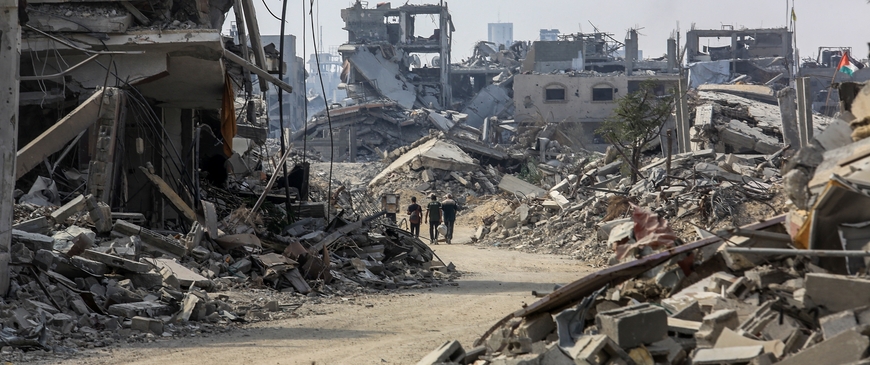
Such an approach would be a grave misstep. The EU should use its leverage over Israel to uphold the international legal order upon which the EU itself depends. Years of inaction have resulted in Gaza’s destruction, leaving the EU’s regional reputation in ruins. Its ability to corral partners has been severely weakened, presenting long-term problems for the EU’s global reach.
The EU should use its leverage over Israel to uphold the international legal order upon which the EU itself depends. Years of inaction have resulted in Gaza’s destruction, leaving the EU’s regional reputation in ruins.
The costs of further inaction should be abundantly clear. Should the Israeli government pursue its preferred approach of annexing Palestinian lands and making a two-state solution impossible, with tacit or explicit support from the US, the destabilising effects for the region and the EU would be unavoidable. The costs would fall not just on the Palestinian people, though they would certainly suffer the most. The renewed outflow of Palestinian refugees would increase burdens on unstable countries in the region. The effects would also be felt in Europe, whether in a further migration wave or in greater domestic backlash to the EU’s inaction, further dividing European societies. If the EU wants to maintain even the vague principles it has held to since 1980, let alone secure a more meaningful regional role, a unified policy is urgently needed, with the enforcement of respect for international norms at its centre.
Thomas Maddock is the Clara Marina O’Donnell fellow (2025-2026) at the Centre for European Reform.
Add new comment