
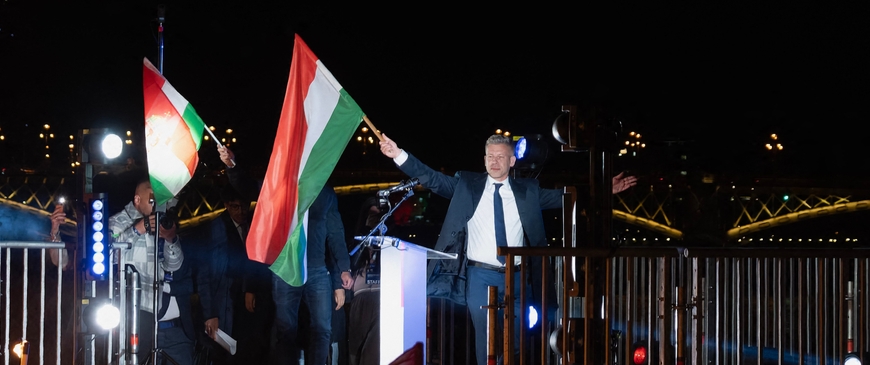
Magyar is up against the clock in Hungary
Brussels and Budapest have a rare and fleeting chance to improve Europe’s defence and correct the bloc’s dysfunction.
Viktor Orbán is out. After 16 years, Hungary’s voters have ended his stranglehold on power and with that, his predatory “System of National Cooperation”. Péter Magyar and his Tisza party have achieved what seemed close to impossible: wiping out an entrenched “electoral autocracy” on a playing field that had been designed to prevent exactly that.
Orban’s regime, sustained by a mix of targeted threats, economic dependencies, information warfare and, also, genuine popularity, is finally on the way out.
But Hungary’s new government has a steep hill to climb. It cannot undo 16 years of damage fast, nor can it do it completely alone. It will need the EU — or more precisely, EU funds — to get the national engine rolling again.
The EU will, likewise, need Hungary. Orbán’s departure presents a unique opportunity for Brussels to make progress on issues that Hungary has blocked or slow-walked for years, from supporting Ukraine to sanctioning Russia and EU enlargement.
This mutual dependency can create mutual benefits — but only if neither side loses sight of the rule of law.
Magyar is taking control of a country that has been systematically ransacked. Orbán has captured institutions — from the judiciary to the media — and put them in service of his own partisan agenda. He has threatened critics with jail terms, undermined civil liberties and weaponised anti-LGBT+ laws and rhetoric while eroding protections for marginalised groups.
Additionally, Hungary has wasted 16 years during which the rest of central Europe benefited from exceptional growth and prosperity — and Orbán opted to line the pockets of allies at the expense of the public purse.
Magyar is inheriting a state where public services — from healthcare to education — are reeling from years of under-investment, the budget deficit in March registered at above 80 per cent of its annual target, and the investment climate is poisoned by corruption and a lack of legal certainty.
The frozen €17bn in EU funds, which were suspended over rule of law concerns, can give the new government much-needed breathing room in tackling these challenges. Moreover, Hungary is the only country that hasn’t had its plan approved for Safe, the EU’s defence-focused loan.
With an additional €16bn available for defence, that’s a total of €33bn up for grabs over the next few years, an amount equal to roughly 17 per cent of Hungary’s GDP.
Almost €10bn, part of the recovery and resilience facility, will expire at the end of August, and a further €7bn from Hungary’s cohesion funds is frozen under the so-called conditionality mechanism, of which more than €1bn will be lost at year’s end. This leaves Magyar with limited time to form a government, complete the required anti-corruption reforms and revoke laws that violate rights and freedoms.
But it is not just Magyar who is up against the clock. For the EU, a more pragmatic Hungarian government presents a rare, time-limited chance to improve both Europe’s long-term security and the EU’s long-term functioning.
It is an opportunity for the EU to finally get the promised €90bn to Ukraine, to agree on a new seven-year budget that is ambitious and fit for the challenge, to make progress on enlargement and to perhaps move away from the requirement of unanimity in foreign policy.
Political courage and room for manoeuvre will decline the closer we get to the 2027 election season, starting with France — where the far-right Rassemblement National is still in the lead — and continuing with Italy, Poland, Spain and six other EU countries. The rest of the year will show whether Europe can be united now that its biggest internal political obstacle has gone.
Despite the urgency of the situation, Brussels shouldn’t just release the suspended funds. The European Commission should monitor Hungary and make sure that any steps the new government takes improve, rather than abuse, the rule of law.
As we have seen with Poland, restoring democracy takes time. While Magyar secured a resounding supermajority — allowing him to change any law, including Hungary’s constitution, in any way he wants — such a mandate comes with huge responsibilities. Money should flow only if the rule-of-law milestones are met and cleared by the new government.
A Hungarian government that respects the rule of law and can deliver on its promises is a win-win. To the extent that Brussels can, it should help Hungary do both.