
The EU is trying to speak the language of power in Africa, but what is it saying?
Africa is currently the continent with the largest number of armed conflicts in the world – over 50 – representing 40 per cent of all wars globally. This is a 45 per cent increase since 2020.
It is the epicentre of violence from armed Islamist groups, with six of the ten countries most affected by terrorism located in Africa. Regimes in Africa are increasingly militarised, but this militarisation exacerbates conflicts rather than ending them. The EU’s current approach to conflict, which increasingly involves supporting efforts to achieve peace through military force, risks making things worse in Africa, not better. To support African countries in their efforts to stabilise, the EU should instead focus on disrupting war economies that incentivise further violence.
The EU’s current approach to conflict, which increasingly involves supporting efforts to achieve peace through military force, risks making things worse in Africa.
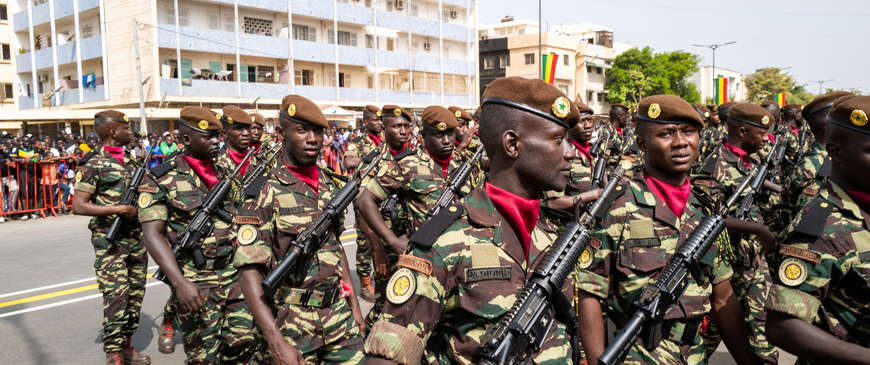
Many African countries fighting insurgencies are pushing for as much foreign security assistance as possible, and certainly, the reality of escalating conflict paints a bleak picture. Through the European Peace Facility (EPF), the EU has attempted to respond by stepping up its defence exports, including – for the first time in the EU’s history – lethal equipment and munitions, as well as non-lethal equipment such as vehicles, communications, and intelligence, surveillance and reconnaissance (ISR) equipment.
The EPF five years on
The EU has long been involved in managing African conflicts through its Common Security and Defence Policy (CSDP) missions, the vast majority of which have been in Africa, as well as security-focused development programmes, humanitarian aid and diplomatic and mediation support. In the past, the Athena mechanism and the African Peace Facility (APF) were the main mechanisms to fund EU security assistance in Africa. The Athena mechanism paid for CSDP military missions and operations, logistics, buildings and non-lethal equipment. The APF supported African-led military operations, such as the Multinational Joint Task Force (MNJTF) against Boko Haram in West Africa and the AU Mission to Somalia (AMISOM) and was financed through Commission-run development funding.
The EPF was created in 2021 to replace both instruments: it can be used to build military or defence capacities through training or equipment, and to support the existing African-led military operations mentioned above. It was pushed by member-states such as France and Germany and the former High Representative for Foreign and Security Policy Federica Mogherini before she left office as a fund that would help the EU achieve its strategic goals of acting promptly and coherently to build peace and stability.
Because it relates to “operations having military or defence implications” and the procurement of arms and ammunition, the Treaty on European Union and the EU’s main regulation on development assistance prohibit using the regular EU budget to finance the EPF. Instead, the EPF is a special off-budget fund, financed through contributions by member-states every year. Member-states must decide unanimously in the Council of the EU to fund military assistance through the EPF – although states are permitted to refrain from voting (through a procedure called constructive abstention) or opt out of contributing to an agreed measure.
The EPF became central to the EU’s response to Russia’s full-scale invasion of Ukraine: In 2021, the EPF’s budget was set at €5 billion, but this figure has since risen to €17 billion with over €11 billion going to the Ukraine war effort. Though the EPF’s first phase will expire in 2027, the EPF’s centrality to the EU’s assistance to Ukraine means that it will almost certainly be renewed. However, the EPF was originally planned with Africa in mind, to address perceived deficiencies of the APF. In his first visit to the African Union in 2020, then-High Representative Josep Borrell argued, “When a truck arrives to a village and they start killing everybody with a machine gun, you will not stop them by just preaching”. The idea was that through equipping and arming partner countries as well as training them, the EU would become a more effective and well-regarded conflict manager.
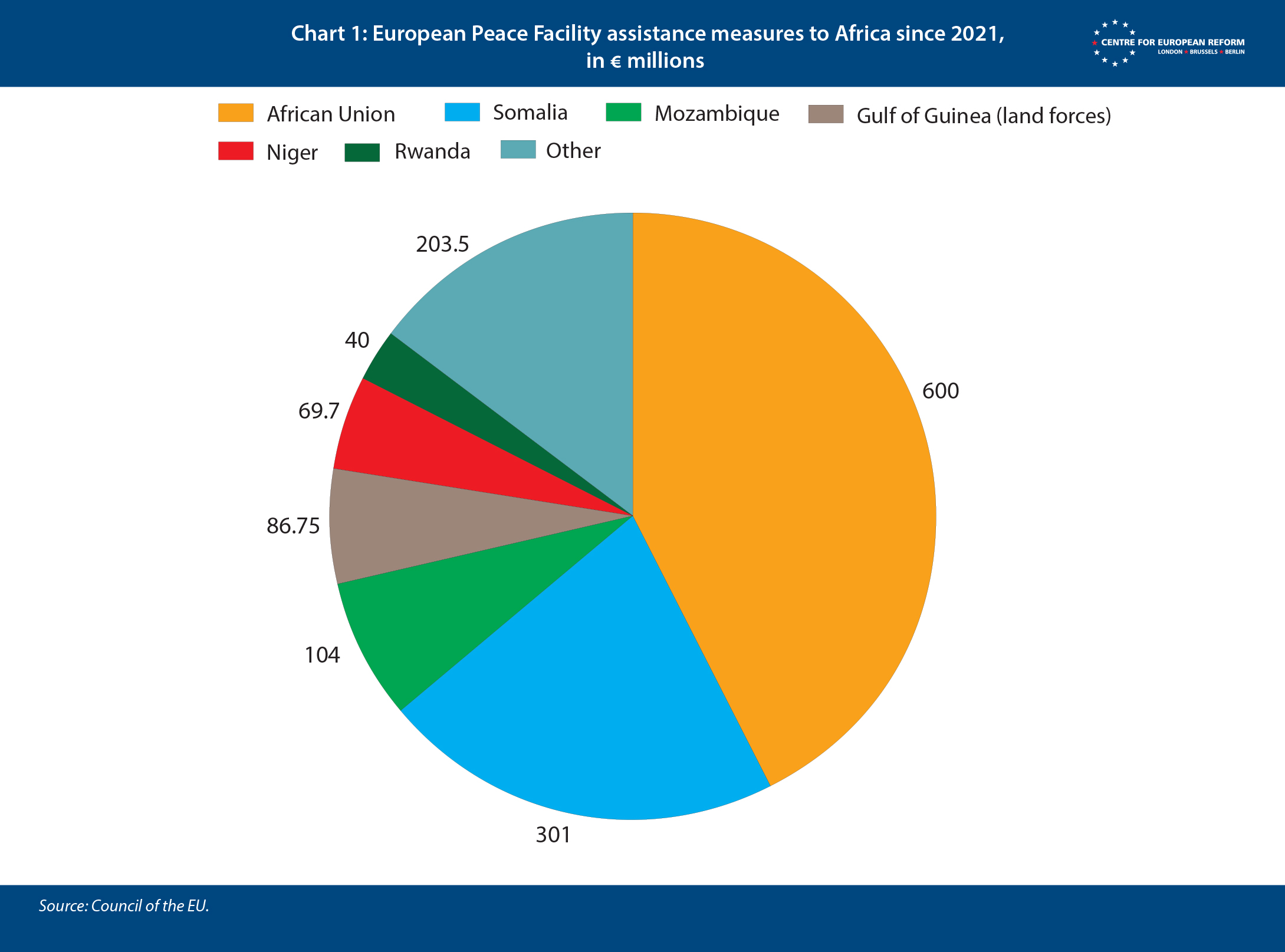
As shown in Chart 1, the EPF has funded a variety of programmes across Africa since 2021. So far, shipments of weapons to Africa under the EPF have been limited to Somalia, Niger (pre-2023 coup) and Benin: the bulk of EU assistance measures have been purchases of critical strategic enablers for African militaries, such as ISR capabilities, technology to counter improvised explosive devices, transport and logistics. Among many other measures, the EPF has provided €340 million for the African Union Mission in Somalia (AMISOM) and its successor, the African Union Transition Mission in Somalia (ATMIS); €50 million for the Ghanaian armed forces; and €130 million for the Multinational Joint Task Force (MNJTF) countering Boko Haram. These numbers might seem small compared to the €11.1 billion already spent on or earmarked for weapons, equipment and training for Ukraine, but they can have a massive impact. For example, the €35 million the EU gave to the Beninese Armed Forces in 2024 was the equivalent of 27 per cent of the country’s overall defence budget that year.
Security assistance as geopolitics?
A major motivation for the EU’s increased focus on equipment exports is the desire to become more competitive as a conflict manager, as geostrategic rivals deepen their commitments to training and equipping African countries. Since the Wagner Group – a Russian private military company – first engaged in Libya and the Central African Republic (CAR) in 2017-18, Russia has expanded its security assistance to Mali, Niger and Burkina Faso. Russia increased its presence following coups in these countries and the ejection of Operation Barkhane, the French counter-terrorism intervention which had been active in the region since 2014 but was forced to withdraw in 2022. The Wagner Group has since been largely absorbed into a more official Africa Corps managed by the Russian Ministry of Defence and has become deeply involved in the daily conduct of counterinsurgency in the Sahel, accompanying soldiers on operations, providing combat training and protecting the leaders in Burkina Faso, Niger and the CAR. Rosoboronexport, Russia’s state arms company, meanwhile, reported $4 billion in arms contracts with 46 African countries.
China has in recent years become the largest arms supplier to sub-Saharan Africa, supplying affordable weapons without conditions, and Türkiye has also invested in defence exports and security assistance to Africa, becoming Africa’s leading supplier of drones. It has signed military co-operation agreements and training programmes with 30 African countries. Türkiye has deepened its ties to Somalia, where it trains elite units in the Somali National Army and has sold Bayraktar TB2 drones and other weapons for counter-terrorism. It started these supplies long before the UN arms embargo to Somalia was lifted in 2023. Gulf States such as the UAE have also been increasingly active in the military sphere, signing co-operation agreements with countries such as Mali, Somalia, Mauritania, Chad and Mozambique, and providing armoured vehicles and helicopters to Kenya, Uganda and the Democratic Republic of Congo (DRC).
The EU’s assistance is nowhere close to competing with Russia or Türkiye’s weapons exports (even when taking more active French arms companies into account), and it would be inadvisable to try to match these countries. Data from SIPRI shows that China is the largest supplier of arms to sub-Saharan Africa (23 per cent) followed by Russia (12 per cent) and Türkiye (11 per cent). France supplies 8 per cent of weapons to Africa as a whole, but most of this relates to sales to Egypt. Other EU member states are negligible players, with Germany accounting for 0.4 per cent of sub-Saharan Africa’s imports 2019-2023.
Exporting hard power undermines stability
Whatever the EU’s motives, exporting weapons and munitions contributes to growing militarisation on the continent, which feeds conflict and instability, undermining key EU priorities such as increasing trade and reducing migration. In the Sahel, the situation is worse than ever. There have been 11 coups in Africa since 2020, which have installed military regimes. Juntas employ scorched earth counterinsurgency tactics, use militias, and focus on killing the maximum number of insurgents on the battlefield. This ‘military-first’ approach has not led to ending conflicts or sparing lives – if anything, it begins a perpetual cycle of violence. There is strong evidence that Russian mercenaries participated in the extrajudicial killings of between 300 and 500 civilians in Moura, Mali. The killing of civilians, which has worsened under military rule, does not weaken insurgent groups, but emboldens them. UN-commissioned research has consistently found that popular grievances against the state increase, which drives recruitment into armed groups. The al-Qaeda linked armed group Jama’at Nusrat al-Islam wal-Muslimin in Mali has enjoyed extraordinary growth and was strong enough to blockade the capital Bamako of fuel and recently make an unprecedented co-ordinated attack across a number of cities.
Exporting weapons and munitions to Africa feeds conflict and instability, undermining key EU priorities such as increasing trade and reducing migration.
While many of the EU’s closest partners are technically democracies, these states with elected governments have also become more militarised. For example, Benin, one of the EU’s key partners in West Africa after Europe’s ejection from Mali and Niger, has chosen to address the threat from armed groups in its northern regions with a military-first approach through Operation Mirador. In Mozambique, hundreds of protestors were killed by security forces following a 2024 election that faced widespread accusations of vote rigging; but the EU’s military assistance continued as normal. The EU used the EPF to supply equipment to the DRC armed forces in 2025, but that has done little or nothing to bring the country closer to peace. The government has continued to use militias to fight rebel groups, further fuelling the conflict in Eastern DRC.
EPF assistance is causing further headaches by undermining longstanding EU efforts to promote peace and stability in the Great Lakes region. The EU is sending military equipment to Rwanda to support its assistance to the Mozambican military in Cabo Delgado, where there is an anti-government insurgency led by armed Islamist groups. Yet the Rwandan Armed Forces are also unilaterally deployed in eastern DRC, supporting M23 rebels, who have massively escalated the conflict and have carried out significant human rights violations. Rwanda has been accused of undermining the mediation processes underway in the region, which the EU and its member-states have long supported. Belgium constructively abstained on a Council decision last year to provide a second tranche of assistance to Rwanda, citing Rwandan support for M23.
Injecting more weapons and military equipment into an armed conflict carries a high risk that this material will end up in the wrong hands. Research found that the key lifeline for the armed Islamist groups in the Sahel was no longer the illicit trafficking of arms from other countries, which was declining in relative terms, but rather came from attacking poorly controlled government stockpiles and looting military barracks. It is a similar story in Mozambique, where research has demonstrated that the bulk of weaponry for the Islamic State in Cabo Delgado came from state security forces. In the DRC it is not uncommon for militias to even loot munitions from storage buildings in wildlife parks. Somalia has lost a significant amount of weaponry to the illicit criminal market through theft and corruption. The more weapons end up in circulation, the more difficult it is to demobilise and disarm combatants and to bring actors to the negotiating table.
The EEAS carries out risk assessments of these dangers before an assistance measure is launched, but there is no easy way to prevent this problem. Similarly, there is no straightforward way to prevent human rights violations in the armed forces the EU supports (despite their highly damaging effects) and little to no evidence that foreign-led human rights training changes behaviour. The objective of the EPF – and security assistance in general – is to help partner countries get out of insecurity and violence, yet it is in these very contexts that assistance is most likely to be misused or end up with unauthorised users.
War economies prevent peace
The grim realities of ongoing, and in many cases escalating, conflicts across sub-Saharan Africa as well as geopolitical competition have put the EU under pressure to turn to hard power. But fuelling war economies in the subcontinent only perpetuates the cycle of conflict. The leaders of several of the EU’s partner governments in Africa, including Mozambique and Somalia, pay lip service to the need for dialogue and negotiations with armed groups, but the more foreign military equipment that flows in, the easier it is to postpone coming to the table. Research has found that protracted conflicts continue when violence is profitable, which means that stabilisation occurs not through a victory on the battlefield, but reshaping the incentive structures of elites, interrupting the funding streams that fuel war economies.
Increasing shipments of EU military equipment to the continent directly undermines the aims of the African Union’s ‘silencing the guns’ initiative.
Increasing shipments of military equipment to the continent directly undermines the aims of the African Union’s ‘silencing the guns’ initiative, which promotes disarmament, demobilisation and reintegration (DDR) and an end to illicit arms flows. Next year, the Council will decide on whether and how to keep up its military assistance, either by continuing the EPF or creating another mechanism. This should be an opportunity to recommit to the African Union’s goals and use the EPF to invest in arms control and DDR programmes.
The EPF’s accountability mechanisms also need reform. The EU should strengthen its impact assessments and publicise at least its top level criteria for the risk assessments it completes before providing military equipment. There are currently insufficient mechanisms for protection and accountability in the event that the EU’s equipment is used for human rights violations or ends up in the wrong hands. Since the EPF is an off-budget mechanism, the European Parliament and Court of Justice of the EU do not provide oversight.
While Russia and Türkiye become entangled in ineffective military-first interventions, there is a gap for the EU to disrupt war economies and offer trade partnerships.
In the current geopolitical environment, the EU should resist the temptation to try to compete with the military offer of its geostrategic rivals – their approach will fail to stabilise conflict, and the EU will never be as values-free as them. While Russia and Türkiye become entangled in ineffective military-first interventions, and the Trump administration recently signalled its willingness to resume military assistance to juntas in the Sahel, there is a gap for the EU to offer something different that would serve its strategic interests better: disrupting war economies and offering trade partnerships.
Katherine Pye is a non-resident associate fellow at the Centre for European Reform.
Related content
Access denied: The EU's discriminatory visa regime is undermining its reputation in Africa
Add new comment