


Research

The China Shock 2.0 could destroy Europe as we know it
03 June 2026
The Telegraph
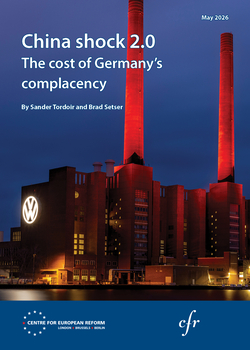
“China Shock 2.0: the cost of Germany’s complacency” is the title of a new report by Sander Tordoir and Brad Setser for the Centre for European Reform. They said Germany was in the eye of the storm. Its core industries are being squeezed out of the Chinese market, third countries, and its own home market, all at the same time.“Much of the demand generated by Germany’s fiscal expansion could leak straight into Chinese imports and throttle Germany’s recovery,” they said.
Comment l’Allemagne a désindustrialisé l’Europe
02 June 2026
Europe Infos
Le Centre for European Reform reprend une image qui colle à cette situation, un Phantomschmerz, cette douleur de membre fantôme décrite par Sander Tordoir et Brad Setser. La douleur se ressent là où quelque chose de vital a déjà été perdu. Appliquée à l’industrie, l’idée est parlante, on continue d’organiser des politiques comme si la puissance industrielle était intacte, mais les capacités, les emplois, les sites, ont déjà reculé, et le système ressent le manque quand il faut réagir vite.
China is having Germany for dinner and that’s a problem for the world
01 June 2026
The Times
A new report from the Centre for European Reform lays bare how far China has gone in eating Germany’s lunch and eyeing up its dinner. Last year was the first this century where German firms imported more capital goods (components used in production processes) from China than it exported to China.

CER podcast: Unpacking Europe: The path to EU enlargement
01 June 2026
Zselyke Csaky spoke with Milan Nic about where EU enlargement is headed.
EU’s dealmaking machine grinds steadily on
01 June 2026
Financial Times
This Centre for European Reform paper, a campaign manual for trade warriors, has also got a lot of attention.
Why Germany's China policy is dividing Europe and weakening its own economy
01 June 2026
TRT World
The latest report from the Centre for European Reform (CER) analytically outlines the implications of the so-called ‘China Shock 2.0’: the Asian giant’s economic model does not operate in accordance with the rules of the ordoliberal EU single market.
The EU’s new economic security tools and China’s countermeasure calculus
01 June 2026
The Diplomat
A paper by the Centre for European Reform argued that Germany faces a “China shock 2.0” as Chinese mass production and import substitution pressure German firms in China, Europe, and third markets. It cited China’s export volumes rising over 40 percent since the pandemic, a manufacturing surplus of about $2 trillion, and potential risks to 400,000-plus German jobs tied to exports to China.
OECD says 60% of Chinese gains in market share driven by subsidies
01 June 2026
The Wall Street Journal
“French diplomats have put China’s imbalanced growth model at the top of the agenda and called for the EU to more strongly defend its home market,” economists at the Centre for European Reform wrote in a report released last month. “Germany remains hesitant, even as China has already eaten much of German industry’s lunch and is preparing to start on dinner.”
As EU mulls economic tools, China vows to take steps against any new trade restrictions
31 May 2026
South China Morning Post
According to a report in late May by the London-based think tank Centre for European Reform, a European 301-type instrument would allow Brussels to counter distortions outside traditional trade defences, such as the yuan’s undervaluation, and flexibly target vulnerable sectors, including cars, chemicals and clean energy.
Industrie européenne : "La pression chinoise s'exerce sur trois fronts, c'est sans précédent !"
30 May 2026
L'Express
Le choc de compétitivité imposé par la Chine n’obéit pas aux règles habituelles. Pour résister, le Vieux Continent doit faire beaucoup plus, prévient l'économiste Sander Tordoir.
Von der Leyen gears up for fight over China trade ties
29 May 2026
Politico
The question that Germany now faces is whether it is willing to join forces with France and other countries, and the Commission, “to defend the European home market from the flood of Chinese goods that is coming our way,” said Sander Tordoir, chief economist at the Centre for European Reform.
EU wants 'robust' defence against China trade imbalance
29 May 2026
France 24
"The main thing is Europe has an arsenal of trade instruments at its disposal already. What's missing is a lack of political will to deploy them," said Sander Tordoir, chief economist at the Centre for European Reform (CER) think-tank.
EU wil breder invoerheffingen gaan inzetten tegen China
28 May 2026
NRC Handelsblad
Recente denktankrapporten laten zien hoe de dikwijls door de staat gesubsidieerde Chinese exportmachine de Europese industriële basis ondermijnt, terwijl het land tegelijkertijd steeds meer de eigen markten afschermt voor Europese bedrijven. Vooral exportland Duitsland ondervindt de „China-schok 2.0” aan den lijve, schreven economen Sander Tordoir en Brad Setser onlangs.
„China führt einen industrie-politischen Krieg – und Europa hat nicht reagiert“
28 May 2026
Automonilwoche
Brad Setser ist Co-Autor der vielbeachteten Studie „China-Schock 2.0″. Ein Gespräch über die strategische Falle der Autoindustrie und Zölle, die China wirklich wehtun würden.Kurz vor der Reise von Wirtschaftsministerin Katherina Reiche (CDU) nach China (27./28. Mai) schlägt eine Studie des Thinktanks Center for European Reform (CER) hohe Wellen. Der Titel: „China-Schock 2.0 – die Kosten der Selbstzufriedenheit Deutschlands“. Darin argumentieren die Ökonomen Sander Tordoir und Brad Setser, Deutschland unterschätze das Ausmaß der Bedrohung Chinas für die hiesige Industrie.
La Cina divora la Germania. E Berlino non sa che fare
28 May 2026
Huffington Post
Ma uno studio del Centre for European Reform firmato da Brad Setser e Sander Tordoir dal titolo "China shock 2.0: The cost of Germany's complacency" evidenzia come la Germania sia la prima a non saper diagnosticare le cause del suo male. Per fare un esempio, sembra un paziente che ha subìto un'amputazione e si senta affetto dalla sindrome dell'arto fantasma. Un dolore (economico) persistente per qualcosa che non c'è più.
Reiche lobt und gratuliert – trotzdem droht ein neuer China-Schock für Deutschland
28 May 2026
Die Welt
Die Abhängigkeiten in der Chipindustrie und bei Seltenen Erden sind für Setser und Tordoir mahnende Beispiele. „Die Lehre ist, dass es weit billiger ist, die Kapazitäten der eigenen Industrie zu verteidigen als zu versuchen, sie später aus der Asche wieder neu aufzubauen.“
Why Europe must embrace tariffs
28 May 2026
Financial Times
In a recent paper, Sander Tordoir and Brad Setser point out that Chinese export outperformance has been matched by Euro area underperformance. In industries where China’s export market share has risen over the past few years, German output has been particularly weak.
Hier ist immer alles groß. Anders als zuhause
28 May 2026
Die Zeit
Dabei wächst die Kluft Deutschlands zu seinem wichtigsten Handelspartner China Tag für Tag. Die beiden Ökonomen Sander Tordoir und Bret Setser haben kurz vor Reiches Reise die Studie China Schock 2.0, die Kosten der deutschen Behäbigkeit veröffentlicht.
The costs of German complacency: a disjointed Europe, and Spain on China’s radar
28 May 2026
Agenda Publica
According to a recent report from the Centre for European Reform think-tank, Germany’s economic paralysis is no temporary slump but a structural crisis in the path of China’s commercial steamroller. While Berlin has misdiagnosed itself, obsessed with energy prices and bureaucracy, 'China Shock 2.0' has been demolishing its external competitiveness.
Por qué Europa debe adoptar los aranceles
28 May 2026
Expansion
En un reciente estudio, Sander Tordoir y Brad Setser señalan que el extraordinario rendimiento exportador de China ha ido a la par del bajo rendimiento de la eurozona. En los sectores donde la cuota de mercado de exportación china ha aumentado en los últimos años, la producción alemana ha sido particularmente débil. Las importaciones totales de China apenas han crecido en los últimos cinco años y, desde mediados de 2025, ha estado vendiendo más bienes de capital a Alemania de los que ha comprado.