
Europe’s future: Grounds for hope? - Annual report 2025
The CER's annual report features an essay which analyses the many problems the EU faces, but concludes that it is not doomed. The report also highlights the CER’s most important events and publications in 2025.
Europe’s future: Grounds for hope?
The last time I visited Russia, in May 2019, I heard people close to the Kremlin talk about ‘two Wests’: the liberal West that focused on international law, human rights, multiculturalism and multilateralism, and the realist West that emphasised Judeo-Christian civilisation, ethnic homogeneity, family values and diplomacy led by great powers. My interlocutors had no doubt as to which version of the West was on the rise.
Afterwards I wrote a piece – for the New Statesman – about what I had picked up in Moscow. “Much of the Kremlin’s self-confidence stems from the belief that the Western world is changing in ways that suit Russia. Trump [then in his first term as US president] is seen to represent a long-term trend in the US rather than a short-term blip: Russian analysts reckon that the US will be less focused on intervening around the world to uphold a rules-based, US-led order, and that it will be more nationalist, mercantilist and interest-focused. So in the long run the US and Russia should be able to accommodate each other.”
The Russians I spoke to also thought that Europe was undergoing a similar transformation. “The successes of Viktor Orbán, Marine Le Pen, Nigel Farage and Matteo Salvini herald a new Europe that, like Russia, will seek to sustain family values and Christianity, while confronting Islamic extremism. Chastened by its foolish support for democracy in places like Libya and Syria, this Europe will not fuss much over human rights. Russians note that Trump and Putin share an illiberal world view that values the pursuit of national interest and disdains multilateralism.”
I also reported on the warmth of the Moscow-Beijing relationship. “Putin’s friendship with Xi Jinping, and the fact that Russia and China are probably closer than at any previous time in their history, reinforces the self-confidence in Moscow.”
Since then, Russia has launched a full-scale invasion of Ukraine (in February 2022) and Trump has returned to the White House (in January 2025). I was reminded of that trip to Moscow when the White House published its National Security Strategy (NSS) in December 2025. Much of the Russians’ analysis in 2019 was reflected in the NSS; no wonder the Kremlin welcomed its publication.
The NSS does not see Russia as a threat to Europe. But it does chastise the EU for “undermin[ing] political liberty and sovereignty… creating strife, censorship of free speech and suppression of political opposition.” It says ending the war in Ukraine is important but does not criticise Russia for starting the war. It implies the Europeans are guilty of prolonging the war by aiding Ukraine.
The NSS – echoing Russian analysts – states that Europe faces “civilisational erasure” due to low birthrates, excessive immigration and loss of national identity. It highlights a perceived risk of European countries becoming majority non-European, by which it presumably means non-white. It expresses support for the far-right parties in Europe which claim the EU is eroding political freedom and sovereignty. Regarding transatlantic relations – including the NATO military alliance – as transactional, the NSS says nothing about the shared values which many Europeans believe bind the Western allies together.
Since the Centre for European Reform opened its first office in 1998 – at the high point of globalisation – Europe has faced a series of massive challenges: Islamic terrorism, long-running wars in Afghanistan and Iraq, the financial crisis, the eurozone crisis, a surge of immigrants in 2014-16, Covid, the Ukraine war and its impact on energy prices. But the combination of threats that the EU faces in 2026 is the most serious in its history. Five of the most important are tangled up together:
- Europe’s relative economic decline weakens its global standing and ability to pay for strong defence.
- The growing success of far-right parties in Europe undermines the legitimacy, strength and credibility of the EU.
- Russia is a real military threat, at least to the countries of Central and Eastern Europe.
- China’s new economic model, focused largely on export growth, threatens swathes of European industry.
- The US can no longer be relied upon to guarantee Europe’s security.
This essay examines these threats, but concludes with some reasons why Europe’s future may not be entirely dark.
It’s the economy, stupid
Economics lie at the root of the EU’s difficulties. If the economy was more vibrant and successful, other countries and blocs would have more respect for the EU. For example, China would not regard the EU with disdain, as a declining power. Europeans would have more money to spend on military capabilities. And European voters would be less likely to fall for the siren songs of far-right politicians.
The problems are well-known, and were summed up in reports in 2024 by Enrico Letta and Mario Draghi, two former Italian prime ministers. The EU’s share of global GDP has shrunk this century from 21-22 per cent to 14-15 per cent (on a purchasing power parity basis, which means corrected for price differences). Living standards have hardly risen in 20 years in many West European countries. Productivity growth has tailed off.
The single market remains incomplete – the European Central Bank estimates that non-tariff barriers within the market are the equivalent of a 65 per cent tariff on goods and a 100 per cent tariff on services (although these estimates include unavoidable border effects like linguistic differences). Plans for a capital markets union have made little progress, which is one reason why European tech start-ups are often either bought by US firms or migrate across the Atlantic. Both high energy prices and excessive EU-driven reporting requirements are a burden on many businesses. There is a huge need for greater investment in areas like energy infrastructure, defence and the green and digital transitions. But by the end of 2025, most of the recommendations of the Draghi and Letta reports remained unimplemented.
The significance of the far right
Europe’s economic malaise has contributed to discrediting the centrist politicians who run most European countries, but it is not the only factor driving the growth of far-right political parties. Hostility to green legislation has played its part. Many voters, particularly among the less well-off and less well-educated, fear that measures to combat climate change will reduce their living standards and force them to change their lifestyles. Politicians who think it important to tackle climate change have failed to counter such fears effectively. The third, and probably most important nutrient of right-wing populism is irregular immigration. Far-right leaders have exploited the inability of governments to control their borders – playing on fears of a loss of identity, the dilution of indigenous cultures and Islam.
The rise of social media and AI, and the decline of traditional, mainstream media have given added momentum to far-right forces; many voters no longer watch, listen to or read relatively objective sources of news, but find their prejudices amplified in the media they follow. The Trump administration is doing what it can to foster far-right forces in Europe – for example Vice President JD Vance has given overt support to the Alternative for Germany (AfD) party. Covertly, the Russians devote considerable resources to manipulating social media to boost support for the far right.
The strength of the far right has put an end to treaty-based European integration. There will probably never be another treaty, like those of Maastricht or Lisbon, that begets more integrated EU decision-making. This is because such treaties require unanimity and the far right is likely to be strong enough in one or several member-states to veto change. Furthermore, several countries would require referenda to approve any new treaty – and EU governments’ track record of winning such votes is abysmal. The EU is locked into a vicious circle: populists flourish in part because the EU is ineffective, but their strength prevents the EU from establishing more effective institutions.
The main impact of right-wing populist parties is on the politics of the member-states themselves, even where they do not hold office. Populists (including left-wing ones) generally oppose the kind of painful economic reforms that would enable countries to grow faster and more sustainably. Thus in France populists are not in the minority government but their influence means that the pension age is likely to be lowered, when the country’s dangerously large mountain of public debt means that it should be raised. Meanwhile the Spanish government – in which left-wing populists are a junior partner – is incapable of broadening the tax base, tackling tax evasion or reducing youth unemployment by reforming labour market rules.
Populists have pushed national governments to be much tougher in dealing with irregular immigration, and much more hostile to national and EU measures to combat global warming. And in the longer run, some right-wing populists could make it harder for the EU to stand firm against Russia. Already, Hungary’s and Slovakia’s sympathies for Russia make European unity on Ukraine difficult to achieve. If parties such as the AfD, France’s National Rally or Austria’s Freedom Party achieve success, the EU will come under pressure to soften its line on Russia.
The Russian menace
Many people in the EU are scared of Russia, but few Russians appear scared of the EU or its member-states. This is despite the fact that the EU’s economy is four times bigger than Russia’s, or five times if you include the UK (on a purchasing power parity basis), and despite Russia’s invasion of Ukraine depriving it of access to Western technologies, capital and expertise.
Russia’s long-term economic prospects may be grim, but for now the Putin regime appears to be politically strong. It believes that it is at war with the West and has built a war economy. Military spending now makes up more than 8 per cent of Russian GDP. Moscow has engaged in plenty of hostile acts in Europe – cutting undersea cables, carrying out sabotage, using drones to close airports and practising information warfare. China sustains it with diplomatic, economic, technological and moral support.
Russia does not believe in rules but does respect strength. Unfortunately, neither NATO nor the EU has displayed sufficient strength vis-à-vis Russia. Trump’s faltering commitment to NATO has weakened that alliance and changed the strategic calculus for Russia. Orbán’s friendship with Putin has undermined the EU’s ability to draw Ukraine towards membership. Recent disagreements, such as Belgium’s obstruction of a Commission plan to secure a loan to Ukraine with immobilised Russian assets, show that the divisions are not just about Hungary. One problem for Europe is the lack of a common threat perception. The countries geographically distant from Russia, notably those on the Mediterranean, feel less directly threatened by Russia and tend to be less willing to raise defence spending and take a firm stance towards the country.
Another problem is that Britain has left the EU. Although the UK’s armed forces have been weakened by years of inadequate spending, it remains a serious country militarily, and its voters have few illusions as to the nature of Putin’s regime. But even in Britain, as in most EU countries, public opinion does not appreciate the imminence of the Russian threat. Political leaders in much of Europe have hitherto failed to raise voters’ awareness and explain why defence spending must rise substantially.
Given all these difficulties, the EU’s support for Ukraine has been quite impressive: European countries and institutions have provided nearly two-thirds of the military and financial aid received by Ukraine since February 2022. But because of Trump’s unwillingness to aid Ukraine, the Europeans need to do more, especially to come up with the ‘strategic enablers’ like satellites, missile defence and electronic warfare capabilities that they currently lack. The EU and the European members of NATO have not yet done enough for them to be confident that Russia would be deterred from further aggression.
Is China becoming a threat?
China has long been a concern for the European Union, but is now becoming a real threat, at least in the field of economics. EU-China relations have worsened substantially in the last few years, for three reasons.
First, the EU’s trade deficit with China has grown, reaching €305 billion in 2024 and likely to be higher in 2025. This has happened in part – say Europeans – because the Chinese do not play fair. Many of their own markets are closed to European goods, despite EU markets being relatively open to China. The Europeans have been complaining for years but the Chinese appear not to listen and have done very little to open up.
China’s economic model has evolved in recent years so that it is now highly dependent on exports for growth (investment in property and infrastructure have diminished in importance). China is seeking to dominate world markets in green and other key technologies such as electric vehicles, batteries, solar panels and semi-conductors, as well as older industries such as chemicals, steel and ship-building. It appears to be on the road to success. Germany has moved from balanced trade with China – and a big trade surplus in capital goods – to a big overall trade deficit of 2 per cent of GDP in 2025. Since Trump imposed tariffs on China, the Europeans’ predicament has worsened, with China redirecting US-bound goods to Europe, and to Europe's export markets. China used to dominate low- or mid-tech industries; now it is mastering high-tech, with potentially ruinous consequences for European manufacturing.
The second reason is that Chinese restrictions on rare earth exports – primarily in retaliation against US protectionism – have hit European manufacturers. China has paused the very strong measures announced in October 2025, which would have required any firm anywhere in the world to get a licence to export any product with as little as 0.1 per cent of Chinese rare earth content, but its earlier restrictions remain a major concern.
Faced with hostile and illegal trade policies from both the US and China, the EU has refused to throw its considerable weight around. When Trump imposed 15 per cent tariffs on EU exports, the EU did not retaliate, for fear of losing US support for Ukraine. When China refused to open its markets and played games with rare earths, the EU hit back with pea-shooters, for example by putting moderate tariffs on EV exports and by launching a series of minor anti-subsidy investigations. One of the reasons the EU has not been tougher with China is internal disunity: Hungary and Spain are welcoming Chinese EV factories, while German car and chemicals companies are still heavily invested in the country and fear being victims of Chinese retaliation.
The third reason for the worsening relationship is that China has not only maintained its support for Russia’s war effort – mainly through the supply of dual-use goods – but also, despite European complaints, increased it. Xi Jinping clearly has no intention of abandoning Putin. Russia is too valuable as an ally against the US in challenging the international order that is described as liberal by Westerners but as US-dominated by China and Russia. True, Trump may share some of their hostility to the liberal order, as well as Xi and Putin’s belief in spheres of influence for great powers. Yet China still regards the US as an existential threat.
America: Friend or foe?
Those Russian analysts I met in 2019 were right about Donald Trump: he represents a long-term trend in American politics, even if he is an extreme manifestation of it. His December 2025 National Security Strategy has already been discussed. It is worth summarising why his second term is frightening Europe’s political elites.
The first problem, though not of direct concern to most Europeans, is his domestic performance. The persecution of political opponents, the deportation of those snatched off the street without any due process, the attacks on universities, the politicising of state institutions and much else make Europeans worry about the health of American democracy. European investors, meanwhile, fret about the threat to the independence of the Federal Reserve, which could send inflation soaring.
Second, Trump has started trade wars with much of the world. America’s effective tariff rate is now 17 per cent, its highest since World War II. Globalisation was already slowing down by some measures, and Trump’s tariffs have accelerated this trend, chipping away at global growth. Trump does not believe in rules for international trade, preferring a system of bargaining in which the strong triumph. The EU, as the world’s most open trading bloc, stands to lose much more than the US from the erosion of international trade rules. In 2023 the EU’s total trade with the rest of the world (exports and imports of goods and services) was about 25 per cent of GDP, compared with 13 per cent for the US.
Third, the political interference in Europe’s domestic politics is unprecedented. The MAGA movement in the US has built strong connections to networks of far-right forces in Europe. Trump and his friends do not intervene only in national politics – they want to hit the EU itself. For example, they dislike the Digital Services Act and so regard it as illegitimate; they have banned its chief architect, former Commissioner Thierry Breton, from the US, alongside several leaders of campaigns against online hatred.
Fourth, Trump appears incapable of viewing the Ukraine war with any objectivity. On repeated occasions during 2025 he put pressure on Ukraine to cede to some of Russia’s demands, for example by giving up territory, but he has put very little pressure on Russia to compromise or accept a ceasefire. Trump’s priority often appears to be a US-Russia rapprochement that would allow business deals between the two countries to flourish. His views on Ukraine are part of a bigger problem, which is his overt contempt for international law. He has not bothered to offer much of a legal justification for the abduction of the dictator Nicolás Maduro from Venezuela – or for his oft-repeated desire to take Greenland from Denmark, a NATO ally. If he chooses to occupy that Danish territory, Europeans can do nothing to stop him.
Fifth, Trump has put the future of NATO into play. In his first term Trump seriously questioned the US’s commitment to NATO. In his second term he says he is committed, but he wants a more transactional alliance, in which US security guarantees depend on the allies raising defence spending to 5 per cent of GDP, and one that is ultimately led by Europe. He wants more emphasis on burden-shifting, less on the deterrence of Russia and no more NATO enlargement. EU leaders can just about cope with such an approach, but given Trump’s unpredictability they cannot afford to be complacent. Any shift to a Europe-led NATO would require a formal transition plan, which allies are unlikely to get from this US administration. If the US did seize Greenland through some form of coercion, that would be the end of NATO as we know it.
On NATO, as on other areas of US policy, EU leaders have to hope for the best – there could be another liberal internationalist in the White House at some point – but prepare for the worst. It is certainly possible that a succession of Trumpian figures will win the presidency in future years. Preparing means that Europe needs to build the capacity to act autonomously, as rapidly as possible.
And yet the EU is not condemned to fall apart or founder. Europeans have the potential to meet the many challenges they face. What follows are six arguments for not being entirely pessimistic about the EU’s future.
Two cheers for von der Leyen
The European Commission is providing leadership that is often solid and effective. President Ursula von der Leyen has her faults. For example, the excessive centralisation of decision-making in her own hands and those of her closest advisers has harmed morale in the institution, and leads to non-urgent decisions being delayed. But her analysis of what the major problems are and how they should be tackled is often spot-on, and the Commission has performed well on many of the most important dossiers – such as sanctioning Russia, aiding Ukraine or responding to the energy price hikes. And to her credit, von der Leyen commissioned the report on European competitiveness by Mario Draghi, endorsed its mostly sensible conclusions and has made a start on trying to implement them, for example by pushing a ‘simplification’ agenda to curb the regulatory burden on business.
That the Commission has not done more to implement the Draghi report is in large part the fault of foot-dragging by member-states. Although von der Leyen lacks economic expertise she has enough common sense to understand what is needed to make Europe more competitive – and to see that in her first term of office the Commission imposed too many onerous regulations on business.
The Commission has gone further than I would have liked towards adopting French-style industrial policy – involving rules specifying EU-content requirements and sometimes old-fashioned protectionist tariffs. But in recent years the experiences of the Covid pandemic, the war in Ukraine, Chinese mercantilism and Donald Trump’s return to office have led many Europeans to worry about the security of supply chains, the risks of excessive dependency on particular countries and the need for Europe to become more self-reliant. Therefore elements of the EU’s shift towards industrial policy – such as the Critical Raw Materials Act, the Chips Act and the Net Zero Industry Act (which sets targets for the production of green technologies within the EU) – have attracted widespread support and can be justified.
The Commission’s proposals for the next Multi-annual Financial Framework (MFF) – the EU budget from 2028-34 inclusive – are mostly good, seeking to curb spending on farming and regional aid, while boosting it for competitiveness and defence (see below). They also seek to link the provision of funds to the implementation of reforms by member-states. Given the political uncertainty and potential instability that besets many European countries, one can be thankful that the Commission is a relatively serious and sensible institution.
The Channel narrows
Russia’s leaders cheered when the British voted for Brexit. Whatever the rights and wrongs of Britain’s membership of the EU, Brexit weakened the West, by diminishing the EU’s military, diplomatic and economic potential. The often fraught and sometimes bad-tempered UK-EU relationship that persisted from 2016 to 2024 tarnished Europe’s global standing.
But since Labour took office in July 2024 there has been a genuine rapprochement, particularly in discussions on Ukraine and security. The ‘E3’ format, bringing together the leaders of Britain, France and Germany, has emerged as an important factor in the Ukraine diplomacy. So has the ‘coalition of the willing’, a broader group co-chaired by Britain’s Prime Minister Keir Starmer and France’s President Emmanuel Macron. Starmer, Macron and Germany’s Chancellor Friedrich Merz have learned to trust each other. When it comes to the high politics of Europe’s response to the Ukraine war, it does not matter very much that Britain is outside the EU: they work together closely on topics such as sanctions, aid for Ukraine and frozen Russian assets.
At the technocratic level, which matters a lot for UK-EU economic relations, the ‘reset’ has achieved much less. Starmer’s government took its time to work out what it wanted and has stuck to its red lines of no customs union, no single market and no freedom of movement – which constrains how far the reset can go. The EU also lacked ambition, placed relations with the UK low on its agenda, and sometimes said no to things that it had offered other partners in free trade agreements (such as mutual recognition of conformity assessment, or equivalence in financial services); and it sometimes emphasised to the British that they had chosen to leave and should not expect Brexit to be pain-free. Negotiations over the UK rejoining the single market for farm produce and electricity trading, and setting up a 'youth experience scheme' for young workers, should produce modest but useful results.
The French like bilateral defence co-operation with the UK but do not want to see it closely involved in EU defence policy. So they tried to exclude the UK from the Security Action for Europe (SAFE) programme, which could have allowed British defence companies to take part in joint procurement projects backed by EU loans. The French succeeded, much to the annoyance of several member-states, which had wanted to see the UK more closely integrated with the EU’s defence industrial base. But the British took this on the chin and the episode has not done much to harm the overall rapprochement.
In the longer term, the UK’s need to generate economic growth could lead it to revisit its red lines. If it did so, many on the EU side would want to respond positively. But the ‘Farage factor’ could cause difficulties: if EU leaders believe that Nigel Farage is likely to become prime minister, they may be reluctant to negotiate agreements that are liable to be torn up when he takes office.
For now, the atmosphere across the Channel is quite amicable, especially at the level of politicians. The more dangerous the geopolitical situation, the less those technical issues creating trade frictions will matter, and the more flexibly the EU will treat the UK.
In any conflict with Russia, the EU countries know that the UK will stand by them. In the long run – Farage permitting – we can expect a closer relationship.
Don’t forget the middle powers
Although the EU and the UK are currently squeezed between Russia, China and the US – countries which appear (at least with their current leaders) to be more-or-less indifferent to the rules-based global order which many Europeans cherish – they are far from isolated internationally. Many middle-sized powers support trade rules, international courts and strong multilateral institutions. They are horrified by the ‘might is right’ approach of Trump, Putin and Xi, and their belief that great powers should enjoy spheres of influence.
Countries such as Japan, South Korea, Australia, Mexico and Canada share the Europeans’ view of global order. And even countries that are not very or not at all democratic – such as Singapore, Indonesia, Türkiye or Saudi Arabia – still believe in a rules-based trading system. Many of these countries care about climate change.
Forging free trade agreements (FTAs) with such countries leads to political and economic benefits. In recent years the EU has concluded trade deals with India, New Zealand, Mexico and Vietnam. Its FTA with Mercosur – a quarter century in the making – has been approved by EU governments. An FTA with Indonesia is in the pipeline.
One possible pointer to the future occurred on the margins of the UN General Assembly in New York last September. A new grouping of European and Pacific foreign ministers – known as ‘the E4P4’ – discussed trade rules, maritime security and the threats from China and Russia. The European four were Britain, France, Germany and Italy, and the Pacific four Australia, Japan, New Zealand and South Korea.
When the US disabled the World Trade Organisation’s dispute settlement system, by refusing to appoint new judges, the EU and a group of like-minded countries acted. In 2020 they established the Multi-Party Interim Appeal Arbitration Arrangement (MPIA), as an alternative. Those taking part includ Australia, Brazil, Canada, the EU, Japan, the UK – and China.
Both China and Brazil are part of the BRICS grouping, which China has promoted in recent years as a kind of counterweight to the G7. Large parts of the ‘global south’ do not want to have to choose between the US and China and could, in certain circumstances, team up with the EU. But they are deterred from doing so by the fact that the EU appears guilty of double standards: it took tough measures against Russia after the invasion of Ukraine, but not against Israel for assaulting Gaza, in response to Hamas’ attack on Israel. If the EU can find a way of extricating itself from the charge of double standards, possibilities for co-operation with poorer and southern countries will open up. This is important, given that the EU’s own Global Gateway initiative – despite mobilising more than its target of €300 billion by 2025 – remains dwarfed by China’s Belt and Road Initiative, which has committed more than €1 trillion in the global south.
Many small countries worry about being trampled upon by big elephants. They would respond favourably to the EU presenting itself as a champion of rules – and of the international diplomacy that seeks to tackle climate change. If the EU can team up with the middle powers, as well as parts of the global south, it will enhance its diplomatic clout.
More military muscle
It is easy to mock the EU’s ambitions in defence – for decades it has produced a lot of verbiage and focused more on building institutions than on real military capabilities. It did some peacekeeping but NATO was the serious military organisation. NATO still is the serious organisation, even with questions over America’s commitment to the Atlantic alliance. But the full-scale invasion of Ukraine has prompted Europe – broadly-defined, including the UK – to raise its game in defence.
European governments are spending more. In June 2025 NATO adopted a target of spending 3.5 per cent of GDP on defence by 2035, plus another 1.5 per cent on related spending. Defence budgets had already been rising. The EU as a whole reached the earlier NATO target of 2 per cent during 2025. The EU, the UK and Norway now spend about €485 billion a year on defence, compared with €305 billion in 2022. And more of that spending is going on investment in equipment and R&D: for the EU member-states it reached €106 billion in 2024 – 31 per cent of total defence spending – and in 2025 probably went up to €130 billion.
Germany is a big part of this shift. The previous government of Olaf Scholz found an extra €100 billion for defence in an off-budget fund, while the current Merz government has changed the constitution to ensure that defence spending does not count in the calculation of compliance with the country’s fiscal rules. Merz has committed to spending 3.5 per cent of GDP on defence by 2029, which is about €195 billion, and has promised to build the strongest army in Europe.
The EU is playing an increasingly important role in the European defence industry – and von der Leyen has made that industry one of her priorities. One can argue about the exact role that the Commission should play – von der Leyen is always looking to extend its role – but she is right that the EU can help to reduce the fragmentation and duplication that have plagued Europe’s defence industries and armed forces, for example by providing financial incentives for common procurement. A succession of programmes with hard-to-remember acronyms – EDIRPA, ASAP, EDIP and now SAFE (which includes €150 billion of cheap loans) – have sought to encourage European firms to work together. The next MFF will be an important step forward: the Commission’s initial proposal is to spend €131 billion over seven years on defence and security (a fivefold increase on the present MFF). That sort of financial clout will enable the Commission to play a role in shaping the way the industry develops.
Of course, the most important decisions will still be those taken in national capitals. But there, too, the Commission is helping. It has pushed through a ‘national escape clause’ which allows national governments to increase defence spending by up to 1.5 per cent of GDP over four years, without breaking EU rules on deficits. These increases are much needed. The International Institute for Strategic Studies has pointed out that although Russia’s economy is much smaller than that of NATO’s European members, in terms of purchasing power parity its defence spending is about the same.
Evidently, credible European defence requires much more than money. For example, can Germany build the kind of war-fighting culture that imbues the British and French armed forces? Can the EU make it easier to move military equipment around Europe? Will a sufficient proportion of European defence budgets be spent on militarily-useful equipment? And can European governments do a better job of scaling up defence production rapidly? Having said all that, bigger defence budgets are an essential precondition for effective defence, and several of Europe’s most important leaders seem to understand what is needed.
More flexible institutions
Another source of optimism is the growing discussion of the need for greater institutional flexibility. The persistence of the EU’s unanimity rule in several key areas of policy-making sometimes leads to painfully slow decision-making and can result in the EU lowering its ambitions. Yet voting rules are themselves subject to unanimity and there is no prospect of all 27 members agreeing to extend qualified majority voting.
Macron has in the past suggested that the EU needs more ‘differentiated integration’, and at various times has called for the countries in the euro or those with advanced military capabilities to move forwards on their own. The rationale is that slow coaches should not constrain the more ambitious from integrating faster.
The slowness of the enlargement process, with candidates seeing that full membership is many years away, has recently spurred debates on whether accession countries could become partial members before they join fully and obtain voting rights. Albania is one candidate that says it would happily embrace such arrangements. That model might also apply to Ukraine.
Draghi has called for greater use of the ‘enhanced co-operation’ provisions that are already in the treaties. These enable nine or more member-states, with the support of the Commission, to move ahead together, when there is no other way forward. The most recent use of enhanced co-operation came at the December 2025 European Council. The EU decided to use unspent ‘headroom’ in its budget as security for a €90 billion loan to Ukraine. Because Czechia, Hungary and Slovakia did not want to be liable for interest payments, the relevant procedures are being structured as an enhanced co-operation among 24 member-states.
The journalist Martin Sandbu has suggested greater use of this provision, for example for the capital markets union or the ‘28th regime’ of corporate law, which would give firms wanting to do business or raise funds an opt-in alternative to national incorporation. “One could identify a group of nations that trusted each other enough and had sufficiently similar policy preferences to form a ‘coalition of the willing’ for the deeper integration Draghi and others called for,” he has written. Interestingly, Sandbu thinks that France and Germany, beset with problems as they are, do not have to be involved. He suggests that the Nordic-Baltic six could form the core of such an avant-garde, recruiting allies to reach the nine-country quorum.
Variable geometry is much easier to organise in inter-governmental areas like defence, and its utility in dealing with Ukraine has already been mentioned. NATO is not always the right organisation to act, since the US may not support an action and could wield a veto. The EU, too, may not be appropriate, given that it contains Putin-friendly Hungary but neither Britain nor Norway. As one French official put it, “if the Russians mounted a coup in Moldova, neither NATO nor the EU would be the right body to respond – we would need a coalition of the willing.” In the long run, Europe may need a new and more structured organisation, involving the militarily serious countries, to lead its defence.
Variable geometry has its downsides, such as greater institutional complexity, less clear lines of accountability and the fact that only all 27 can issue common EU debt. But those may be prices worth paying, for bolder and more decisive decision-making. For example, if a group led by Nordics and Baltics did complete the banking and capital markets unions, France, Germany and Italy might be shamed into following. And if a coalition of the countries most concerned about Ukraine provided it with security guarantees, those uncommitted would feel pressure to follow suit. If Europe’s institutions are to be successful, they need to become more supple and flexible.
Back to the economy
Europe certainly has economic problems, already enumerated. But there are also pockets of excellence in the European economy, which could sow the seeds of a more successful future. The Baltic states and Poland have been particularly strong performers in recent years. The EU has shown itself capable of reforming and solving problems. Fifteen years ago many observers doubted the euro’s viability. But steps were taken to embed the currency in a stronger institutional framework, and now no serious commentator expects the euro to break up. More recently, the war in Ukraine and the resultant energy price shock stymied the EU’s post-pandemic economic recovery, but the continent ultimately weaned itself off Russian gas without any major disruption.
During the eurozone crisis, the ‘PIIGS’ – Portugal, Italy, Ireland, Greece and Spain – seemed incapable of controlling their levels of sovereign debt and had to pay a significant premium to borrow. But those countries put their houses in order and the premium they pay has greatly diminished. There is no longer a European fiscal crisis, even if French debt levels remain a worry.
Europe has plenty of successful, innovative, world-leading companies, such as ASML (which makes the machines that make chips), Arm (which designs chips – and is now US-listed), Spotify (streaming), SAP (software) and Revolut (a fintech that offers digital banking services through an app). Europe’s track record of generating start-ups is respectable – there are currently over 600 ‘unicorns’ (private start-ups valued at over a billion dollars) in Europe. Europe may lack tech giants, but it performs well in areas such as green tech, fintech and life sciences.
It also hosts plenty of successful firms in more established industries, such as ABB, Airbus, BASF, Bosch, Ferrari, LVMH, Novo Nordisk, Santander or Schneider Electric – and many mid-sized firms that are global leaders in industries such as precision-engineering but whose names are not well-known. Regulation can be a problem but it can also be a boon, notably by setting green norms – which the US is abandoning – and so helping companies to invest in the green transition.
Many Europeans would happily sacrifice a bit of income for the high quality of life they enjoy. The EU scores better than the US on health outcomes, life expectancy, crime rates, public services, welfare provision and the curbing of inequality.
The Commission has the Draghi report and knows what needs to be done to boost Europe’s economic performance. It has made a start on simplifying laws. Europe needs better and braver politicians to unlock more reform at member-state and EU level.
Europe can only pull itself out of its malaise if it raises the level of its ambition. Strong leadership from the Commission can help. So can working closely with the British – and with like-minded middle powers. Boosting Europe’s defence capabilities is a key priority for enhancing its international standing. More flexible institutional structures could improve Europe’s performance in areas as diverse as the single market and military capacity. Then the EU would be better able to cope with the challenging geopolitical environment. And Russia and China – and indeed America – would treat the EU with greater respect than they do today.
Charles Grant, director, Centre for European Reform
The CER in 2025
In the 30 years since the CER’s conception, the world has probably never been more intellectually interesting than it was in 2025, but also never more alarming. The geopolitical storms of recent years, and in particular of 2025, have revealed the foundations of the world we grew up in to be shaky. There is no certainty that democracy will win out against autocracy. The globalisation that stemmed from free flows of goods, services and capital could go into reverse. In an age of power politics and spheres of influence, multilateral bodies and international law may fade into insignificance. In many European countries, parents can no longer be certain that their children will not have to fight in a war. Meanwhile new technologies such as AI are increasing the speed of change and creating more uncertainty.
This world kept the CER busy, and we published 52 papers, organised 53 events and posted 21 podcasts in 2025. We continued to punch above our weight for a small organisation, with just 12 staff. Being small and agile helps us to be flexible and respond quickly to events.
Our research team is divided between offices in London, Brussels and Berlin. Brussels and Berlin are becoming more important for us, and by early 2026 our researchers will be split more evenly between the three offices.
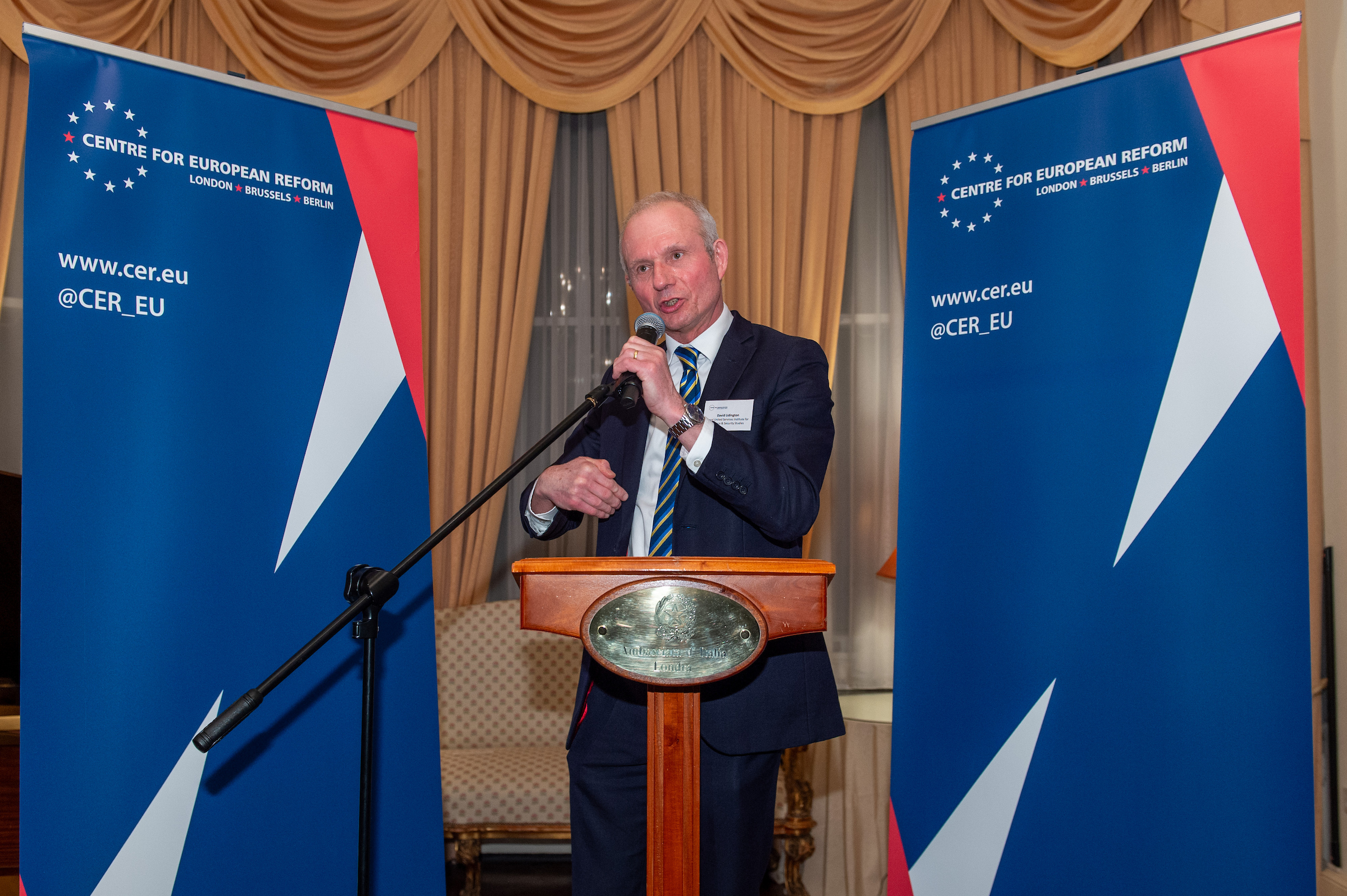
Above: David Lidington
CER's 27th birthday reception hosted by Ambassador Inigo Lambertini, London
In January we bade farewell to Zach Meyers, our assistant director and expert on tech industries, after four years at the CER. He went to Brussels to become director of research at the Centre on Regulation in Europe (CERRE). Then in April we said goodbye to Luigi Scazzieri, who was for eight years the CER’s defence analyst. He has also gone to Brussels, to work at the EU Institute for Security Studies (led by CER alumnus Steven Everts). Zach and Luigi made a huge contribution and we are delighted that they have both become CER non-resident associate fellows.
Armida van Rij joined the team in October, having previously run the Europe programme at Chatham House. In March we said farewell to one Clara Marina O’Donnell fellow, Anunita Chandrasekar, at the end of her six-month stint, and in October we welcomed another, Thomas Maddock. He is the twelfth holder of this fellowship, which commemorates our late defence analyst.
On the CER’s advisory board, James Anderson, Tim Clark and John Monks stepped down, all having made substantial contributions to our work. The board gained five new members: Catherine Day, former secretary-general of the European Commission; Dominic Grieve, a former UK attorney-general; Baroness Frances O’Grady, a former general secretary of the Trades Union Congress; Sir Michael Rake, a senior figure in the business world; and Baroness Patience Wheatcroft, a senior journalist.
It is never easy to measure the impact of a think-tank, but if there was one CER publication that stood out in 2025 for stirring debate it was the policy brief that Sander Tordoir wrote with Brad Setser (of the Council on Foreign Relations) in January, on how German industry could survive the second China shock (that is to say, China's ballooning manufacturing trade surplus, of which more below). Their paper helped to inspire some of the toughening of European trade defences and the move towards ‘buy-European’ industrial policies. Sander presented the report in Brussels alongside former US Trade Representative Katherine Tai and Nobel economics laureate Simon Johnson. It was also cited in a speech by Bundesbank president Joachim Nagel, and featured in a discussion at Princeton between Professor Markus Brunnermeier and Nobel economics laureate Paul Krugman.
One way to exert influence is by briefing political leaders – as we did when Luxembourg prime minister Xavier Bettel and Polish foreign minister Radek Sikorski passed through London. We also contributed to better policy-making by giving oral and written evidence to parliaments. Aslak Berg and Anton Spisak gave oral evidence, and Ian Bond and Luigi Scazzieri written evidence, for the House of Lords European affairs committee’s report on UK-EU relations. Armida gave oral evidence to the House of Commons defence select committee. Sander joined a panel for the European Parliament’s ECON committee and co-wrote a policy brief for it entitled ‘Europe’s policy options in the face of Trump’s global economic reordering’.
Foreign and defence policy
Transatlantic relations and European defence
Donald Trump’s return to office dominated the foreign policy agenda in 2025: on global trade; on the transatlantic relationship and European security; on the war in Ukraine; on the war in Gaza and the Middle East more generally; and on the rules-based international order. Many of the CER’s foreign and security policy publications, events and podcasts in the early part of the year analysed what Trump was likely to do or was already doing, and proposed policy responses.
In our first Unpacking Europe podcast of 2025, Luigi discussed Trump’s inaugural speech with Constanze Stelzenmüller of the Brookings Institution and Ian. They were struck, among other things, by Trump’s apparent wish to intimidate not only America’s enemies but also its allies – something which became a theme during the year. Even at that stage, it seemed that he had designs on Greenland and his rhetoric escalated over the year, raising the prospect of an outright fracture within NATO.
The CER also published a series of papers that pointed towards the need for Europe to hedge against Trump’s unreliability as an economic and security partner. Luigi’s January policy brief ‘Towards an EU ‘defence union’?’ set out the case for the EU to invest more in defence, in part because Trump’s US was likely to take less interest in European security. In an insight in February, ‘Trump is back, worse than last time. Is Europe ready?’, Ian warned European governments not to fall into the trap of hoping that Trump would focus his hostility on someone else, but rather to work together to reduce Europe’s dependency on the US. In March, Luigi’s policy brief ‘How the UK and the EU can deepen defence co-operation’ argued that at a time when both the EU and the UK were facing daunting security challenges from Putin’s revisionism and Trump’s threats, if they failed to work together they would only make Europe weaker.
In an insight in March, Charles Grant set out ten consequences of Trump’s return to office – mostly negative for the US and its allies and partners, but including three positives: greater EU unity; the restoration of Germany’s leadership role in Europe (under newly-elected Chancellor Friedrich Merz); and rapprochement between the EU and the UK. In that context, the theme of EU-UK defence industrial co-operation was tackled in a roundtable with EU commissioner for defence and space Andrius Kubilius, held in Brussels in March. Shortly afterwards, the Commission published its defence white paper, which set out plans for the EU to help member-states increase their defence capability through collaborative procurement. It also laid out the rules for third-country participation in EU defence industrial projects. Luigi analysed the possible impact of the Commission’s plans in an insight, ‘One step forward for Europe's defence’.
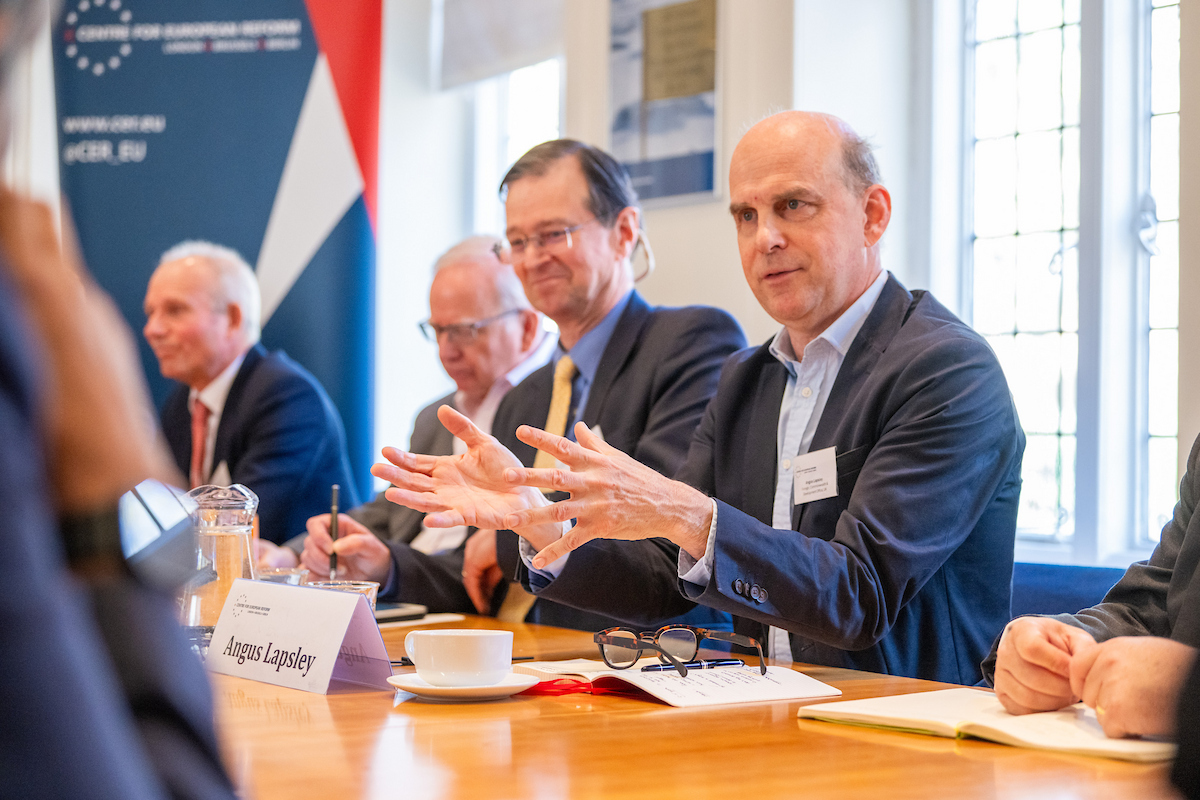
Above: Angus Lapsley
Discussion on 'What future for NATO?', London
By spring, European thoughts were already turning to the NATO summit that would take place in The Hague in June. The CER hosted the UK’s ambassador to NATO, Angus Lapsley, for a discussion of the future of NATO, and a few weeks later looked at the future of the transatlantic relationship more widely with Lord Darroch, former British ambassador to the US and Rachel Ellehuus, a former senior US defence official (and current director-general of the Royal United Services Institute). In the run-up to the summit, Ian published an insight, ‘NATO summit 2025: Time to build a proper European pillar?’, arguing that European leaders had to look at practical arrangements to deal with a radical reduction in the US commitment to NATO.
The summit was not the disaster that some in Europe had feared: almost all NATO leaders agreed to increase defence and security spending to 5 per cent of GDP by 2035, getting in return what turned out to be a temporary pledge from Trump to defend NATO allies. A few days after the summit, NATO assistant secretary-general for political affairs Boris Ruge briefed a CER/Kreab breakfast in Brussels on the summit and how it would be followed up.
Transatlantic relations cooled significantly by the end of the year as the new US National Security Strategy warned of Europe’s 'civilisational erasure’. In response, Armida highlighted the choice that Europe and the US face between competing ideologies – Europe’s continued promotion of democracy, human rights and the rule of law, or the US’s nativism – in a piece for the Chicago Council on Global Affairs that contributed to an analysis of the 250th anniversary of America’s Declaration of Independence
Ukraine, Russia and Europe’s eastern neighbourhood
The aspect of Trump’s foreign policy that caused the most consternation in Europe was his tilt away from supporting Ukraine and towards accommodating Russian president Vladimir Putin’s imperial ambitions. Throughout the year the CER continued to write about Ukraine and its role in Europe’s security, hold events with Ukrainians and other experts on the region, including Russians, and discuss the evolving situation in a number of podcasts. Our first event of the year featured Michael Siebert, the managing director for Eastern Europe and Russia at the European External Action Service (EEAS), Ben Fender, director for Eastern Europe and Central Asia in the Foreign, Commonwealth and Development Office and Olesya Khromeychuk, Director of the Ukraine Institute London (UIL), discussing whether Europe was ready to ensure Ukraine’s success in 2025.
Within weeks of Trump’s inauguration, however, he had called Putin and agreed to start negotiations to end the war in Ukraine. In a meeting with a Russian delegation in Saudi Arabia, senior US officials, without even consulting Kyiv, offered sweeping concessions to Russia, including giving up occupied territory. These developments were discussed at a CER event with Iuliia Osmolovska of the think-tank Globsec and General Sir Richard Shirreff, former NATO Deputy Supreme Allied Commander.
The CER also looked at how the war was affecting the situation in Russia. In March, we organised a discussion on Russia’s future with Anatoliy Chubais – a former senior Russian official under Putin, who left Russia to live in exile shortly after the invasion. In May, we hosted Harvard’s Craig Kennedy, in a meeting that looked at hidden debt in the Russian economy, and its impact on Russia’s war effort.
Against the background of Trump’s continued pressure on Ukraine to make a disadvantageous deal with Russia, Ukrainian analyst Mykola Bielieskov told a CER meeting in May, organised with UIL, why Ukraine kept fighting, and how Europe should help it. He and Olesya Khromeychuk also recorded a CER podcast covering the war, negotiations and the efforts of the ‘coalition of the willing’, led by the UK and France, to put together security guarantees and a reassurance force for Ukraine.
The summer saw further efforts by Trump to push for a Russia-friendly peace deal and by European leaders to buttress support for Zelenskyy. In August, after Trump had welcomed Putin to Alaska, seven European leaders and Zelenskyy met Trump in Washington to try to restore balance to US policy. Following this, in September, Ian published a policy brief, ‘Can Europe save Ukraine – and itself – from Putin and Trump?’, in which he argued that European leaders had to accept that even without Trump’s backing, they would have to confront Russian forces in Ukraine if they did not want to face them on NATO territory later. As the flurry of diplomatic activity died down and it became clear that the war was likely to continue for some time, the CER organised a panel discussion on scenarios for the future of the war with Iuliia Osmolovska, Sir Lawrence Freedman, emeritus professor of war studies at King’s College London, and General Oleg Synianskyi, former head of Ukraine’s foreign intelligence service.
It was against the background of Trump’s erratic policies that Olof Skoog, EEAS deputy secretary-general, spoke to a CER/Kreab breakfast in Brussels in October on ‘How Europe can navigate geopolitical turbulence’. In December, Ian published a policy brief, ‘European security in a time of war: Standing with Ukraine, against Russia and without the US’, looking at the competing worldviews of Ukraine and Russia, and at the kind of security structures Europe would need after the war – built to defend Europe against Russia, without the US.
Apart from the war itself, Ukraine’s efforts to join the EU, and the EU’s relations with its East European neighbours were on the CER’s agenda at various points in the year. In September, in a reminder that the war was not Ukraine’s only challenge, we published Henrik Larsen’s insight ‘Tough love: How the EU should tackle corruption and the rule of law in Ukraine’. In November, in collaboration with the EU delegation to the UK, we organised a discussion with exiled Belarusian opposition leader Sviatlana Tsikhanouskaya on the future of Belarus in a peaceful Europe – though both democracy in Belarus and peace in Europe seem far away.
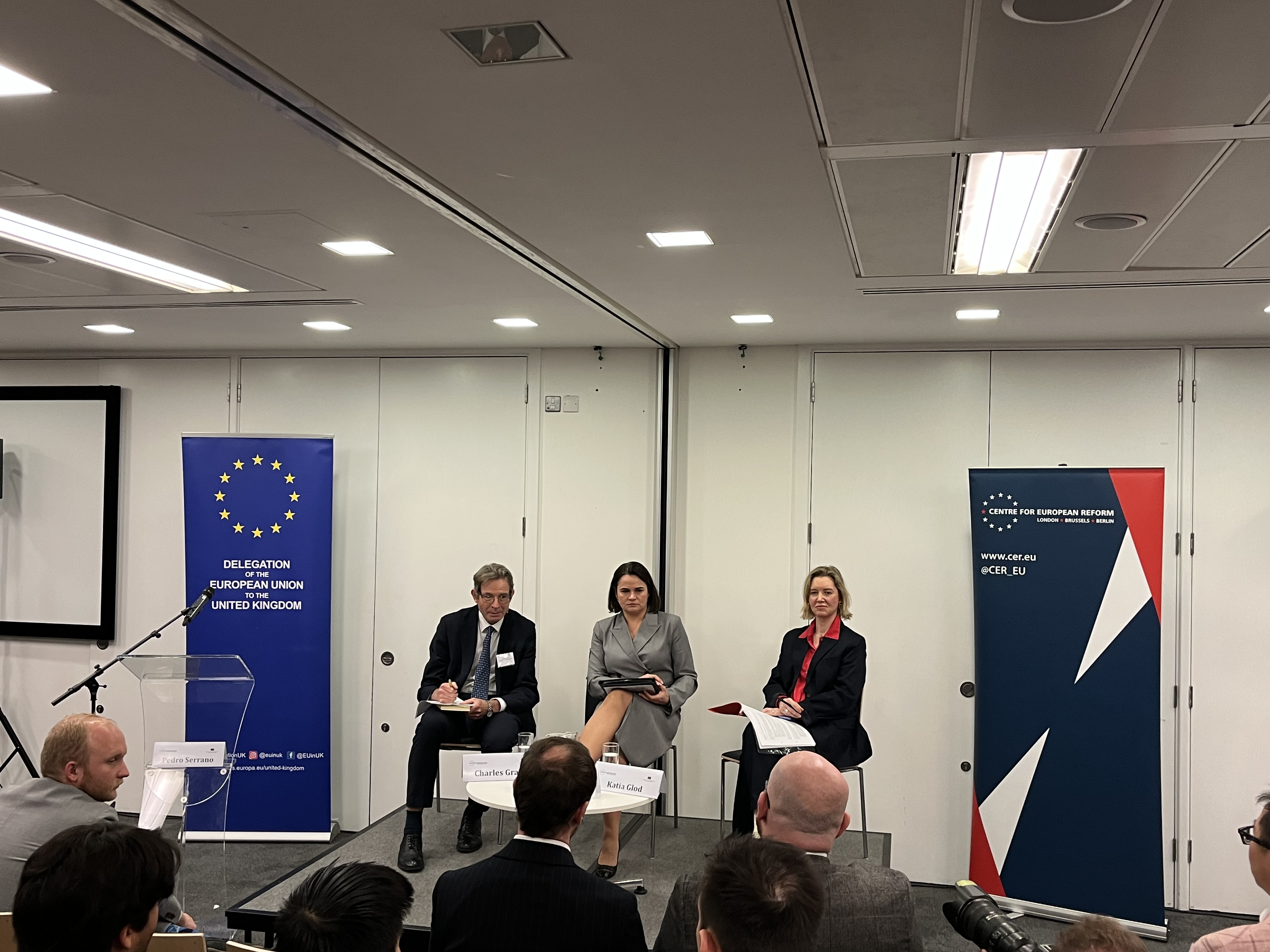
Above (L to R): Charles Grant, Sviatlana Tsikhanouskaya and Katia Glod
Discussion on 'The future of Belarus in a peaceful Europe', London
European security in the age of Trump was also an important theme of the US-European Forum on Global Issues, co-organised by the CER, the Brookings Institution, the Stiftung Wissenschaft und Politik and the Polish Institute of International Affairs (PISM) in Warsaw – the first time the forum had been held there. Among the speakers were Polish foreign minister Radosław Sikorski and former US ambassador to NATO Kurt Volker. The forum also covered threats to democracy; the situation in the Middle East; transatlantic trade; and China.
Türkiye, the Middle East, the global south and China
Despite our focus on transatlantic relations and the war in Ukraine, we did not ignore other parts of the world. In February, Anunita Chandrasekar wrote an insight on the EU-India relationship – increasingly important to both parties in an era of growing great power competition. In April, non-resident associate fellow and former Clara Marina O’Donnell fellow, Katherine Pye, published ‘Access denied: The EU's discriminatory visa regime is undermining its reputation in Africa’, arguing that the EU’s fixation on keeping out irregular migrants was damaging its economic and political interests in Africa, and giving China and Russia opportunities to develop their own soft power in the continent.
Türkiye remains geostrategically important to Europe. Together with the Turkish think-tank EDAM, in October the CER organised the 21st annual Bodrum roundtable, covering topics including Turkish foreign policy, global economic fragmentation and tech, and great power competition. Speakers included Comfort Ero, president and CEO of Crisis Group; Turkish deputy foreign minister Zeki Levent Gümrükçü; Megan Greene of the Bank of England’s monetary policy committee; and C Raja Mohan of The Indian Express. In November, we hosted Turkish MP Ali Babacan, the leader of the opposition Democracy & Progress Party, for a discussion on the future of Türkiye.
For most of the year, the war in Gaza remained ferocious, with Israel seemingly indifferent to civilians killed or injured by its operations against Hamas. In a June podcast, Charles talked to Gideon Rachman of the Financial Times about the geopolitical shifts taking place in the Middle East. Meanwhile, Europe was completely sidelined in the negotiations that led to a ceasefire in October. In December, Thomas Maddock took aim at the EU’s inability to influence the course of events and the impact this had had on the Union’s wider foreign policy interests in an insight, ‘Fixing the EU's broken Israel-Palestine policy’.
We also looked at the political and security influence of China. In October, Ian published a policy brief ‘China and Europe: Can the EU and the UK find a shared strategy?’. He argued that the EU and the UK should co-operate more closely to face the challenges from China, and to ensure that the European liberal, democratic model of governance showed its superiority to the authoritarian model promoted by Xi Jinping. At the start of 2026, however, the liberal, democratic model seemed under threat not only from Beijing (and Moscow), but also from Washington.
The far right, the rule of law and enlargement
The year was marked by the far right’s creeping normalisation across the EU: following significant gains in the 2024 European elections, far-right parties reinforced their impact on both national politics and the European Parliament. To secure legislative victories in the Parliament, the mainstream conservative European People’s Party (EPP) resorted to tactical alliances with the far-right European Conservatives and Reformists, and the Patriots for Europe, on several occasions. This rightward shift impacted the Commission’s policy agenda, where the focus on competitiveness overshadowed efforts to enforce the rule of law and improve democratic resilience. Meanwhile, EU enlargement proceeded unevenly: while the two frontrunners, Montenegro and Albania, made significant progress, Hungary continued to block any movement in Ukraine’s accession negotiations.
In February, Zselyke Csaky analysed whether freezing EU funds was an effective tool to enforce the rule of law, concluding that withholding funds was the EU’s most powerful tool available, but that its success depended on coherent and stringent implementation. The Commission recognised this during the year, when it proposed expanding the rule-of-law conditionality to cover all EU funding in the next seven-year budget cycle.
As far-right parties continued to gain ground, Zselyke returned to the question of how democracies should respond in an April insight, examining whether France and Romania should ban far-right candidates from running for the presidency. She argued that bans might be legally sound but could nevertheless harm democracy in the long run. In June, Zselyke analysed elections in Poland and Romania, both of which showed the staying power of anti-establishment sentiment, while in October she provided a quick reaction to the Czech elections, where controversial former prime minister Andrej Babiš made a comeback, forging an alliance with two far-right parties.
The public discourse following the elections in The Netherlands in October was that of a victory of the social liberal D66 over the far right. But as Armida and Sander pointed out in their insight, far-right parties increased their share of the vote and will continue to influence policy and politics in The Netherlands.
France narrowly avoided elections in 2025, despite the inability of any prime minister to form a stable and durable government. The far right remained favourites to win France’s next parliamentary and presidential elections. Charles and Sophie Pedder, The Economist’s Paris correspondent, analysed French politics in a podcast in November. But despite President Emmanuel Macron being so weak at home, France remained extremely influential in the EU. Charles examined what he termed the ‘Paradox of French power’ in an insight in December. He suggested that one source of France’s influence was that the world had changed in ways that made its arguments for protection, industrial policy and strategic autonomy more convincing.
The CER also explored the policy implications of the far right’s growing clout. In October, John Springford argued that attempts to accommodate populist voters through policy concessions would not work, and that governments should instead focus on tackling their arguments head-on. In November, Zselyke examined the far right’s impact on the EU's climate agenda, showing how it had led the EPP to promote deregulation at the expense of green policies. By voting with the far right the EPP had also upended policy-making in the European Parliament – previously characterised by compromises between mainstream parties – presaging a more uncertain and less climate-friendly future. The broader question of populism’s causes was addressed in a November podcast with John, Zselyke and political scientist Ben Ansell, while in December Catherine de Vries, another political scientist, joined Zselyke and Armida for a podcast on the far right and democratic backsliding in Europe.
EU enlargement remained a priority for the CER throughout the year, as the bloc continued to grapple with the budgetary and institutional implications of a larger Union. In an April policy brief, Luigi questioned whether the EU’s interest in phased integration for countries on the road to membership might also create attractive opportunities for the UK to integrate with the EU in specific policy areas such as defence. In May, Zselyke and Charles examined the need for an enlarged Union to take more decisions by qualified majority voting, in order to avoid paralysis. EU enlargement was also the theme of a CER/Kreab breakfast with Irish Europe minister Thomas Byrne in November.
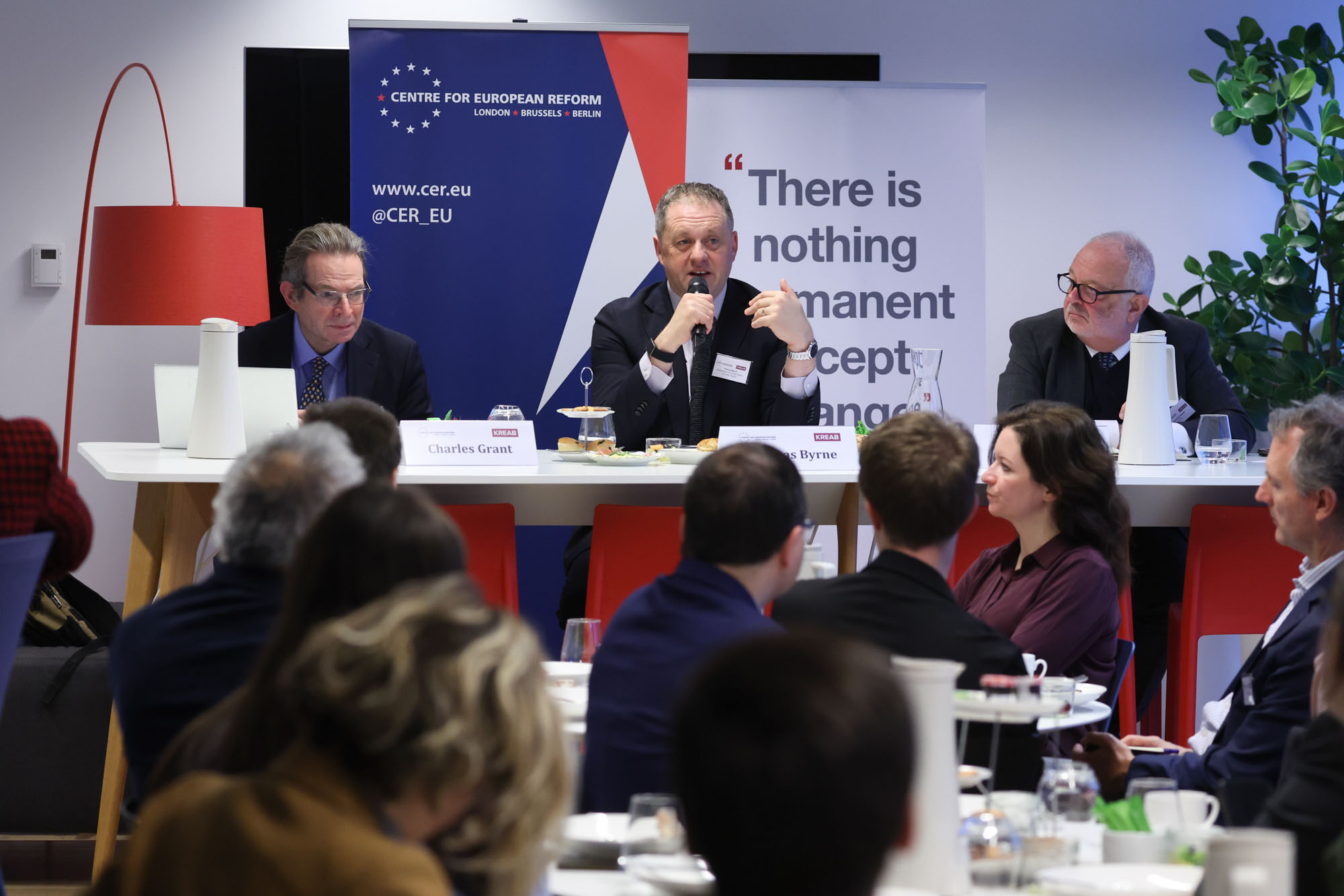
Above (L to R): Charles Grant, Thomas Byrne and Sebastian Remøy
CER/Kreab breakfast on 'The path beyond 27: Taking the next steps on EU enlargement', Brussels
Economics
Europe in a multi-front trade and tech war
The CER worked extensively on the economics that lie at the root of the EU’s difficulties. The problems were summed up in two 2024 reports from Enrico Letta and Mario Draghi, both former Italian prime ministers. In 2025 the European Commission and the member-states slowly began to act on the recommendations of the Draghi and Letta reports by advancing the possibilities for EU firms to incorporate directly at the EU level, and by simplifying regulation. Nevertheless, by the end of the year, most recommendations remained unimplemented.
The EU’s domestic growth agenda was overshadowed by fundamental shifts in the global economic order. The return of Donald Trump to the White House heralded the biggest global trade war since the Great Depression, China’s exports surged and the EU was subjected to profound economic coercion from both Washington and Beijing. The EU also had to confront the economic and fiscal costs of rearmament, as the US pulled back from supporting Ukraine and NATO’s future darkened.
Throughout the year, CER researchers examined how Europe – with its open economy – could respond. In January 2025, Aslak Berg published a policy brief observing that as Europe’s shrinking share of global output eroded the bloc’s influence, the EU should avoid over-reliance on regulation and bolster stability through new trade agreements and legal frameworks beyond the WTO. In a January insight, Zach Meyers warned that if US tech firms used Trump to undermine EU tech rules, they might gain short-term relief but would trigger global pushback that would damage their long-term interests. In February, Aslak warned that Trump’s ‘reciprocal’ tariff plan, while sounding innocuous, was in fact a roadmap towards an all-out global trade war to which Europe would need to respond firmly and swiftly.
Trump unleashed his ‘liberation day’ global trade war in April. In the end, the EU settled for a deeply unbalanced trade deal. Aslak argued in August that although the EU-US deal would weaken the global legal order and leave both sides poorer, accepting a bad agreement was the least damaging option; fear of harm to Europe’s vital security interests meant that the EU side was unwilling to engage in a transatlantic trade war.
In November, Aslak drew wider lessons for European trade policy in an insight: as great-power politics now dominated global trade, the EU for now had to accept its junior position vis-à-vis the US. It should prioritise confronting China, whilst derisking from both by deepening trade ties with the rest of the world and in its own neighbourhood.
As the transatlantic rift deepened in 2025, the European economy was also subject to profound pressure from the east. As mentioned above, Sander wrote a widely cited policy brief with Brad Setser, on how China’s return to export-led growth and market distortions posed an existential threat to German industry. Brad and Sander also shared their recommendations in a forum on the margins of the IMF-World Bank spring meetings in Washington.
Germany’s ailing economy featured more widely in CER work in 2025, especially as the new Merz government reformed the debt brake to pave the way for a trillion-euro investment package to boost security and rekindle growth. In March, Sander wrote an op-ed for NRC Handelsblad stressing that Germany’s fiscal revolution offered the EU hope for stronger growth and greater strategic autonomy, as the global trade system frayed. He also set out a German economic strategy for dealing with China in Die politische Meinung, the magazine of the Konrad Adenauer Stiftung, in July.
US tariffs and China’s overcapacities also drove the EU’s turn towards industrial policy, a topic the CER covered extensively. For example, Sander’s March piece in Foreign Policy mounted a rebuttal to European declinism, pointing out that European manufacturing was larger (in terms of jobs, share of GDP and output) than that of the US – and in areas like clean tech and civil aviation, far ahead. His argument that these industries need defending was developed further in a February policy brief with Elisabetta Cornago on how to design and fund a better European green industrial policy, and in an op-ed for Die Zeit. In October, Sander, Nils Redeker of the Jacques Delors Centre and Lucas Guttenberg of the Bertelsmann Stiftung published the first paper of a new CER collaboration with those two institutions, arguing that Europe should defend its car industry not through deregulation or bailouts, but by using its single market to drive demand for European-made EVs through co-ordinated subsidies with buy-European clauses. They also presented the argument in an op-ed for Die Zeit.
Europe’s best response to a fraying global economic order probably lies at home, through implementing the ambitious reforms proposed in the Draghi report. In July, Zach argued that the EU should reform its digital policies to strengthen its own competitiveness, rather than watering them down in a vain attempt to appease Donald Trump.
In October, Aslak, Elisabetta, Sander and Zach published a policy brief setting out a politically feasible single market growth agenda – centred on smarter regulation, deeper energy and capital market integration, a services-led single market and a balanced, innovation-friendly competition policy.
They also argued that greater integration of the EU energy market would help to deliver lower and less divergent prices across the EU. High energy prices have been a key driver of Europe’s weakened competitiveness. The Commission has been putting affordability at the centre of its energy policy, as Dan Jørgensen, commissioner for energy and housing, explained at a CER/Kreab breakfast in May. Designing better regulation was also a focus of the CER/Kreab breakfast discussion with Commissioner Valdis Dombrovskis in September.
In December, Aslak and Zach examined the new European competitiveness fund in a policy brief, stressing that the EU risks wasting money unless it adopts a disciplined framework that prioritises growth-enhancing reforms. In July, Sander argued in Intereconomics that Europe can only revive innovation by abandoning a false choice between mid-tech and high-tech, and instead strengthening the ecosystems in which mid-tech industries can generate the scale, skills and spillovers that make high-tech leadership possible.
CER experts also focused on the economics of rearmament and supporting Ukraine. Sander built on his influential 2024 report with Luigi Scazzieri on common European defence borrowing in an op-ed for Internationale Politik Quarterly’s Munich Security Conference special edition. In December, Sander and Stephen Paduano of Oxford university wrote an insight on how the EU could overcome Belgium’s legal objections to a €210 billion reparations loan to Ukraine, backed by immobilised Russian assets; they devised a scheme using national guarantees and the European Investment Bank. Although the December European Council decided not to use the Russian assets as collateral, the EU will probably have to revisit that decision if (as seems likely) the war continues and Ukraine needs more funds.
Many of these questions were discussed in November at the CER’s annual economics conference at Ditchley Park, held under the theme ‘Europe’s precarious bid for third-pole economic power’. Speakers included Agnès Bénassy-Quéré of the Banque de France, Barry Eichengreen, professor at the University of California, Moritz Schularick of the Kiel Institute, and Maarten Verwey from the European Commission.
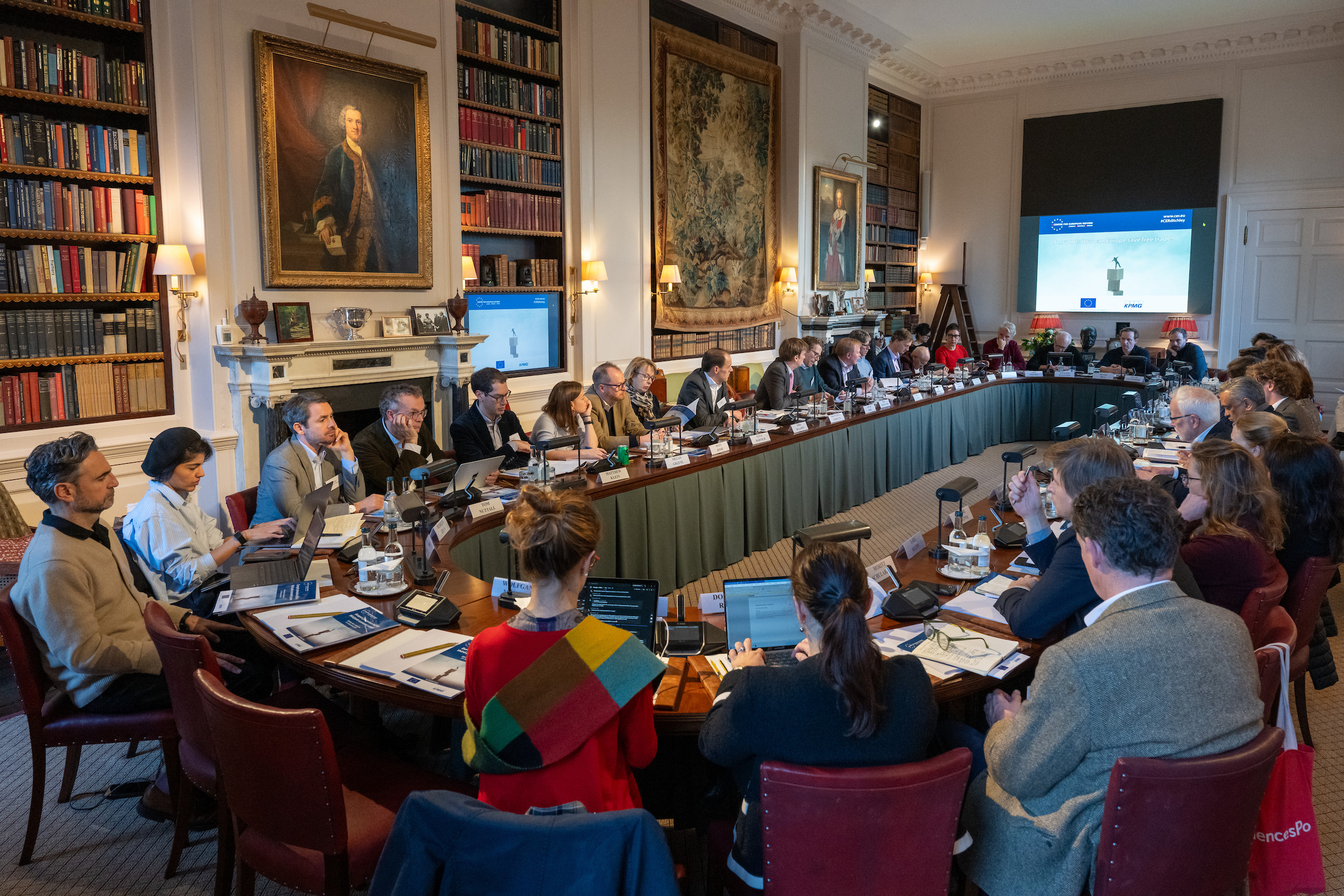
Conference on 'Europe's precarious bid for third pole economic power', Ditchley Park
From Green Deal to Clean Industrial Deal
In early 2025, Ursula von der Leyen presented her new key political project: after the Green Deal of her first mandate, her second mandate would focus on the Clean Industrial Deal. This indicated her Commission’s growing focus on leveraging decarbonisation efforts for an industrial renaissance in Europe. Her Green Deal had promised to be a strategy for economic growth, but the energy crisis has battered European industry. Extremist political parties have wrongly blamed the difficulties of European industry – at a disadvantage due to high energy prices and tough competition from China – on climate policy. This has led to two major policy developments.
First, the Commission has launched a cross-sector simplification agenda, with a series of so-called omnibus acts that greatly weaken some policies (such as sustainability reporting rules) and revise others (such as the carbon border adjustment mechanism, the CBAM, which imposes fees on certain imported goods based on their carbon emissions content). There is certainly merit in designing simpler policies, and rethinking existing ones if they fail to deliver because of their complexities. But rushing to deregulate without conducting proper impact assessments of the policies accused of being burdensome risks pandering to populists rather than promoting sound policy.
Second, the Commission has undertaken a range of industrial policy measures, trying to save legacy industries (with measures addressing the chemicals and car sectors, for example) and to boost nascent ones in the clean tech sphere (such as batteries). Clean industrial policy is crucial for supporting infant clean tech industries and to tie the industrial development agenda to that for decarbonisation. That is why in February, Elisabetta and Sander wrote a policy brief giving recommendations for getting green industrial policy right, both in its design and in the finance it needs in order to be impactful.
The EU’s belated venture into green-focused industrial policy was partly a response to the Inflation Reduction Act (IRA), former US president Joe Biden’s landmark subsidy programme benefiting a range of clean technologies. Even though Donald Trump has largely scrapped the IRA, targeted industrial policy is crucial for the EU to resist unfair competition from China in clean tech. In December, Elisabetta published a policy brief with Lucas Carvalho, Philipp Jäger and Etienne Höra, co-authors from the Bertelsmann Stiftung and the Jacques Delors Centre in Berlin, analysing the implications of Trump’s trade, climate and industrial policy for Europe’s clean tech industry. They argued that European clean tech producers were suffering from weaker sales abroad and tougher competition at home. They offered policy recommendations to prevent these temporary shocks from destroying the EU clean tech industry, and to avoid long-lasting import dependency on a few suppliers of clean tech.
Elisabetta also explored the interplay between EU enlargement and climate policy. She explained in an insight, part of a series on the implications of EU enlargement, that it is in the mutual interest of both current member-states and EU candidate countries to accelerate the latter’s integration into the energy union. A larger electricity market can draw upon more energy generators, lowering EU average prices, and enhancing energy security.
Britain and the EU
The year of the reset
The CER’s annual report for 2024, published early in 2025, featured an essay asking: ‘Can Keir Starmer reset relations with the EU?’ At the end of 2025, we knew that the answer was yes. Relations were the warmest they had been since the 2016 referendum. But if there is one theme running through the CER’s work on UK-EU relations in 2025, it is that neither side was sufficiently ambitious for the reset.
The key event was the UK-EU summit in London in May, which produced three documents: a preamble setting out where the two sides agreed on international issues; a Security and Defence Partnership (SDP), defining closer co-operation on foreign and defence policy; and a ‘common understanding’, setting out a programme for future work, including on economic ties. The last of those has subsequently led to talks on the UK effectively rejoining the single market for farm goods and for electricity trading, as well as on merging emissions trading schemes, youth mobility and returning to the Erasmus+ education and training exchange programme.
We were particularly happy with the commitment to take the UK back into the EU power market. We had pushed for that in the annual report and in other publications, but such an outcome was far from certain. Weeks before the summit, powerful figures in the Commission were opposed. John Springford made a strong case for closer UK-EU energy ties in his April policy brief, ‘Power losses: What is holding back European electricity trade?’. This focused on the EU market itself but also argued that closer ties to the UK would enhance energy security and lower prices on both sides of the Channel. We launched this paper at a seminar in April with speakers from the Department of Energy Security and Net Zero, Eurelectric, SSE and National Grid.
The steps taken at the May summit were useful and worthwhile, but not bold enough to make much difference macroeconomically. In March we had published an insight by Julian King, Britain’s last European commissioner, which criticised the procedures for reforming the post-Brexit Trade and Co-operation Agreement (TCA) as too bureaucratic and slow. He urged the EU to become more flexible: “The TCA should be part of the floor, but not the ceiling of the future relationship.” The summit offered opportunities “to complement the agreement with new political priorities and new more agile ways of working, to be followed up and monitored at the highest level.” Julian called for closer ties on justice and home affairs and on defence industrial co-operation.
In a multi-authored insight published a few days before the summit, we focused on the defence industry. “The EU’s efforts to increase its defence capabilities and rebuild its defence industrial capacity will be hampered if the UK is excluded from them,” we wrote. “The UK needs to rebuild the trust that it lost in the Brexit process…the Commission needs to treat the UK – for defence industrial purposes at least – as more like Norway and Ukraine and less like the US.”
But it did not. The SDP made UK companies eligible to benefit from joint procurement projects, as part of the EU’s Security Action for Europe (SAFE) programme. But in the autumn the EU – driven by France – demanded several billion euros as the price for privileged access to SAFE, leading to the breakdown of talks. British companies will still be able to participate in SAFE-funded projects, but only to a very limited extent. In the long term, however, most member-states want the UK more closely involved in the European defence industry, and it probably will be.
In 2025, the economic damage inflicted by Brexit became ever more apparent. Just after the summit, non-resident associate fellow Anton Spisak wrote an insight on Britain’s trade performance. He had some striking data on how Britain's trade, especially in goods, had slumped since 2020, relative to comparable G7 and EU countries, and how that had negatively affected its productivity and growth. At the end of 2024 goods exports were 20 per cent below their level in 2019, while if they had gone on growing at their pre-2019 rate, goods exports would have been 30 per cent higher at the end of 2024. Anton concluded that although the EU-UK reset might facilitate some additional trade, it was unlikely to make a noticeable difference to the UK’s growth trajectory.
Martin Donnelly, a former senior UK official, argued in an insight in June that the UK should seek to rejoin not only sectors of the single market such as farm goods and electricity trading, but also others such as pharmaceuticals, chemicals and medical devices. In return the UK should be willing to pay money into the EU budget. Martin also called for the government to establish commissions on the costs and benefits of rejoining the EU’s VAT system and a customs union. He then urged the government to look at boosting services by doing deals with the EU in areas like mutual recognition of professional qualifications and freedom of movement for workers in certain sectors, with safeguards to limit overall levels of migration.
After the summer the government did start to talk more positively about getting closer to the EU, perhaps aware that there were few other obvious ways of boosting growth quickly. Opinion polls showed that a clear majority of the British public wanted tighter ties. By the end of the year, several ministers were musing over rejoining the customs union. But Keir Starmer stuck to the mantra of no return to the customs union, single market or freedom of movement.
In an insight in May, Aslak had argued that if Labour was serious about growth it would have to revisit its red lines, which he called red chains. But he was cautious about ‘the’ customs union, pointing out that the UK and the EU would have to form a separate customs union, like that Türkiye had with the EU. That would reduce but not eliminate paperwork at the border, since goods would need to be accompanied by a certificate proving they were free to circulate. Aslak also pointed to the huge political difficulties of giving up the free trade agreements the UK had negotiated since leaving the EU’s customs union.
Aslak thought the government should instead revisit freedom of movement, suggesting Swiss-style arrangements, with safeguards against surges of immigrants. Aslak argued that most British voters worried more about small boats than people coming to the UK to work.
Greater free movement would undoubtedly boost growth, but such talk remained anathema to Starmer’s government. Nevertheless, migration was central to the CER’s work. In June, John Springford wrote a policy brief arguing that the government’s new restrictions on visas for skilled workers would damage the UK’s performance in the energy transition. There would not be enough construction workers to decarbonise buildings and transport. The government’s immigration policies were the subject of a seminar in June, with a panel consisting of John, Brian Bell, chair of the government’s migration advisory committee, Madeleine Sumption, director of the Oxford migration observatory and Professor Jonathan Portes of King’s College London.
We had plenty of opportunities to hear the government’s point of view on Europe, for example at the dinners we held in June with attorney-general Richard Hermer and the then trade minister Douglas Alexander.
We also held a webinar in September with health minister Ashley Dalton on health co-operation with the EU. At the Labour Party conference in Liverpool in September we had a panel consisting of Douglas, again, newly-promoted to Scottish secretary, Emily Thornberry, chair of the Commons foreign affairs select committee, Stella Creasey, chair of the Labour movement for Europe, and Pedro Serrano, head of the EU delegation to the UK.
Other memorable events with a UK-EU slant included roundtables with Martin Donnelly, speaking about the report he had written for the government on economic diplomacy, in May; Oliver Robbins, the permanent under-secretary in the Foreign, Commonwealth and Development Office, in June; Daisy Cooper, the deputy leader of the Liberal Democrats, in July; and Sandro Gozi MEP, chair of the European Parliament’s delegation to the EU-UK Parliamentary Partnership Assembly, in November.
Above (L to R): Daisy Cooper and Ian Bond
Hybrid discussion on 'The Liberal Democrat approach to the UK-EU reset',London
We continued to engage the Conservatives, with our party conference fringe in October including MPs George Freeman and Bernard Jenkin. In July we had given a platform to James Cartlidge, shadow defence secretary, to talk about the UK government’s strategic defence review. In the same month we hosted George Robertson, the chief author of that review and former secretary-general of NATO.
February 2026
Download full publication